
Effects of Multidirectional Lunge Exercises on Lower Limb Muscle Activation and Dynamic Balance Ability
© 2025 by the Korean Physical Therapy Science
Abstract
The aim of this study was to investigate the effects of forward, backward, and sideward lunge exercises on lower limb muscle activation and balance ability in adults.
Three-group pre-post design
Thirty healthy adults were randomly assigned to a forward lunge group (n=10), a backward lunge group (n=10), and a sideward lunge group (n=10). Each group performed their respective lunge exercises three times per week for four weeks, with each session consisting of three sets of 1-minute exercises, and 1-minute rest between sets. Dynamic balance abilities were measured using the BT-4 system (HUR, Finland), and lower limb muscle activity was assessed using surface electromyography (Noraxon, USA)
All three lunge groups showed significant improvements in lower limb muscle activation and balance ability after the intervention (p<0.05). The forward and backward lunge groups showed increased activation of the rectus femoris and vastus lateralis, contributing to knee joint stability, while the sideward lunge group showed greater activation of the gluteus medius, supporting hip stability. There were statistically significant differences in muscle activation and balance ability among the three groups (p<0.05).
The findings suggest that multidirectional lunge exercises can selectively activate specific lower limb muscles depending on the direction of movement, and may be effective for improving joint stability and dynamic balance ability.
Keywords:
Balance ability, Backward lunge, Forward lunge, Muscle activation, Sideward lungeⅠ. Introduction
In modern society, physical activity has significantly decreased due to industrialization and the development of transportation systems. A sedentary lifestyle has led to weakening of the lower extremity muscles, which can result in impaired balance ability (Song and Kim, 2018). The muscles of the lower limbs connect major joints from the pelvis to the knees and ankles, functioning as a key structure that enables efficient movement, weight-bearing, and balance control based on the principle of levers in the human body (Jung, 2016). Previous studies have indicated that muscle weakness can be a major cause of postural instability and falls, and in particular, a decrease in lower limb strength or delayed muscle contraction directly affects balance regulation (Horlings et al., 2010). Furthermore, imbalance in lower limb strength not only causes pain but also leads to limitations in functional movement (Heijden et al., 2015). and is closely related to the progression of osteoarthritis and increased risk of falls (Hortoba´gyi, 2004; Park and Kim, 2017)
Strengthening of the lower extremities is considered an essential factor for improving balance ability regardless of age, from young adults to the elderly. Among the various exercises used for this purpose, closed kinetic chain exercises such as lunges and squats are frequently employed in clinical and training settings. These exercises are advantageous for functionally enhancing lower limb strength as they activate multiple joints and muscle groups simultaneously, which is beneficial for daily activities and sports performance (Kim, 2022).
In particular, lunge exercises have been reported to be more effective than squats in terms of activating specific muscles. Yeo et al. (2016) found that lunges increased the activation of the rectus femoris and gluteus medius more than squats. Koo et al. (2012) reported that lunges significantly increased the activation of the vastus medialis oblique and vastus lateralis. Lee (2022) conducted an 8-week lunge exercise program for middle-aged women and observed improvements in lower limb muscular function as well as dynamic balance. These findings suggest that lunge exercises contribute to both strength and balance enhancement.
The direction and posture used during lunge performance can influence the activation of lower limb muscles and balance. Marchetti et al. (2018) compared traditional and inline lunges and analyzed the muscle activation of the lower extremities and mediolateral (ML) balance according to the position of the front and rear legs. Their results showed significantly higher activation of the biceps femoris and gluteus maximus in the front leg compared to the rear leg, and that inline lunges required greater balance maintenance than traditional lunges. In another study, Park et al. (2018) confirmed that the step length (distance between the front and rear legs) during lunge exercises resulted in differences in lower limb muscle activation. These studies highlight the importance of exercise direction and posture as key variables when selecting exercises aimed at improving lower limb strength and balance.
However, most previous studies have analyzed the effects of lunge exercises under specific conditions or in only one direction, and few have systematically compared the differences in balance control and muscle activation among multidirectional lunges.
Therefore, the purpose of this study is to compare and analyze the effects of forward, backward, and lateral lunge exercises on lower limb muscle activation and balance ability in healthy adults.
Ⅱ. Methods
1. Study Design
The present study applied a single-blind test and employed a three-group randomized pre-post design.
2. Subjects
The present study conducted experiments using 30 healthy adult subjects in their 20s, who were attending G University. The selection conditions for the subjects are as follows. 1) Adult men and women without any musculoskeletal disorders, 2) Those without congenital deformities or abnormalities in the lower limbs, 3) Those with no history of orthopedic or neurological diseases, 4) Those not currently experiencing pain in the back or lower limbs, 5) Those in good physical condition, not affected by illness or fatigue, 6) Those who voluntarily agreed to participate in the study after receiving a full explanation of the experimental procedures and methods. The exclusion standards are as follows. 1) Those with a history of lower extremity injury or surgery within the past six months, 2) Those with neurological, cardiovascular, or internal medical conditions that may affect balance or exercise ability, 3) Those currently undergoing treatment for orthopedic issues, 4) Those unable to perform lunge exercises with proper posture, 5) Those who withdrew voluntarily or failed to follow the intervention protocol during the study period. Prior to participation, all subjects received a thorough explanation of the study’s purpose, procedures, and measures for personal data protection. Written informed consent was obtained from all participants, and the study was conducted in accordance with ethical research principles.
3. Procedure
To minimize subject bias, random assignment was performed using a randomization tool (KakaoTalk’s draw function). Thirty participants were randomly allocated into three groups of equal size (n=10 per group): forward lunge group, backward lunge group, and lateral lunge group. Muscle activation and balance assessments were conducted before and after the four-week intervention. Each participant performed their assigned lunge exercise three times per week for four weeks. Each exercise session consisted of 3 sets of lunges, with each set lasting 1 minute and a 1-minute rest between sets.
4. Experiment Method
The subjects who participated in the experiment performed one of the three types of lunges—forward lunge, backward lunge, or lateral lunge. The dominant leg, defined as the leg bearing most of the body weight, was set as the preferred leg of each subject. The step length for each lunge was determined by considering the subject's height, leg length, and natural step width during walking. The initial stance started with the feet placed shoulder-width apart (Park et al. 2018). The pace of the lunges was controlled using a metronome set at 60 beats per minute (BPM) in 4/4 time to ensure consistency in movement speed. Subjects were instructed to bend the knee and shift their weight onto the dominant leg over 2 seconds, then extend the knee and return to the starting position over the following 2 seconds. One set consisted of performing lunges continuously for 1 minute, and a total of 3 sets were completed with approximately 1 minute of rest between sets. Subjects were instructed to avoid allowing the knee to move past the toes during all lunge types. The non-dominant leg was used only for balance and weight support was minimized on this leg. The front foot of the non-dominant leg was kept in contact with the ground at all times, although lifting the heel was permitted. The movement emphasized vertical displacement over forward or backward motion.
The forward lunge involved stepping the dominant leg forward by the predetermined step length, maintaining an upright torso, and bending the knee to lower the body fully before returning to the start position.
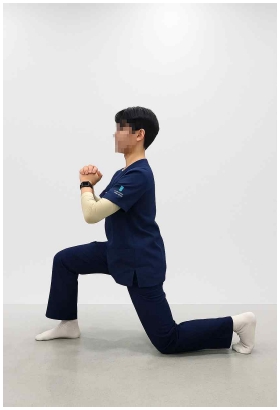
Forward lunge
In the backward lunge, the non-dominant leg stepped backward by the predetermined step length while the torso remained vertical, bending the dominant leg’s knee to lower and raise the body before returning.
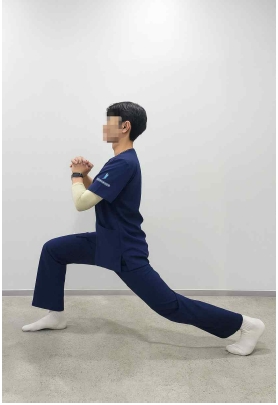
Backward lunge
The lateral lunge required stepping the dominant leg sideways by the predetermined step length, maintaining an upright torso, bending the dominant knee to lower the body laterally, and returning to the start position. During the lateral lunge, the hip joint was flexed as if sitting backward while bending the dominant leg.
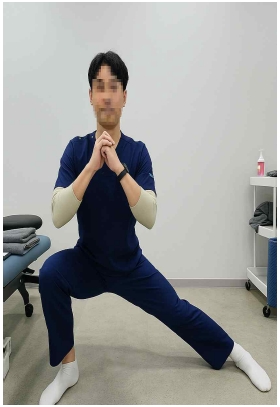
Sideward lunge
5. Outcome Measurements
Dynamic balance abilities were assessed using the BT-4 system (BT-4, Hur Lab, Finland). This device quantitatively measures the center of pressure (COP) movement, postural sway area (PSA), sway area, and limit of stability (LOS) based on built-in pressure sensors. Participants stood on the platform with both feet 2 cm apart, arms relaxed at their sides, and toes positioned at approximately 15° external rotation. Dynamic balance was evaluated by measuring the LOS as participants shifted their body maximally in predetermined directions (forward, backward, left, and right) on the platform(Figure 4).
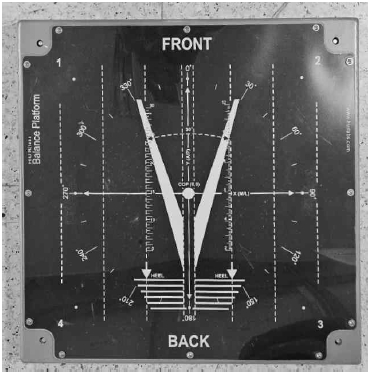
BT-4
Surface EMG electrodes were placed according to the SENIAM recommendations (Hermens et al., 1999) and previous anatomical guidelines (Cram, 1998). For the rectus femoris, electrodes were positioned at the midpoint between the anterior superior iliac spine (ASIS) and the superior border of the patella. The vastus lateralis electrodes were placed at two-thirds of the line from the ASIS to the lateral patella. For the biceps femoris, electrodes were attached at a point located approximately 15 cm below the ischial tuberosity, on the medial portion of the muscle belly. Electrodes for the gluteus medius were placed in the proximal one-third of the distance between the ASIS and the iliac crest, aligned parallel to the muscle fibers.
To account for individual differences in muscle strength and to ensure consistency in data analysis, surface EMG signals were normalized using maximal voluntary isometric contraction (MVIC) values. MVIC measurements were conducted for the vastus medialis, vastus lateralis, and rectus femoris with participants seated on a table, maintaining 90° knee flexion. While maintaining this position, participants were instructed to perform maximal isometric knee extension against manual resistance (Escamilla et al., 2009). For the gluteus maximus and biceps femoris, participants were positioned in a side-lying posture. The hip joint was placed in 20° abduction and 10° external rotation, and participants were asked to perform maximal isometric hip adduction (Kendall et al., 2005). Each contraction was held for 5 seconds, and the middle 3 seconds of the EMG signal were used for analysis. All MVIC tests were performed three times, with 1-minute rest intervals between trials to minimize muscle fatigue. The average of the three trials was used as the reference value, and EMG activity during the intervention was expressed as a percentage of MVIC (%MVIC).
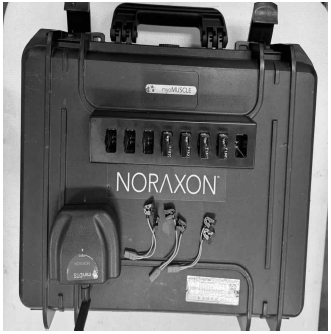
Noraxon EMG
6. Analysis Method
Data from the present study was analyzed using the Windows SPSS (Version 21.0, Chicago, Illinois) statistical program. Normality tests were conducted using the Shapiro-Wilk test. One-way ANOVA was conducted to compare differences among the forward, backward, and sideward lunge groups, and when a significant difference was found, LSD (Least Significant Difference) post-hoc analysis was performed. The paired t-test was conducted to identify differences before and after the experiment regarding dependent variables within each group. Chi-square (χ²) tests were used to compare categorical variables. All levels of statistical significance (α) were set at 0.05.
Ⅲ. Results
1. General Characteristics of the Participants
A total of 30 university students participated in and completed the experiment: 10 in the forward group performing forward lunges, 10 in the backward group performing backward lunges, and 10 in the sideward group performing side lunges. There were no statistically significant differences among the three groups in terms of age, height, weight, or gender, indicating homogeneity (p > .05). The general characteristics of the 30 participants are shown in <Table 1>.

General Characteristics of Participants(N=30)
2. Changes in in Rectus Femoris Activity
Rectus femoris activity significantly increased in the forward group from 46.83 ± 20.35%MVIC to 75.48 ± 18.20%MVIC (p < 0.05), and in the backward group from 47.30 ± 35.37%MVIC to 55.64 ± 24.38%MVIC (p < 0.05). In contrast, the sideward group showed no statistically significant change (p > 0.05). However, no significant differences were observed among the three groups in terms of rectus femoris activation changes (F = 6.627, p = 0.005) <Table 2>.
Comparison of muscle activity of lower extremity(N=30)
3. Changes in Biceps Femoris Muscle Activity
There were no significant changes in gluteus medius activity in the forward and backward groups (p > 0.05). In contrast, the sideward group showed a significant increase from 12.79 ± 6.07%MVIC to 22.90 ± 14.92%MVIC (p < 0.05). However, no significant differences were found among the three groups in gluteus medius activation changes (F = 2.556, p = 0.096) <Table 2>.
4. Changes in Gluteus Medius Muscle Activity
There were no significant changes in gluteus medius activity in the forward and backward groups (p > 0.05). In contrast, the sideward group showed a significant increase from 12.79 ± 6.07%MVIC to 22.90 ± 14.92%MVIC (p < 0.05). However, no significant differences were found among the three groups in gluteus medius activation changes (F = 2.556, p = 0.096) <Table 2>.
5. Changes in Dynamic Balance
Regarding dynamic balance, the sideward lunge group showed a significant improvement in forward limit of stability (LOS), increasing from 4.39 ± 1.52 to 5.46 ± 1.39 (p < 0.05). No significant changes in forward LOS were observed in the forward or backward lunge groups (p > 0.05). However, group comparisons revealed significant differences in forward LOS between the sideward and backward groups, as well as between the sideward and forward groups (F = 4.957, p = 0.015).
As for backward LOS, a significant improvement was observed only in the backward lunge group, from 3.65 ± 0.74 to 4.82 ± 0.78 (p < 0.05), with a significant difference also found between the backward and forward groups (F = 4.537, p = 0.015). No significant changes in backward LOS were observed in the forward or sideward groups (p > 0.05).
No significant differences were found in left or right LOS within or between groups (p > 0.05) <Table 3>.
Comparison of degree of Limit Of Stability(N=30)
Ⅳ. Discussion
The present study was conducted to investigate the effects of forward, backward, and lateral lunge exercises on lower limb muscle activity and dynamic balance in healthy adults. To evaluate the neuromuscular impact of these exercises, changes in electromyographic (EMG) activity were analyzed before and after the intervention. The study focused on three primary muscles involved in lunge execution and postural control: the rectus femoris, biceps femoris, and gluteus medius.
Consistent with previous findings by Lee et al. (2022), who reported that lunges induce eccentric contractions in the quadriceps and isometric contractions in the hamstrings, the present study found significant increases in rectus femoris and biceps femoris activity following both forward and backward lunge exercises. The quadriceps, particularly the rectus femoris, play an essential role in patellofemoral tracking and contribute to knee joint stability by generating posteriorly directed force on the patella (Waryasz & McDermott, 2008).
Although no significant differences in muscle activation were found between the forward and backward lunge groups, this finding supports the conclusions of Park (2019), who noted biomechanical similarities between these movements under controlled conditions. Therefore, from a neuromuscular standpoint, both forward and backward lunges may provide similar levels of stimulation to the lower extremity muscles.
In contrast, the lateral lunge group demonstrated a significant increase in gluteus medius activation. This result is consistent with prior research indicating that exercises involving unilateral weight-bearing with simultaneous hip abduction and extension, such as single-leg squats, produce high gluteus medius activation—up to 82% of maximum voluntary isometric contraction (MVIC) (Boren et al., 2011). The gluteus medius is critical for maintaining pelvic stability during gait and supporting hip function in the frontal plane (Kim et al., 2013). According to Kim (2022), strengthening this muscle through targeted interventions can improve stride length and walking efficiency. The current findings suggest that lateral lunges may be particularly effective for enhancing gluteus medius strength and hip stability.
Regarding dynamic balance, the backward lunge group showed significant improvement in posterior limits of stability (LOS), while the lateral lunge group demonstrated significant improvement in anterior LOS. No significant changes were observed in the forward group, nor were there significant differences in left and right LOS across any groups. These findings are in line with those of Song and Yoo (2021), who noted that backward lunges challenge anticipatory postural adjustments due to reduced visual feedback and a narrower base of support, thus requiring increased trunk muscle engagement such as activation of the erector spinae. Similarly, the enhanced anterior LOS in the lateral lunge group may be associated with increased gluteus medius activation, implying a potential link between hip stability and balance improvement.
Leavey et al. (2010) also demonstrated that proprioceptive and gluteus medius strengthening exercises are effective in improving dynamic postural control. Their findings support the idea that, in unilateral weight-bearing movements, the gluteus medius plays a pivotal role in maintaining balance by enhancing afferent input and neuromuscular feedback mechanisms.
Taken together, the results of this study suggest that different lunge directions produce distinct neuromuscular and balance-related outcomes. Lateral lunges, in particular, appear effective for selectively activating the gluteus medius and enhancing anterior dynamic balance. Meanwhile, both forward and backward lunges similarly stimulate the quadriceps and hamstrings, which may be beneficial for lower limb muscle engagement and posterior stability.
However, several limitations must be acknowledged. First, the intervention period was limited to four weeks, which may not be sufficient to capture long-term neuromuscular adaptations. Second, participants’ physical activity outside of the study could not be fully controlled, potentially introducing confounding variables. Third, the analysis focused only on lower limb prime movers, excluding trunk stabilizer muscles. Lastly, the study sample consisted solely of healthy young adults, limiting the generalizability of findings to other populations such as older adults or individuals with musculoskeletal impairments.
Future studies should address these limitations by extending the duration of the intervention, including a more diverse participant pool, and incorporating analysis of trunk and core musculature. Such research would contribute to a more comprehensive understanding of how directional lunge variations influence muscle activation and balance performance in various populations.
Ⅴ. Conclusion
The present study attempted to examine how forward, backward, and lateral lunge exercises performed by healthy adults impacted lower limb muscle activity and balance. The results showed that both forward and backward lunges significantly increased muscle activity in the rectus femoris and biceps femoris. Since activation of the quadriceps contributes to patellar stabilization by exerting a posteriorly directed force on the patella within the patellofemoral groove, these results suggest that forward and backward lunges may be beneficial for individuals with knee instability.
In addition, lateral lunges were found to significantly enhance activation of the gluteus medius, which plays a key role in improving lateral hip stability. This suggests that lateral lunges are effective for strengthening hip abduction and supporting the contralateral pelvis during the mid-stance phase of gait.
With regard to balance ability, a significant difference was observed between the backward lunge and lateral lunge groups in posterior limits of stability (LOS), and between the same two groups in anterior LOS, indicating that the direction of lunging influences specific aspects of balance control.
Based on the results of the present study, it can be concluded that lunge exercises selectively activate specific muscle groups and enhance balance depending on the direction of movement. Therefore, selecting the appropriate lunge direction according to an individual's functional level and exercise goals may serve as an effective training strategy.
References
- Boren K, Conrey C, Le Coguic J, et al. Electromyographic analysis of gluteus medius and gluteus maximus during rehabilitation exercises. Int J Sports Phys Ther. 2011;6(3):206.
- Cram, J.R., Kasman, G.S., Holtz, J. Introduction to Surface Electromyography. Gaithersburg, MD: Aspen Publishers. 1998.
- Escamilla RF, Macleod TD, Wilk KE, et al. Anterior cruciate ligament strain and tensile forces for weight-bearing and non–weight-bearing exercises: a guide to exercise selection. J Orthop Sports Phys Ther. 2009;39(5):330-342.
- Gu BI, Kim JY, Lee B, et al. Comparison of vastus medialis and vastus lateralis muscle activities during squat, lunge, and forward step-up on stable and unstable surfaces. Natural Science. 2012;197-210.
-
Heijden RA, Lankhorst NE, Linschoten R, et al. Exercise for treating patellofemoral pain syndrome. Cochrane Database Syst Rev. 2015;21:CD010387.
[https://doi.org/10.1002/14651858.CD010387.pub2]

-
Hermens, H.J., Freriks, B., Disselhorst-Klug, et al. Development of recommendations for SEMG sensors and sensor placement procedures. Journal of Electromyography and Kinesiology, 2000;10(5), 361–374.
[https://doi.org/10.1016/S1050-6411(00)00027-4]
-
Horlings CGC, van Engelen BG, Allum JH, et al. A weak balance: the contribution of muscle weakness to postural instability and falls. Nat Clin Pract Neurol. 2008;4(9):504-515.
[https://doi.org/10.1038/ncpneuro0886]
- Jung JM. Analysis of lower limb joint mechanics and muscle activation during squat movement in women with genu varum [master’s thesis]. Chung-Ang University Graduate School of Education; 2016. Seoul, Korea.
- Kaplan SJ. Post-hospital home health care: the elderly’s access and utilization [dissertation]. Washington University; 2008.
- Kendall FP, McCreary EK, Provance PG, et al. Muscles: Testing and Function with Posture and Pain. 5th ed. Baltimore, MD: Lippincott Williams & Wilkins; 2005.
- Kim HR. Changes in lower limb muscle activation according to ankle eversion angle and step length during lunge exercise [master’s thesis]. Gachon University Graduate School; 2022. Incheon, Korea.
- Kim HM, Song YJ, Moon SG, et al. Effects of functional leg length discrepancy on gluteus medius and tensor fasciae latae muscle activation during lunge posture in female university students. J Orthop Manual Phys Ther. 2013;19(2):39-46.
-
Leavey VJ, Sandrey MA, Dahmer G. Comparative effects of 6-week balance, gluteus medius strength, and combined programs on dynamic postural control. J Sport Rehabil. 2010;19(3).
[https://doi.org/10.1123/jsr.19.3.268]
-
Marchetti PH, de Oliveira AS, Peccin MS, et al. Balance and lower limb muscle activation between in-line and traditional lunge exercises. J Hum Kinet. 2018;62:15.
[https://doi.org/10.1515/hukin-2017-0174]
-
Park HY, Kim NH, Cha YJ. Comparison of proximal lower limb muscle activation according to anterior-posterior foot position during lunge exercise. Korean J Phys Med. 2018;13(4):131-138.
[https://doi.org/10.13066/kspm.2018.13.4.131]
-
Park J, Kim SY. Effects of balance exercise combined with lower limb strengthening exercise on lower limb function, joint range of motion, muscle strength, and balance in patients with knee osteoarthritis. Korean J Phys Med. 2017;12(4):147-158.
[https://doi.org/10.13066/kspm.2017.12.4.147]
- Park SH. Biomechanics and motor control of forward and backward lunge exercises [doctoral dissertation]. Seoul National University Graduate School; 2019. Seoul, Korea.
- Song SK, Kim J. Differences in balance ability according to lower limb strength exercise in female college students. Korean Assoc Entertain Ind. 2018;163-165.
-
Waryasz GR, McDermott AY. Patellofemoral pain syndrome (PFPS): a systematic review of anatomy and potential risk factors. Dyn Med. 2008;7:1-14.
[https://doi.org/10.1186/1476-5918-7-9]
- Yeo SJ, Yoon SD, Park KD. Comparison of lower limb muscle activation during kettlebell swing and lunge in young men in their 20s. Korean J Phys Educ Sci. 2016;25(5):1219-1226.
-
Lee JH. Effects of 8-week lunge exercise on unstable surface on lower limb strength, body composition, and balance in middle-aged women [master’s thesis]. Konkuk University Graduate School; 2022. Seoul, Korea.
[https://doi.org/10.20463/pan.2022.0020]