
Effects of Thoracic Stretching Combined with Scapular Stabilization Exercises on Grip Strength and Muscle Activation in College Students
© 2025 by the Korean Physical Therapy Science
Abstract
This study aimed to investigate the effects of thoracic stretching combined with scapular stabilization exercises on grip strength and muscle activation in college students.
Two-group pre-post design.
The participants were college students from C University. They performed scapular stabilization exercises combined with thoracic stretching for five-weeks, while the control group received thoracic stretching intervention only. Grip strength and the muscle activity of the biceps brachii, brachioradialis, and flexor carpi radialis were measured before and after the intervention and compared.
Grip strength significantly improved only in the thoracic stretching combined with scapular stabilization exercises group, while no significant changes were observed in the thoracic stretching group. No significant changes were observed in arm muscle activity, except for a reduction in flexor carpi radialis activity within the thoracic stretching combined with scapular stabilization exercises group.
The program, which combined thoracic stretching with scapular stabilization exercises, enhanced wrist flexor and biceps activation, resulting in improved grip strength. To effectively influence other arm muscles, modifications based on muscle innervation patterns are needed, and comprehensive protocols should be designed to evaluate broader functional outcomes.
Keywords:
Grip strength, Muscle activity, Scapular stabilization exercise, Thoracic stretchingⅠ. Introduction
In modern society, the widespread use of smartphones and computers has become a part of everyday life. As a result, prolonged sedentary behavior and the habitual adoption of inappropriate postures have become entrenched, making musculoskeletal misalignment a growing concern (Kang et al., 2012). In particular, the prevalence of malalignment patterns such as forward head posture and rounded shoulders is high among young adults in their twenties (Jung et al., 2016). One study reported that 56.6% of university students exhibited postural misalignment syndrome (Kim et al., 2015), while another showed that 61% of individuals in their teens to thirties demonstrated forward head posture (Health Insurance Review & Assessment Service, 2023). Such postural problems should be highlighted not only because they cause physical imbalance, but also because they act as long-term health risk factors (Ruivo et al., 2016).
Forward head posture reduces cervical lordosis and increases stress on posterior spinal muscles (Morningstar, 2002), becoming a primary cause of neck pain and functional disorders (Harrison et al., 2005). Muscle imbalance resulting from malalignment further increases the risk of secondary musculoskeletal disorders such as shoulder impingement syndrome and upper crossed syndrome (Belling Sørensen & Jørgensen, 2000). Notably, such malalignment may compress neuromuscular structures, leading to weakness in the hand and wrist (Khill & Gong, 2005). Grip strength is not only an indicator of arm and wrist strength but is also closely related to overall physical health (Yoo et al., 2006). Therefore, reduced grip strength among young adults is associated with various adverse outcomes, ranging from muscle weakness to increased risks of falls, disability, reduced quality of life, and even mortality (Bohannon, 2008).
Malalignment can thus result in not only pain and functional disability but also decreased performance in academic and social activities, causing significant limitations in daily living. Since one’s twenties is a critical period in which improper postural habits often become ingrained due to academic and social demands, early prevention and management are especially important. Recent research has increasingly focused on the effects of scapular stabilization exercises and thoracic spine stretching (Lee, 2021). Scapular stabilizer muscles, such as the rhomboids, middle and lower trapezius, and serratus anterior muscles, play an important role in keeping the scapula attached to the thorax and controlling the normal movement of the scapula during arm elevation. Weakness of the scapular stabilizer muscles leads to downward rotation, anterior tilt, and protraction of the scapula. The abnormal positioning of the scapula induces shortening of the pectoralis minor muscle (Paine & Voight, 2013). Previous studies revealed that strengthening the scapular stabilizer muscles or scapular stabilization exercises combined with pectoralis minor stretching, which can decrease pain, improve scapular dysfunction, correct neck and shoulder posture in case of neck and shoulder impairment (Hotta et al., 2018). Scapular stabilization exercises, which strengthen the lower trapezius and serratus anterior, help restore normal scapular positioning and correct cervical alignment (Lee, 2019). Previous studies have reported improvements in upper extremity function and grip strength following these exercises (Lee & Jeong, 2020). Similarly, thoracic mobilization has been shown to alleviate neck pain and improve function (Cleland et al., 2007). Additionally, a recent study by Hwang et al. reported that a thoracic mobility exercise program improved spinal range of motion, pain, disability, and quality of life in middle-aged women with chronic low back pain (Hwang et al., 2024).
However, few studies have empirically verified the effects of scapular stabilization exercise and thoracic stretching on grip strength and upper-limb muscle activity. Muscle activity, like grip strength, is a critical factor in assessing daily and occupational performance, and research that considers both variables together has important clinical implications. To address the decline in grip strength and muscle activity caused by postural malalignment, it is necessary to directly compare and analyze the effects of these interventions. In university students, TheraBand and Body Blade exercise improved grip strength (Jo et al., 2019).
Accordingly, this study was conducted to investigate the effects of thoracic stretching combined with scapular stabilization exercises and thoracic stretching programs on grip strength and upper-limb muscle activity in adults in their twenties. Through the study results, we expect to provide scientific evidence to promote musculoskeletal health, improve daily living and work performance, and offer a foundation for developing effective intervention programs to address widespread postural misalignment in modern society.
Ⅱ. Methods
1. Participants and Study Period
This study investigated the effects of thoracic stretching combined with scapular stabilization exercises and thoracic stretching on grip strength and arm muscle activity among college students. Participants were recruited from “C” University in Chungcheongbuk-do. Exclusion criteria included functional limitations that made grip strength measurement difficult, a history of hand or wrist surgery within the past three months, or pain in the hand or wrist region within the previous week. An a priori sample size calculation was performed using G*Power 3.1. Assuming a two tailed independent samples t test as the primary analysis, an allocation ratio of 1:1, a significance level (α) of 0.05, power (1−β) of 0.80, and a large effect size (Cohen’s d=1.20) based on prior power analyses in scapular stabilization/shoulder intervention studies, the minimum required sample size was 20 participants (n=10 per group).
Based on the selection criteria, 20 participants were randomly assigned (1:1) to the scapular stabilization exercise group (n=10) or the thoracic stretching group (n=10). To ensure methodological rigor, randomization used a computer generated random sequence prepared by an independent researcher who was not involved in the intervention or assessments. Group allocation was concealed in sealed, opaque, sequentially numbered envelopes and revealed only at the start of the intervention. The intervention was conducted over a five week period, from March 3 to April 11, 2025, with sessions held three times per week.
2. Experimental Tools
A cylindrical tool available in three types depending on hardness and material. A soft foam roller made of EVA sponge was used in this study (Kim, 2017).
<Figure 1. EVA foam roller, 9.5×60cm>
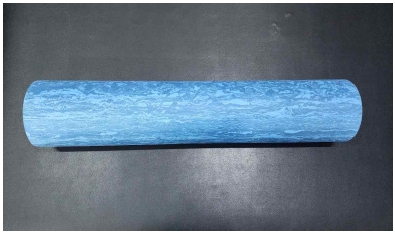
EVA foam roller, 9.5×60cm
Made of natural rubber and categorized into five sizes by user height. This study used a green ball with a diameter of 65 cm (Won, 2013).
<Figure 2. Gym ball, 65cm>
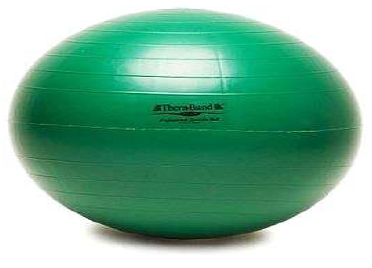
Gym ball, 65cm
A natural rubber resistance band (TheraBand®, The Hygenic Corporation, USA) was used for the scapular stabilization exercise program (Hwang, 2008). Participants selected an appropriate band color according to standardized guidelines.
<Figure 3. Elastic band>
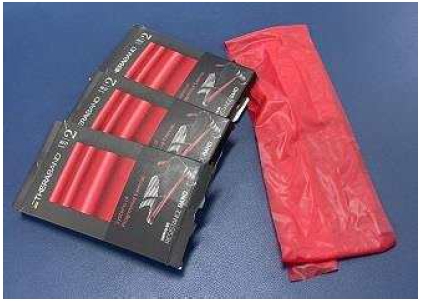
Elastic band
3. Intervention Programs
Participants completed baseline assessments(Week 0), were randomized 1:1 by a computer-generated sequence with allocation concealment in sealed opaque envelopes, and then undertook supervised training three times per week for five consecutive weeks. The experimental group received thoracic stretching followed by scapular-stabilization exercises, whereas the control group performed the same thoracic stretching only, time-matched. Session timing, set–rep schemes, and rest intervals were standardized across visits; adherence and adverse events were monitored at each session. The overall flow of recruitment, screening, baseline testing, randomization, intervention, post-intervention testing, and analysis is summarized in Figure 4 study flowchart. Detailed exercise procedures and figures are provided in the Appendix.
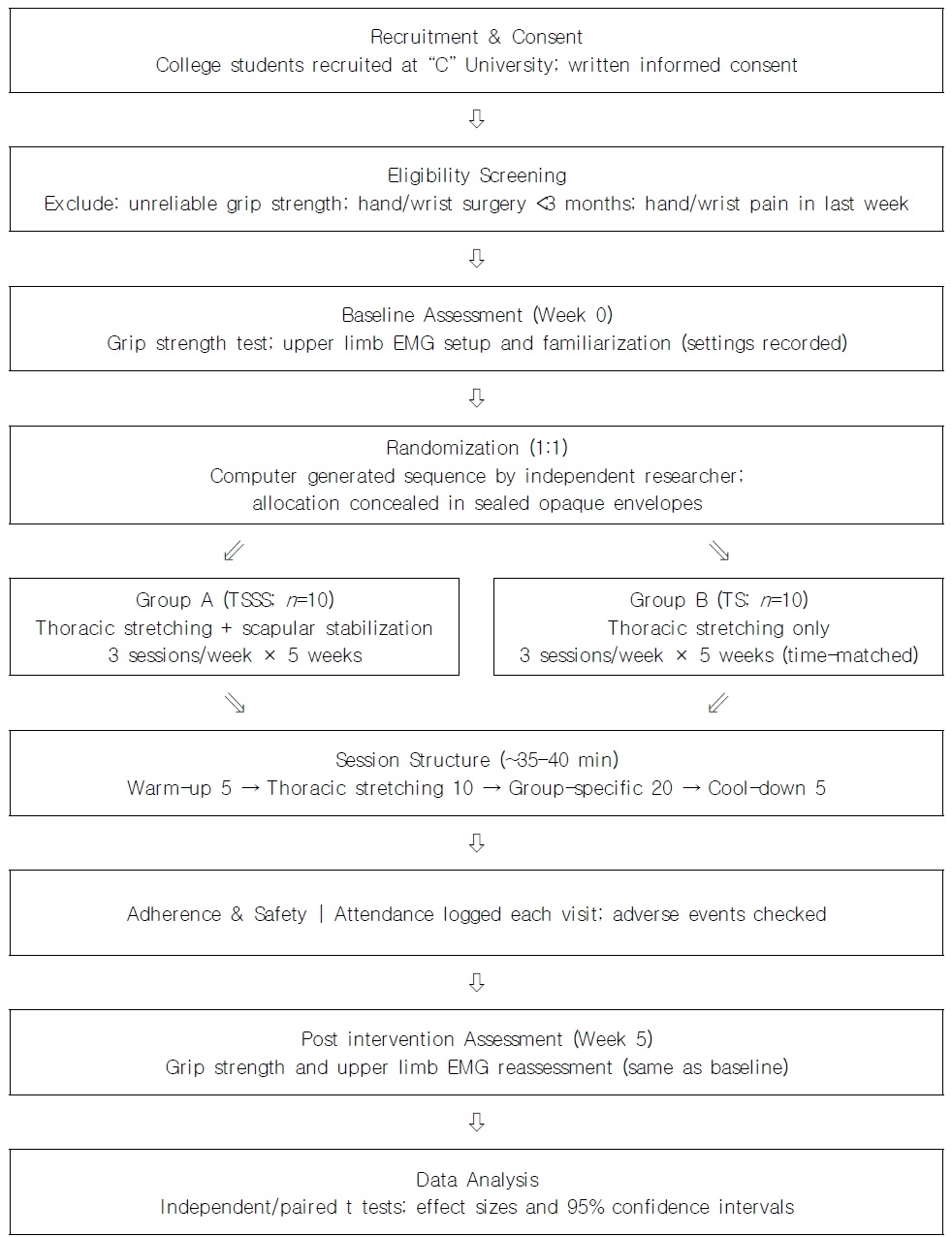
Study flowchart
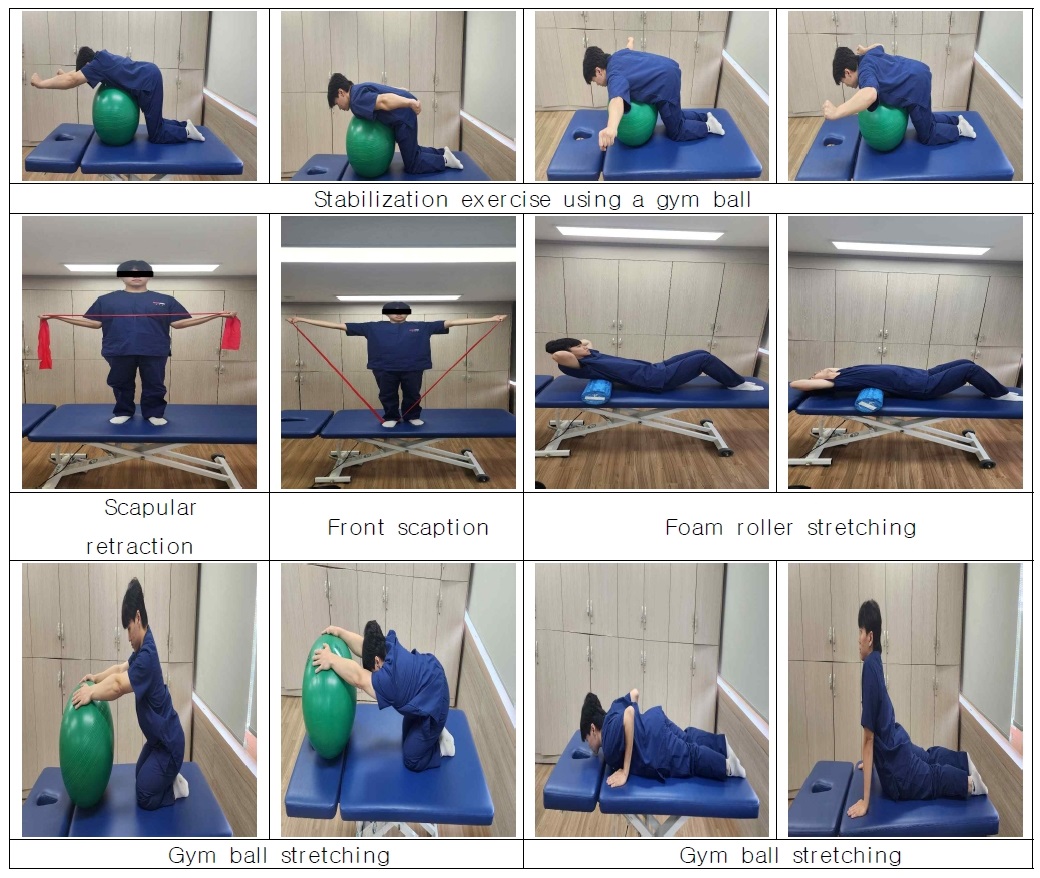
Detailed exercise procedures (TSSS and TS)
4. Measurement Methods and Tools
(1) Grip Strength
Participants stood upright with the arms relaxed at the sides, avoiding elbow or wrist flexion. Grip force was measured with maximum effort for 3 seconds using a hand dynamometer (Oh et al., 2017), repeated three times with at least 30-second rests between trials. The highest value of the dominant hand was recorded as the representative grip strength.
(2) Muscle Activity
Surface EMG electrodes were attached to the biceps brachii, brachioradialis, and flexor carpi radialis according to SENIAM guidelines. Muscle activity was recorded during gripping tasks, with pre and post intervention values compared as percentages. During the experiment, muscle activity was measured with a sampling rate set at 1,024 Hz, a band-pass filter set between 20 and 500 Hz, and a notch filter set at 60 Hz. Adhesive electrodes (3M, 2250 Ag-AgCl type) were attached to the dominant side of the biceps brachii, brachioradialis, and flexor carpi radialis muscles. Muscle activation data were analyzed using EMG Analyzer v2.9.37.0, and the Root mean square (RMS) values were used to quantify and normalize the surface electromyography (sEMG) signals.
(1) Grip Strength
Grip strength was measured using a digital hand dynamometer (EH101, COMET, China). The device demonstrated high inter-rater reliability (ICC = .971) and comparable validity with a standardized Korean device (Lee et al., 2023).
(2) Electromyography (EMG)
Muscle activity was assessed using a wireless EMG system (TeleMyo Mini DTS System, Noraxon, USA).
5. Data Analysis
Data were analyzed using SPSS 21.0 for Windows. Independent-sample t-tests were conducted to compare differences between groups, while paired-sample t-tests were used for within-group comparisons before and after the intervention. A significance level of p < 0.05 was adopted for all analyses.
Ⅲ. Results
1. General Characteristics of Participants
This study compared the effects of Thoracic stretching combined with scapular stabilization exercises and thoracic stretching on grip strength and arm muscle activity among college students. No significant differences were observed between the two groups in demographic variables such as age, height, and weight. Homogeneity was confirmed through the Kolmogorov–Smirnov test of normality. <Table 1.>

General Characteristics of Participants(N=20)
2. Changes in Grip Strength
In the scapular stabilization exercise group, grip strength significantly increased after the intervention (Δ = 7.71 kg, p< .001). In contrast, the thoracic stretching group showed no significant change (Δ = 0.77 kg, p= .727). Between-group comparisons of post-intervention values were not significant (p= .138); however, analysis of change scores revealed a significantly greater improvement in the scapular stabilization group compared with the thoracic stretching group (p= .013). <Table 2.>
Differences in Grip Strength Between Groups and Over Time (N=20)
3. Changes in Muscle Activity
Pre-intervention comparisons indicated no significant differences between the two groups (p= .286), confirming homogeneity. Within-group pre–post comparisons showed no significant changes in either the TSSS or TS group (p= .760, p= .272, respectively). Similarly, no significant between-group differences were observed after the intervention (p= .254).
As with the biceps brachii, no significant pre-intervention differences were found between the two groups (p= .209). Within-group comparisons revealed no significant changes in either group (p= .834 for TSSS, p= .730 for TS), and no significant between-group differences were observed following the intervention (p= .684).
No significant differences were observed between groups at baseline (p= .423). Between-group comparisons revealed no significant changes after the intervention (p= .304). However, within the TSSS group, flexor carpi radialis activity significantly decreased following the intervention (p= .029), whereas no significant change was observed in the TS group (p= .530).<Table 3.>
Electromyography of mean values
Ⅳ. Discussion
The present study demonstrated that scapular stabilization exercise was effective in improving grip strength among college students, whereas thoracic stretching did not produce significant changes in either grip strength or arm muscle activity. These findings are generally consistent with previous studies (Kim, 2020; Jang, 2017; Noh, 2024). For instance, studies applying therapeutic massage combined with scapular stabilization exercises reported significant increases in grip strength (Jang, 2017), and progressive scapular stabilization programs have similarly shown improvements in grip strength in experimental groups (Noh, 2024). However, no significant changes were found in muscle activity. Muscle imbalances, such as tight posterior shoulder muscles, may still be present and contribute to dysfunction.
Muscle imbalance, characterized by dominant internal rotators relative to external rotators, can lead to excessive anterior–superior translation of the humeral head. Such displacement increases mechanical stress on the rotator cuff and capsuloligamentous structures, potentially contributing to glenohumeral instability and the onset of subacromial impingement syndrome (Hammer, 1995).
Moreover, inadequate activation or delayed motion of the scapular stabilizers particularly the serratus anterior may fail to provide an appropriate base for humeral motion, further promoting anterior displacement of the humeral head.
The present findings reinforce the interrelationship within the upper kinetic chain, suggesting that enhanced proximal stability facilitates distal function. Insufficient stability around the scapular region may limit the capacity to generate optimal hand grip force. Therefore, the observed increase in isometric grip strength after performing thoracic stretching in combination with scapular stabilization exercises may be attributed to the improved proximal control. Strengthening this stability appears to contribute directly to enhanced grip performance.
Excessive thoracic kyphosis causes the scapula to adopt a pattern of downward rotation, internal rotation, and anterior tilt, which narrows the subacromial space and promotes anterior superior translation of the humeral head. Thoracic extension and rotational stretching can help restore the thoracic scapular glenohumeral kinetic chain, facilitating scapular upward rotation and posterior tilt while re-centering the rotator cuff. As a result, pain is reduced, and delayed muscle recruitment during distal strength exertion is minimized, thereby enabling more effective grip force generation. In addition, strong handgrip contractions are associated with coactivation of the anterior and middle deltoid muscles, which enhances the excitability of motor units surrounding the shoulder, particularly the infraspinatus and posterior deltoid, through propriospinal pathways. This neuromuscular pattern reflects an integrated mechanism linking central stabilization, pain modulation, and force output. Clinical evidence has also demonstrated that incorporating grip strengthening components can influence rotator cuff strength and shoulder function (AlAnazi, 2022).
This may be explained by the fact that grip tasks primarily recruit proximal shoulder muscles rather than the distal arm muscles targeted in this study (Cho & Kim, 2014). Furthermore, some research has reported no significant increase in grip strength when comparing scapular stabilization groups with non-exercising groups (Jung et al., 2007), which aligns with aspects of the present results.
In contrast, the thoracic stretching group in this study exhibited no significant improvements in either grip strength or muscle activity. This outcome is also consistent with prior studies, which suggested that isolated manual therapy or joint mobilization applied to patients with mechanical neck pain failed to produce effective results (Gross et al., 2010).
Notably, previous studies have indicated that long-term improvements in pain reduction and functional capacity are more effectively achieved when stretching and joint mobilization are combined with strengthening exercises (Song et al., 2013). These findings suggest that correcting postural malalignment requires a multifaceted approach, incorporating not only stretching or mobilization but also strengthening interventions. Indeed, strengthening programs have been reported to improve forward head posture (Song et al., 2013), while neural mobilization techniques have been shown to increase grip strength (Jung et al., 2007). Such evidence implies that more comprehensive outcomes may be expected when intervention programs integrate both neuromuscular and musculoskeletal components (Han & Song, 2021).
Several limitations of this study should be acknowledged. First, the study population consisted solely of healthy college students in their twenties, limiting the generalizability of the results. Second, participants were not diagnosed with postural malalignment syndrome, and the degree of muscle weakness was relatively mild. Third, the short intervention period prevented assessment of long-term effects. Future research should therefore employ longer intervention durations, recruit larger cohorts including clinical populations, and develop programs that integrate strengthening approaches with neuromuscular perspectives. Such studies would yield more meaningful results. Moreover, incorporating multidimensional outcome measures including flexibility, muscular endurance, pain, and daily functional performance would enable a more comprehensive evaluation of intervention effectiveness.
Despite these limitations, the findings of this study can serve as a foundation for promoting musculoskeletal health and preventing disorders in young adults. Further research is warranted to develop optimized intervention protocols applicable to both healthy individuals and patient populations. Such efforts may contribute to addressing widespread problems of postural malalignment, musculoskeletal pain, and functional impairment in modern society, thereby enhancing overall health and quality of life.
Ⅴ. Conclusion
In this study, scapular stabilization exercise had a positive effect on improving grip strength among college students, whereas its effect on enhancing arm muscle activity was limited. Addressing the limitations identified such as the short intervention period, the use of a non-clinical population, and the absence of long-term follow-up future research should involve larger-scale studies targeting patients with postural malalignment and incorporate strengthening programs that integrate neuromuscular perspectives.
Furthermore, adopting multidimensional outcome measures, including flexibility, muscular endurance, pain, and daily functional capacity, would allow a more comprehensive evaluation of the effectiveness of exercise interventions. Such approaches may contribute valuable scientific evidence for promoting overall health and functional improvement.
The findings of this study can serve as fundamental data for health promotion and musculoskeletal disorder prevention in young adults. However, to develop optimized and effective intervention programs applicable to both healthy individuals and clinical populations, further advanced research is required. Ultimately, such efforts will help address prevalent postural misalignment and musculoskeletal problems, thereby supporting healthier social participation and quality of life in modern society.
References
-
AlAnazi A., Alghadir AH., Gabr SA. Handgrip strength exercises modulate shoulder pain, function, and strength of rotator cuff muscles of patients with primary subacromial impingement syndrome. Biomed Res Int. 2022;2022:9151831.
[https://doi.org/10.1155/2022/9151831]

-
Belling Sørensen AK, Jørgensen U. Secondary impingement in the shoulder: an improved terminology in impingement. Scand J Med Sci Sports. 2000;10(5):266-278.
[https://doi.org/10.1034/j.1600-0838.2000.010005266.x]
-
Bohannon RW. Hand-grip dynamometry predicts future outcomes in aging adults. J Geriatr Phys Ther. 2008;31(1):3-10.
[https://doi.org/10.1519/00139143-200831010-00002]
- Cho OL, Kim BS. The effects of perceived grip intensity during initial rehabilitation on shoulder and arm muscle activity. Korean J Sports Sci. 2014;12(3):349-356.
-
Cleland JA, Childs JD, Fritz JM, et al. Development of a clinical prediction rule for guiding treatment of a subgroup of patients with neck pain: use of thoracic spine manipulation, exercise, and patient education. Phys Ther. 2007;87(1):9-23.
[https://doi.org/10.2522/ptj.20060155]
-
Faul F, Erdfelder E, Lang AG, et al. G*Power 3: A flexible statistical power analysis program for the social, behavioral, and biomedical sciences. Behav Res Methods. 2007;39(2):175-191.
[https://doi.org/10.3758/BF03193146]
-
Faul F, Erdfelder E, Buchner A, et al. Statistical power analyses using G*Power 3.1: Tests for correlation and regression analyses. Behav Res Methods. 2009;41(4):1149-1160.
[https://doi.org/10.3758/BRM.41.4.1149]
-
Gross A, Miller J, D’Sylva J, et al. Manipulation or mobilisation for neck pain: a Cochrane review. Man Ther. 2010;15(4):315-333.
[https://doi.org/10.1016/j.math.2010.04.002]
- Hammer W. Shoulder: primary or secondary impingement? Dynamic Chiropractic. 1995;13(8):1-5.
- Han JH, Song CH. Effects of neural mobilization and joint mobilization on disability, pain, and range of motion in patients with cervical radiculopathy. PNF Mov. 2021;19(3):361-374.
-
Harrison DE, Haas JW, Cailliet R, et al. Concurrent validity of flexicurve instrument measurements: sagittal skin contour of the cervical spine compared with lateral cervical radiographic measurements. J Manipulative Physiol Ther. 2005;28(8):597-603.
[https://doi.org/10.1016/j.jmpt.2005.08.012]
- Health Insurance Review & Assessment Service. Statistics on diseases of national interest, forward head posture. 2023.
-
Hotta GH, Santos AL, McQuade KJ, et al. Scapular focused exercise treatment protocol for shoulder impingement symptoms: three-dimensional scapular kinematics analysis. Clin Biomech. 2018;51:76-81.
[https://doi.org/10.1016/j.clinbiomech.2017.12.005]
-
Hwang DK, Jang HY, Lee SM, Lee BH. Effects of thoracic mobility exercise on the range of motion, pain, disability index and quality of life in middle-aged women with chronic back pain. Journal of Korean Physical Therapy Science 2024;31(2):15-29.
[https://doi.org/10.26862/jkpts.2024.06.31.2.15]
- Hwang YR. The effects of dumbbell and elastic band exercises on body composition, physical fitness, and blood components in elderly women [master’s thesis]. Hanshin University; 2008. Korea.
-
Im B, Kim Y, Chung Y, Hwang S. Effects of scapular stabilization exercise on neck posture and muscle activation in individuals with neck pain and forward head posture. J Phys Ther Sci. 2016;28(3):951-955.
[https://doi.org/10.1589/jpts.28.951]
- Jang JH. The effects of therapeutic massage combined with shoulder stabilization exercise on pain and grip strength in patients with acute shoulder pain [master’s thesis]. Korea; 2017.
-
Jo MH, Kim DH, Kim IH, et al. The effects of Body Blade and Thera Band exercise in upper extremity muscle strength, grip strength and balance in university students. Journal of Korean Physical Therapy Science 2019;26(1):22-34.
[https://doi.org/10.26862/jkpts.2019.06.26.1.22]
-
Jung SI, Lee NK, Kang KW, et al. The effect of smartphone usage time on posture and respiratory function. J Phys Ther Sci. 2016;28(1):186-189.
[https://doi.org/10.1589/jpts.28.186]
- Jung YW, Bae SS, Jang WS. The effect of neural mobilization on the grip strength. J Korean Soc Phys Med. 2007;2(1):11-20.
- Jung YW, Bae SS, Jang WS. The effects of scapular stabilization exercise on upper extremity strength. J Korean Soc Phys Med. 2007;2(1):11-20.
-
Kang H. Sample size determination and power analysis using the G*Power software. J Educ Eval Health Prof. 2021;18:17.
[https://doi.org/10.3352/jeehp.2021.18.17]
-
Kang JH, Park RY, Lee SJ, et al. The effect of forward head posture on postural balance in long-time computer-based workers. Ann Rehabil Med. 2012;36(1):98-104.
[https://doi.org/10.5535/arm.2012.36.1.98]
- Khill JH, Gong MS. Sports chiropractic. Seoul: Happy and Books; 2005.
- Kim JH. Pilates for saving my body: using the foam roller. Our Sports. 2017;17:34-38.
- Kim KJ, Jung HS, Cho HR. A survey on postural misalignment syndrome among university students using spinal thermography. J Complement Altern Med Res. 2015;6:5-13.
- Kim YH. The effects of glenohumeral stabilization exercise and centering exercise on pain, shoulder strength, and grip strength in patients with subacromial impingement syndrome [master’s thesis]. Korea; 2020.
-
Lee D, Jeong M. Effect of early stabilization exercise focused on the scapulothoracic joint on recovery in patients with rotator cuff tear surgery. J Korean Phys Ther. 2020;32(1):14-20.
[https://doi.org/10.18857/jkpt.2020.32.1.14]
-
Lee HT, Noh HR, Kim DJ, et al. Analysis of grip strength and reliability of Korean hand dynamometer in adults in their twenties. Asia Pac J Converg Res. 2023;9(11):539-548.
[https://doi.org/10.47116/apjcri.2023.11.41]
- Lee JC. Effect of shoulder stabilization exercise and McKenzie exercise on forward head posture. J Converg Cult Technol. 2019;5(4):227-235.
-
Lee SB. The effects of scapular stabilization exercise and thoracic mobilization on shoulder function in adults with scapular dysfunction. J Ind Converg Res. 2021;19(3):83-90.
[https://doi.org/10.22678/JIC.2021.19.3.083]
-
Morningstar M. Cervical curve restoration and forward head posture reduction for the treatment of mechanical thoracic pain using the Pettibon corrective and rehabilitative procedures. J Chiropr Med. 2002;1(3):113-115.
[https://doi.org/10.1016/S0899-3467(07)60013-5]
- Noh IC. The effects of progressive scapular stabilization exercise on pain, range of motion, grip strength, and disability in patients with acute whiplash injury [master’s thesis]. Korea; 2024.
-
Oh YH, Moon JH, Kong MH, et al. The association between hand grip strength and health-related quality of life in Korean adults. Korean J Sports Med. 2017;35(2):103-111.
[https://doi.org/10.5763/kjsm.2017.35.2.103]
- Paine RM, Voight M. The role of the scapula. Int J Sports Phys Ther. 2013;8(5):617-629.
-
Ruivo RM, Carita AI, Pezarat-Correia P. The effects of training and detraining after an 8-month resistance and stretching training program on forward head and protracted shoulder postures in adolescents: randomized controlled study. Man Ther. 2016;21:76-82.
[https://doi.org/10.1016/j.math.2015.05.001]
- Song JE, Kim SY, Jang HJ. The effects of thoracic mobilization and strengthening exercise on forward head posture in young adults with increased thoracic kyphosis. J Korean Acad Orthop Man Phys Ther. 2013;19(2):11-18.
- Won JH. The effect of gym ball exercise on alleviating back pain in elderly women [master’s thesis]. Hanshin University; 2013. Korea.
- Yoo SH, Kim HD, Song JK, et al. New physical measurement assessment. Seoul: Daekyung Books; 2006.