
The Relationship Between Occupational Stress and Depression Among Unmarried Female Physical Therapists in Their 20s to 30s: Focusing on the Moderating Effect of Resilience
© 2025 by the Korean Physical Therapy Science
Abstract
This study aims to examine the moderating effect of resilience in the relationship between occupational stress and depression among unmarried female physical therapists in their 20s and 30s who are currently working in clinical settings. The purpose is to gain a comprehensive understanding of the psychological stress experienced by these therapists during their occupational performance and to verify the role of psychological resources in alleviating resulting depressive symptoms.
Cross-sectional study design.
The survey for this study was conducted from May to June 2023, targeting unmarried female physical therapists currently employed across the country. A total of 124 valid responses were used for the final analysis.
Occupational stress showed a significant positive correlation with depression (r=0.435, p<0.01), while resilience was significantly negatively correlated with depression (r=-0.674, p<0.01). Occupational stress had a significant positive effect on depression (β=0.295, p<0.001), and resilience had a significant negative effect (β=-0.614, p<0.001). Moreover, resilience demonstrated a significant moderating effect on the relationship between occupational stress and depression (β=-0.139, p<0.05).
This study contributes to a deeper understanding of the mental health of physical therapists by empirically examining the role of resilience in the interaction between occupational stress and depression. The findings offer a foundation for the development of education and intervention programs aimed at improving mental health and fostering a healthier work environment for physical therapists.
Keywords:
Depression, Female, Occupational Stress, Physical Therapists, ResilienceⅠ. Introduction
In today’s society, many employees experience depression due to their work environments, and such depression can significantly impact various aspects of occupational performance (Bromet et al., 2011; Wang et al., 2014). Depression refers to a state where an individual loses interest or enjoyment in daily activities and experiences emotions such as sadness, low self-esteem, and a sense of helplessness. It is a condition that anyone can face and may also be accompanied by physical symptoms like loss of appetite or sleep disturbances (Abdoli et al., 2022; Radloff, 1977). Several factors influence the occurrence of depression, including gender, age, marital status, and occupational stress. Among these, occupational stress is considered a significant factor that induces both physical and psychological burnout, and it has been closely associated with the development of depression (Calder Calisi, 2017; Bromet et al., 2011). In particular, female employees have been reported to experience higher levels of occupational stress than their male counterparts due to gender-based societal expectations and the demands of fulfilling dual roles both at work and at home. Female workers, including female physical therapists, often face greater challenges related to occupational security, autonomy in their tasks, and role ambiguity. These adverse workplace conditions significantly contribute to increased levels of depression (Lee Bokim, 2009; Lee et al., 2016). Understanding these dynamics highlights the critical need for promoting resilience as a protective factor for female physical therapists dealing with occupational demands.
Occupational stress can lead to various physical symptoms such as fatigue, headaches, and sleep disturbances, as well as psychological issues including anxiety, irritability, substance or alcohol abuse, and a sense of helplessness (Kwon & Jung, 2019). These symptoms not only reduce work performance but can also result in increased depression (Kwon & Han, 2018). Studies by Desouky and Allam (2017) and Yoon and Kim (2014) have shown that higher levels of occupational stress are associated with elevated depression scores and a decreased ability to cope with stress. In research specifically focused on physical therapists, female physical therapists have been found to experience higher levels of occupational stress compared to their male counterparts (Kim et al., 2020). Additionally, studies examining occupational stress and depression in customer service professions revealed that female employees experience greater stress related to occupational opportunities, autonomy, technical skill utilization, and role ambiguity than male employees (Lee, 2009). These findings underscore the heightened vulnerability of female physical therapists to work-related mental health challenges and the importance of fostering resilience within this group. Furthermore, differences in occupational stress based on marital status are also noteworthy. Previous studies have shown that unmarried female employees, including early-career physical therapists, tend to experience higher levels of occupational stress due to unstable employment, lower positions within organizational hierarchies, and uncertainties about their future careers. In contrast, married female workers experience additional stress stemming not only from their roles in the workplace but also from responsibilities related to caregiving and family relationships at home. These findings suggest that the nature and pattern of occupational stress may differ depending on marital status (Song, 2017; Yoon & Kim, 2020). Unmarried female physical therapists in particular may be more vulnerable to stress due to limited social support systems, highlighting the importance of addressing psychological protective factors such as resilience to help mitigate the impact of occupational-related stress and reduce the risk of depression.
A psychological resource that has recently gained attention as a protective factor for addressing psychological stressors and alleviating depression is resilience. Resilience refers to an individual's capacity to effectively cope with stress or crisis situations and recover to a stable state. It has been widely recognized as a key protective factor that can lower the risk of depression (Ristevska-Dimitrovska et al., 2015; Hjemdal et al., 2011). Individuals with high levels of resilience are better able to regulate negative emotions and recover quickly from emotional exhaustion (Setiawati et al., 2021). This capacity is essential for maintaining mental health and coping effectively with occupational stress. Notably, resilience has been identified as an important psychological buffer among professionals in the medical and healthcare fields (Park, 2014; Hong, 2006). However, in South Korea, most research on the relationship between occupational stress and depression has focused on police officers, shift-working nurses, fire fighters, and clinical nurses, while studies specifically examining female physical therapists remain limited. This highlights the need for further investigation into how resilience functions within this particular population to protect against the mental health effects of occupational-related stress.
Therefore, this study aims to empirically examine the moderating effect of resilience on the relationship between occupational stress and depression among unmarried female physical therapists working in clinical and healthcare settings. The purpose of this research is to gain a more comprehensive understanding of the psychological stress experienced by female physical therapists during their occupational performance and to identify the role of resilience as a psychological resource that can mitigate the resulting levels of depression.
Furthermore, the findings of this study are expected to serve as foundational data for the development of educational programs aimed at improving the mental health of female physical therapists. In addition, they may provide empirical evidence to inform the creation of continuing education content and the design of university curricula that support effective coping strategies for managing occupational stress in the field of physical therapy.
Ⅱ. Methods
1. Participants and Data Collection
This study conducted an online survey from May to June 2023, targeting female physical therapists across South Korea. The participants were limited to unmarried female physical therapists in their 20s and 30s who were actively working in clinical settings. The survey was administered online, and participation was solicited through social media platforms. Participants were provided with sufficient information about the study and were included only after giving informed consent. Out of 131 responses collected, 2 were excluded due to missing age information and 5 were excluded due to insincere or incomplete responses. As a result, data from 124 respondents were used for the final analysis. These data were used to examine the relationship between occupational stress and depression, as well as the moderating role of resilience among unmarried female physical therapists.
2. Measurement Tools for Major Variables
To assess the occupational stress of unmarried female physical therapists, this study used a questionnaire that was originally developed by Kim Mae-Ja and Koo Mi-Ok (1984) to measure nurses’ occupational stress, and later revised and supplemented by Kim Eun-Hyung (2018) to suit the work environment of physical therapists.
This tool consists of 18 items divided into four subscales: excessive workload (5 items), work-related issues with physicians and supervisors (4 items), interpersonal relationships with patients and caregivers (3 items), and professional role conflict (6 items).
Each item is rated on a 5-point Likert scale ranging from “Not at all true (1 point)” to “Very true (5 points),” with higher scores indicating greater occupational stress. The reliability coefficient (Cronbach’s α) of the occupational stress scale was 0.95 in the study by Kim Mae-Ja and Koo Mi-Ok (1984), and 0.82 in the present study.
To assess the level of depression among unmarried female physical therapists, the Korean version of the Beck Depression Inventory (BDI), originally developed by Beck (1961) and adapted by Lee Young-Ho and Song Jong-Yong (1991), was used.
The Korean version of the BDI consists of 21 items covering depressive symptoms, somatic symptoms, dissatisfaction related to failure and self-image, and feelings of self-blame and guilt.
Each item is rated on a 4-point Likert scale ranging from 0 to 3, with a total score range of 0 to 63. Higher scores indicate more severe levels of depression. The reliability coefficient (Cronbach’s α) was 0.85 in the study by Lee and Song (1991), and 0.90 in the present study.
To assess the resilience of unmarried female physical therapists, the Korean version of the Connor-Davidson Resilience Scale (CD-RISC), originally developed by Connor and Davidson (2003) and translated by Baek Hyun-Sook and Lee Young-Wook (2010), was used.
This tool consists of 25 items across five subscales: hardiness (9 items), support (2 items), spirituality (2 items), persistence (8 items), and optimism (4 items).
Each item is rated on a 5-point Likert scale ranging from “Not at all true (1 point)” to “Very true (5 points),” with higher scores indicating greater resilience. The reliability coefficient (Cronbach’s α) was 0.97 in the study by Baek and Lee (2010), and 0.93 in the present study.
3. Data Analysis
To examine the relationships among the main variables and to test the moderating effect of resilience, data were analyzed using IBM SPSS Statistics version 23.0 and the PROCESS macro version 2.15 (Hayes, 2013).
First, frequency analysis was conducted to examine the general characteristics of the participants. Second, descriptive statistics including means, standard deviations, skewness, and kurtosis were calculated to assess the normality of the variables. Pearson’s correlation analysis was performed to identify the relationships among the main variables. Additionally, a chi-square test was conducted to examine differences in occupational stress and resilience according to years of clinical experience. Finally, the moderating effect of resilience on the relationship between occupational stress and depression was tested using Model 1 of the PROCESS macro (Hayes, 2013). The level of statistical significance was set at p < .05 (Kim & Lee, 2020).
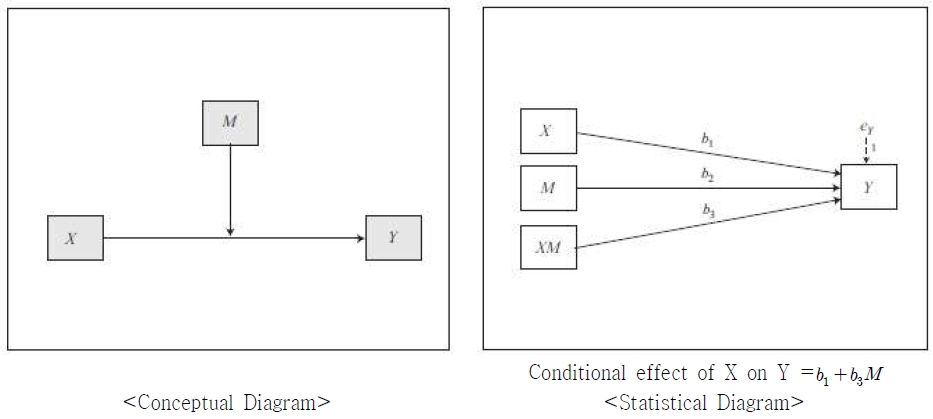
Research model design
Ⅲ. Results
1. General Characteristics of Participants
This study was conducted with a total of 124 unmarried female participants. The general characteristics of the participants are presented in Table 1.

General Characteristics of Participants(N=124)
The majority of participants were in their 20s (n = 102, 82.3%), followed by those in their 30s (n = 22, 17.7%). In terms of educational background, 67 participants (54.0%) had a bachelor's degree, 55 participants (44.4%) had an associate degree, and 2 participants (1.6%) had completed graduate school.
Regarding the type of medical institution, the largest group worked at clinics (n = 41, 33.1%), followed by hospitals (n = 39, 31.5%), long-term care hospitals (n = 31, 25.5%), general hospitals (n = 7, 5.6%), university hospitals (n = 4, 3.2%), and centers (n = 2, 1.6%).
As for the clinical specialty, 71 participants (57.3%) were working in the neurological field, and 53 participants (42.7%) in the musculoskeletal field.
In terms of years of service, 53 participants (42.7%) had less than 2 years of experience, 42 participants (33.9%) had 3 to 4 years, and 29 participants (23.4%) had 5 to 7 years.
Lastly, the majority of participants (n = 95, 76.7%) reported an average monthly salary between 2,000,000 and 3,000,000 KRW. This was followed by 18 participants (14.5%) earning between 3,000,000 and 4,000,000 KRW, 9 participants (7.3%) earning between 1,000,000 and 2,000,000 KRW, and 2 participants (1.6%) earning over 4,000,000 KRW.
2. Correlation Among Major Variables
Pearson's correlation analysis was conducted to examine the relationships among the major variables, and the results are presented in Table 2. The normality of the variables was verified by examining skewness and kurtosis. According to Kline (2015), skewness values within ±3 and kurtosis values within ±10 are considered acceptable. Based on this criterion, all variables in this study satisfied the assumption of normal distribution (as cited in Kim & Kim, 2022).
Correlations Among Major Variables(N = 124)
The descriptive statistics for each variable were as follows: occupational stress (M = 3.07, SD = 0.53), resilience (M = 3.48, SD = 0.61), and depression (M = 1.86, SD = 0.40).
Regarding the relationships among the variables, occupational stress showed a significant positive correlation with depression (r = .435, p < .01), whereas resilience was negatively correlated with depression (r = –.674, p < .01). These findings suggest that higher levels of occupational stress are associated with increased depression, while higher levels of resilience are associated with lower levels of depression.
3. Differences in Occupational Stress and Resilience by Years of Experience
To examine how occupational stress and resilience differ according to years of experience among unmarried female physical therapists in their 20s and 30s, a cross-tabulation analysis was conducted. Prior to the analysis, frequency analysis was used to classify the levels of occupational stress and resilience into three groups: low (bottom 30%), moderate (middle up to 70%), and high (top 30%).
The results of the cross-tabulation analysis on the differences in occupational stress and resilience by years of experience are presented in Table 3 and Table 4.
Differences in Occupational Stress by Years of Experience(N = 124)
Differences in Resilience by Years of Experience(N = 124)
The analysis of occupational stress by years of experience revealed that among those with 2 years or less of experience, the low group (21 people, 39.6%) was the most common, while among those with 3-4 years of experience, the high group (18 people, 42.9%) was the most prevalent. Similarly, among those with 5-7 years of experience, the high group (13 people, 44.8%) was the most common. A statistical test was conducted to examine whether there were significant differences in occupational stress by years of experience. The test result showed a statistical value of 110.137 with a p-value of .038, indicating a significant difference in occupational stress based on years of experience. These findings suggest that occupational stress increases as years of experience increase.
The analysis of resilience by years of experience revealed that among those with 2 years or less of experience, the high group (20 people, 37.7%) was the most common, while among those with 3-4 years of experience, the moderate group (21 people, 50.0%) was the most prevalent. Similarly, among those with 5-7 years of experience, both the moderate and low groups (10 people, 34.5% each) were relatively higher. A statistical test was conducted to examine whether there were significant differences in resilience by years of experience. The test result showed a statistical value of 3.966 with a p-value of .411, indicating that there is no significant difference in resilience based on years of experience. These findings suggest that resilience does not differ significantly with years of experience.
4. Examination of the Moderating Effect of Resilience on the Relationship Between Occupational Stress and Depression
To examine the moderating effect of resilience on the relationship between occupational stress and depression in 20-30s unmarried female physical therapists, the analysis was conducted using Hayes (2013) SPSS PROCESS macro Model 1. The results are presented in the following table, Table 5.
Examination of the Moderating Effect of Resilience(N = 124)
The effect of occupational stress on depression was found to be statistically significant (β = 0.295, p < 0.001), and the effect of resilience on depression was also statistically significant (β = -0.614, p < 0.001). Furthermore, when resilience was entered as a moderating variable, it showed a moderating effect on the relationship between occupational stress and depression (β = -0.139, p < 0.05). Based on the R² value, the model explains 54.5% of the variance in the dependent variable, and the interaction term contributes an additional 1.8% of explanatory power. Additionally, the model fit was found to be significant (F = 47.884, p < 0.001). Therefore, resilience was verified to have a moderating effect on the relationship between occupational stress and depression among unmarried female physical therapists.
To examine the moderating effect of resilience in more detail, a Simple Slope Analysis, as proposed by West et al. (1991), was conducted. The results are presented in Table 6 and [Fig. 2].
Significance Test of Simple Regression Lines Based on Resilience Conditional Values
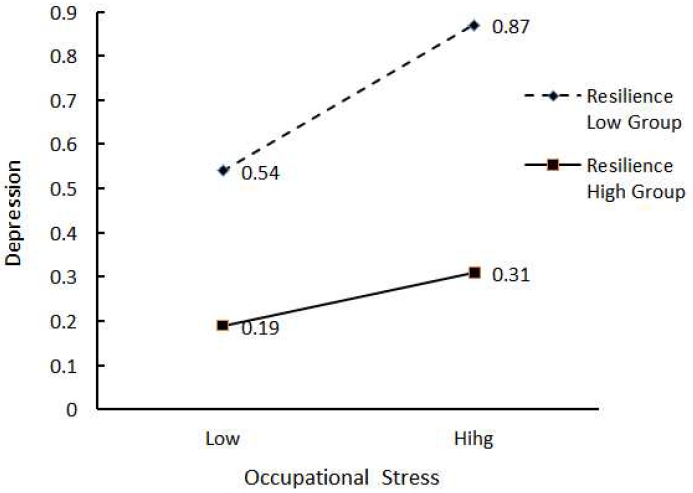
Moderating Effect Graph Based on Resilience
The moderating effect of resilience was statistically significant in the low group (β = 0.433, p < 0.001), but not in the high group (β = 0.158, p > 0.05). Statistical significance was further confirmed by testing the significance level using the 95% confidence interval (CI), where the confidence interval did not include 0.
Looking at the graph, in the low resilience group, as occupational stress increases, the level of depression also increases. In contrast, in the high resilience group, even as occupational stress increases, the rate of increase in depression is relatively unchanged. In other words, it can be concluded that the level of depression in unmarried female physical therapists in response to occupational stress can be moderated by resilience.
Ⅳ. Discussion
This study aimed to examine the moderating effect of resilience on the relationship between occupational stress and depression in unmarried female physical therapists in their 20s and 30s. The results revealed a significant positive correlation between occupational stress and depression (r = 0.435, p < 0.01), indicating that occupational stress can negatively impact mental health. This finding is consistent with the research by Yoon (2014) and Desouky and Allam (2017), suggesting that high levels of occupational stress may lead to emotional burnout or increased psychological distress. Specifically, occupational stress is associated with factors such as work overload, organizational conflict, and occupational insecurity. When these factors accumulate, they can contribute to the development of depression. Therefore, the study highlights the need for stress management programs at healthcare institutions and the enhancement of individual stress coping strategies.
On the other hand, the negative correlation between resilience and depression (r = -0.674, p < 0.01) suggests that individuals with higher resilience are less likely to experience depression. This finding aligns with the studies by Gong, Lee, and Nam (2015) and Wang et al. (2019), indicating that psychological resilience can serve as an important protective factor for mental health. Individuals with higher resilience tend to maintain positive thinking even in stressful situations and use effective coping strategies to achieve psychological stability.
Additionally, the results of examining occupational stress and resilience according to years of experience showed that occupational stress increased as years of service increased, while resilience did not show significant differences across years of experience. This finding is consistent with previous research, which suggests that an increase in work experience can lead to higher occupational stress. According to a study on nurses, higher work experience was associated with increased stress, which was interpreted as being due to greater occupational responsibilities and the increased complexity of tasks (Lee et al., 2021). However, resilience did not show significant differences based on years of experience, indicating that resilience is not simply improved by accumulating experience and that separate psychological interventions are necessary. This suggests that systematic education and counseling interventions are required to enhance resilience, which can be considered an essential part of improving mental health in the workplace.
This study aimed to examine the moderating effect of resilience on the relationship between occupational stress and depression among unmarried female physical therapists in their 20s and 30s. The analysis results indicated that occupational stress had a positive effect on depression (β = 0.295, p < 0.001), while resilience had a negative effect on depression (β = -0.614, p < 0.001). This suggests that higher levels of occupational stress are associated with higher levels of depression, while higher resilience levels are associated with lower levels of depression. Additionally, when resilience was used as a moderating variable, a significant interaction effect between occupational stress and depression was observed (β = -0.139, p < 0.05). Specifically, in the group with low resilience, as occupational stress increased, depression levels also showed a significant increase. However, in the group with high resilience, the change in depression levels was relatively smaller, even as occupational stress increased. These results indicate that resilience can act as a protective factor, buffering the negative effects of occupational stress on depression. This finding is consistent with the research of Bonanno et al. (2002), Fredrickson et al. (2003), and Gillespie et al. (2007). That is, individuals with high resilience are able to maintain emotional balance in stressful situations and manage negative emotions more effectively, leading to a lower risk of developing depression. Moreover, individuals with high resilience tend to reinterpret stress positively and use adaptive coping strategies to maintain emotional stability (Wang et al., 2019).
This study specifically targeted unmarried female physical therapists in their 20s and 30s. This focus is based on previous research indicating that the experience of occupational stress varies depending on marital status. According to Song (2017), unmarried women experience higher levels of occupational stress due to factors such as unstable employment in the early stages of their careers, lower organizational status, and uncertainty regarding future plans. Additionally, they are more vulnerable to depression due to limited social support systems. Similarly, Yun and Kim (2020) pointed out that unmarried women experience higher overall occupational stress levels compared to married women and lack sufficient stress coping resources. Therefore, unmarried female physical therapists may be considered a group that requires more careful intervention and protective factors for their mental health.
The implications of the research findings are as follows. First, interventions at the healthcare institution level are needed to reduce the occupational stress experienced by unmarried female physical therapists. Efforts should be made to alleviate occupational stress through reducing workload, improving the work environment, and strengthening support systems within the organization. Second, there is a need for the development of educational and psychological support programs aimed at enhancing resilience. Therefore, by incorporating programs that focus on positive psychology education, cognitive restructuring training, and psychological flexibility enhancement into continuing education for physical therapists and undergraduate curricula, it is believed that therapists can manage stress more effectively and prevent depression in advance.
Despite the results and significance of this study, there are the following limitations. First, this study is a cross-sectional study, which limits the ability to establish the temporal causal relationships between variables. It is unclear whether occupational stress causes depression or if a depressed psychological state increases occupational stress. Future studies should examine the causal relationships between variables over time, which may provide a clearer understanding of the relationship between them. Second, this study is limited to unmarried female physical therapists in their 20s and 30s, so the results cannot be generalized to all physical therapists or other age, gender, and marital status groups. Therefore, future research should include comparative studies that encompass married women, male physical therapists, or various age groups, which may offer a more comprehensive understanding of occupational stress, depression, and resilience among physical therapists. Lastly, the measurement tool used in this study was a self-report questionnaire, and it is difficult to eliminate bias arising from social desirability or the respondent's subjective interpretation. Thus, future studies may enhance the reliability of the data by incorporating qualitative research methods, such as in-depth interviews.
Ⅴ. Conclusion
This study aimed to examine the impact of occupational stress on depression and whether resilience functions as a moderating variable in this relationship among 124 unmarried female physical therapists in their 20s and 30s. The analysis revealed that occupational stress showed a significant positive correlation with depression, while resilience demonstrated a significant negative correlation with depression. Specifically, as occupational stress levels increased, depression levels also rose, whereas higher resilience was associated with lower levels of depression. Moreover, resilience was found to have a statistically significant moderating effect on the relationship between occupational stress and depression. Specifically, in cases of low resilience, the impact of occupational stress on depression was more pronounced, while in cases of high resilience, this effect was relatively attenuated. These findings suggest that resilience may serve as a psychological protective factor that buffers against the negative emotional responses caused by occupational stress.
This study is significant in that it deepens the understanding of physical therapists' mental health and empirically examines the role of resilience in the interaction between occupational stress and depression. The findings of this study can serve as foundational data for the development of educational and intervention programs aimed at promoting a healthy work environment and improving mental health among physical therapists. Specifically, if education aimed at enhancing resilience is combined with organizational-level support, it is expected that not only will physical therapists' personal resilience improve, but their occupational satisfaction and performance efficiency will also increase.
References
-
Abdoli N, Salari N, Darvishi N, et al. The global prevalence of major depressive disorder (MDD) among the elderly: A systematic review and meta-analysis. Neurosci Biobehav Rev, 2022;132:1067-1073.
[https://doi.org/10.1016/j.neubiorev.2021.10.041]

-
Baek HS, Lee KW. A study on the reliability and validity of the Korean version of the Connor-Davidson Resilience Scale [Master’s thesis]. Eulji University, 2010;
[https://doi.org/10.4306/pi.2010.7.2.109]
-
Beck AT, Ward CH, Mendelson M, et al. An inventory for measuring depression. Arch Gen Psychiatry, 1961;4(6):561-571.
[https://doi.org/10.1001/archpsyc.1961.01710120031004]
-
Bonanno GA, Wortman CB, Lehman DR, et al. Resilience to loss and chronic grief: a prospective study from preloss to 18-months postloss. J Pers Soc Psychol, 2002;83(5):1150.
[https://doi.org/10.1037/0022-3514.83.5.1150]
-
Bromet E, Andrade LH, Hwang I, et al. Cross-national epidemiology of DSM-IV major depressive episode. BMC Med, 2011;9(1):1-16.
[https://doi.org/10.1186/1741-7015-9-90]
-
Calder Calisi C. The effects of the relaxation response on nurses’ level of anxiety, depression, well-being, work-related stress, and confidence to teach patients. J Holist Nurs, 2017;35(4):318-327.
[https://doi.org/10.1177/0898010117719207]
-
Connor KM, Davidson JR. Development of a new resilience scale: The Connor-Davidson resilience scale (CD-RISC). Depression and Anxiety, 2003;18(2):76-82.
[https://doi.org/10.1002/da.10113]
-
Desouky D, Allam H. Occupational stress, anxiety and depression among Egyptian teachers. J Epidemiol Glob Health, 2017;7(3):191-198.
[https://doi.org/10.1016/j.jegh.2017.06.002]
-
Fredrickson BL, Tugade MM, Waugh CE, et al. What good are positive emotions in crisis? A prospective study of resilience and emotions following the terrorist attacks on the United States on September 11th, 2001. J Pers Soc Psychol, 2003;84(2):365.
[https://doi.org/10.1037/0022-3514.84.2.365]
-
Gillespie BM, Chaboyer W, Wallis M, et al Resilience in the operating room: Developing and testing of a resilience model. J Adv Nurs, 2007;59(4):427-438.
[https://doi.org/10.1111/j.1365-2648.2007.04340.x]
-
Hjemdal O, Vogel PA, Solem S, et al, Stiles TC. The relationship between resilience and levels of anxiety, depression, and obsessive–compulsive symptoms in adolescents. Clin Psychol Psychother, 2011;18(4):314-321.
[https://doi.org/10.1002/cpp.719]
- Hong ES. Conceptual understanding and educational approaches to resilience. J Spec Educ, 2006;41(2):45-67.
-
Hosseini A, Kakuma R, Ghazinour M, et al. Migration experience, resilience and depression: a study of Iranian immigrants living in Australia. Int J Cult Ment Health, 2017;10(1):108-120.
[https://doi.org/10.1080/17542863.2016.1270977]
- Jo HJ, Choi KY, Lee JJ, et al. A study on prediction of postpartum depression and recovery factors of depression during pregnancy. J Korean Soc Perinatol, 2004;15(3):245-254.
- Kim EH. A study on the occupational stress according to the personality type of physical therapists [Master’s thesis]. Sahmyook University, 2018;
- Kim KM, Kim IS, Choi JC. occupational stress of physical therapists by gender, employment type, medical facility, and treatment area. J Korea Soc Comput Inform, 2020;25(6):193-197.
-
Kim MJ, Koo MO. Development of a tool to measure stress experienced by nurses on duty. J Korean Acad Nurs, 1984;14(2):28-37.
[https://doi.org/10.4040/jnas.1984.14.2.28]
-
Kim SW, Kim JH. The relationship between school violence victimization and perpetration among middle school students: Longitudinal mediation effect of perception of school climate. J Learn-Cent Curr Instr, 2022;22(21):485-500.
[https://doi.org/10.22251/jlcci.2022.22.21.485]
-
Kim SW, Lee BH. The mediating effect of social support and ego-resilience in the relationship between academic stress and college life adaptation of physical therapy students. J Korean Phys Ther Sci, 2020;27(2):48-62.
[https://doi.org/10.26862/jkpts.2020.09.27.2.48]
-
Kong KR, Lee EN. The mediating effect of resilience in the relationship between symptom experience and depression in patients with chronic obstructive pulmonary disease. J Korean Acad Adult Nurs, 2015;27(4):375-383.
[https://doi.org/10.7475/kjan.2015.27.4.375]
- Kwon HK, Han NY. Moderating effect of perceived organizational support in the relationship between occupational characteristics, organizational characteristics, and occupational stress, psychological depression, and human errors among train drivers. J Korea Ind Inform Syst Res, 2019;24(1):95-108.
-
Kwon HJ, Jeong GY. The effect of physical therapists' emotional intelligence on occupational stress through resilience. J Wellness, 2019;14(2):253-269.
[https://doi.org/10.21097/ksw.2019.05.14.2.253]
- Lee BI. occupational stress and depression of customer service workers by gender. J Korean Ind Nurs, 2009;18(2):232-241.
- Lee SE, Cho YM, Yoon EG. Factors influencing secondary traumatic stress in nurses of regional trauma centers. J Healthc Manag, 2021;26(2):119-128.
- Lee S, Kim J, Park E. Gender differences in occupational stress and occupational satisfaction among Korean employees. J Occup Health, 2016;58(2):145–153.
- Lee YH, Song JY. A study on the reliability and validity of BDI, SDS, MMPI-D scales. Korean J Clin Psychol, 1991;10(1):98-113.
- Mok JS. The effect of group art therapy on the alleviation of depression and anxiety and the improvement of resilience (KRQ-53): Focusing on social service agents in the Military Manpower Administration. J Hum Welf Pract, 2017;19:23-49.
- Park SH. The effect of nurses' resilience on nursing occupational performance [Master’s thesis]. Hanyang University, 2014;
-
Radloff LS. The CES-D scale: A self-report depression scale for research in the general population. Appl Psychol Meas, 1977;1(3):385-401.
[https://doi.org/10.1177/014662167700100306]
-
Ristevska-Dimitrovska G, Stefanovski P, Smichkoska S, et al. Depression and resilience in breast cancer patients. Open Access Maced J Med Sci, 2015;3(4):661.
[https://doi.org/10.3889/oamjms.2015.119]
-
Setiawati Y, Wahyuhadi J, Joestandari F, et al Anxiety and resilience of healthcare workers during COVID-19 pandemic in Indonesia. J Multidiscip Healthc, 2021;1-8.
[https://doi.org/10.2147/JMDH.S276655]
- Song JY. Differences in occupational stress and occupational satisfaction of female workers according to marital status. Women's Stud Rev, 2017;31(2):55-78.
-
Southwick SM, Vythilingam M, Charney DS. The psychobiology of depression and resilience to stress: implications for prevention and treatment. Annu Rev Clin Psychol, 2005;1:255-291.
[https://doi.org/10.1146/annurev.clinpsy.1.102803.143948]
-
Wang YP, Gorenstein C. Attitude and impact of perceived depression in the workplace. Int J Environ Res Public Health, 2014;11(6):6021-6036.
[https://doi.org/10.3390/ijerph110606021]
-
Wang L, Xu B, Gu Y, et al. The mediating and moderating effects of resilience on the relationship between perceived stress and depression in heroin addicts. J Community Psychol, 2019;47(3):495-503.
[https://doi.org/10.1002/jcop.22133]
- West SG, Aiken LS, Wu W, et al. Multiple Regression. Handbook of Research Methods in Personality Psychology, 1991;602-632.
- Yoon EG, Kim YM. Comparison of occupational stress and life satisfaction between unmarried and married women. J Korean Occup Health Nurs, 2020;29(3):210-218.
- Yoon MS, Kim SH. Multiple mediation effects of depression and social support on the relationship between firefighters' occupational stress and quality of life. Ment Health Soc Work, 2014;42(2):5-34.
- Jung SY, Lee YW, Kim CY. A study on the recovery methods for subsyndromal depression of Chinese international students. J Korea Multimedia Soc, 2021;24(10):1425-1434