
Effects of Exercise Interventions on Anxiety in Korean University Students: A Narrative Review
© 2026 by the Korean Physical Therapy Science
Abstract
Anxiety is a common mental health concern among Korean university students, and exercise, a core physical therapy modality, has been proposed as a non-pharmacological approach to its management. Yet this evidence has not previously been reviewed from a physical therapy standpoint.
Narrative review.
Primary studies examining exercise interventions or physical activity and anxiety in Korean university student samples were identified through two domestic databases (RISS, KISS) and three international databases (PubMed, ScienceDirect, Google Scholar), using population, intervention, and outcome search terms. Twenty studies met the eligibility screen. Eleven satisfied all pre-specified criteria (Korean university-student sample; exercise or physical activity as the independent variable; anxiety measured directly with a standardized instrument; anxiety analyzed as a primary outcome) and were treated as fully eligible study, while the remaining nine partially met these criteria and were treated as partially eligible study.
Reductions in state or trait anxiety were reported across aerobic, resistance, combined aerobic-resistance, mind-body, and other movement-based categories, although not all studies reached statistical significance. Heterogeneity in design and anxiety instruments precluded direct comparison between exercise categories. Only one randomized controlled trial was identified among the fully eligible studies, sample sizes were small, and the evidence skewed toward female participants. One fully eligible study, a 15-week Pilates course, reported a significant increase, rather than a decrease, in anxiety; this counter-directional finding is retained and discussed rather than omitted. None of the reviewed programs were delivered within a formal therapeutic exercise prescription framework, and only one involved a physical therapy-affiliated research team.
Exercise may be associated with reduced anxiety in some studies of Korean university students, though the evidence base remains small, mostly non-randomized, and skewed toward women, with at least one counter-directional finding. This gap points to a concrete role for physical therapists in designing and testing dose-specified, individually progressed exercise programs for anxiety in this population.
Keywords:
Anxiety, Exercise, Korean university students, Narrative review, Physical activityⅠ. Introduction
University students globally exhibit a high prevalence of anxiety symptoms (Li et al., 2022). Specifically, among Korean university students, these symptoms are heavily driven by socio-cultural and environmental stressors, including academic pressure, employment and career-related uncertainty, financial strain, and interpersonal challenges, alongside the broader developmental transition into early adulthood (Kim et al., 2022; Xiang et al., 2024).
Exercise has been widely discussed as a non-pharmacological strategy for improving mental health, including depression, stress, and anxiety (Singh et al., 2023). Regular physical activity has been linked to improved hypothalamic-pituitary-adrenal axis regulation, increased endogenous opioid and endocannabinoid activity, and reduced systemic inflammation, all of which are proposed mechanisms for its anxiolytic effect (Mahindru et al., 2023; Forteza et al., 2021; Beavers et al., 2010). Exercise prescription, defined as the systematic manipulation of frequency, intensity, time, and type according to the FITT principle, is a core competency of physical therapy practice, and therapeutic exercise is already used by physical therapists to manage a wide range of physical and, increasingly, psychological conditions (Ho et al., 2022; Stavrinou et al., 2025; Davis & McGrane, 2021). Although anxiety-focused exercise interventions fall within the scope of physical therapy practice, relatively few reviews have examined this evidence base from a physical therapy perspective (Hodgson et al., 2025). Furthermore, the primary studies currently available for Korean university students are heterogeneous in design, exercise modality, and anxiety-measurement approach.
This narrative review aimed to (1) identify studies examining the effect of exercise on anxiety specifically among Korean university students across domestic and international databases; (2) summarize the reported findings within each exercise category, including relevant exercise-prescription parameters such as frequency, intensity, time, and duration; and (3) evaluate the methodological strength of the evidence to inform physical therapists who design or recommend exercise-based anxiety interventions for the university-student population.
Ⅱ. Methods
1. Design and search strategy
This study was conducted as a narrative review to synthesize current evidence on exercise and anxiety. Literature searches were performed between June 1 and June 30, 2026, across two domestic databases (RISS, KISS) and three international databases (PubMed, ScienceDirect, Google Scholar). Databases were searched for studies published between January 2000 and June 2026. No language restriction was applied, and searches were conducted in both Korean and English. Google Scholar and hand-searching of reference lists were used as supplementary sources. Google Scholar was searched as a supplementary source using the query: Korean “university students” anxiety exercise. Because Google Scholar ranks results by relevance rather than returning a bounded result set, records were screened in rank order and retrieval was discontinued after the first 41 records, at which point results were no longer topically related to exercise or anxiety in university-student populations. These 41 records were retained for screening. In addition, the reference lists of included articles were hand-searched, yielding 7 further records. Because the domestic databases do not fully support nested Boolean operators, a single combined query could not be executed. Because RISS and KISS are Korean-language database, the original Korean search terms are reported alongside their English translations to ensure the search strategy is reproducible. Instead, separate queries of the form [대학생 AND 불안 AND X] were run for X = 운동 (exercise), 스포츠 (sports), 신체활동 (physical activity), 요가 (yoga), 필라테스 (Pilates), and 무용 (dance), and the results were merged. Preliminary searching confirmed that 유산소운동 (aerobic exercise), 무산소운동 (anaerobic exercise), 복합운동 (combined exercise), 심신운동 (mind-body exercise), and 태극권/타이치 (Tai Chi) were fully captured by the 운동 and 요가 queries, and these terms were therefore not run as separate queries. In RISS, the search was restricted to domestic journal articles, theses and dissertations, and research reports; monographs were excluded as they do not report original research data. In KISS, journal articles were searched. For PubMed, the following single strategy was applied: (“college student*”[tiab] OR “university student*”[tiab] OR “undergraduate*”[tiab]) AND (Korea*[tiab] OR Korea[ad]) AND (exercise[tiab] OR "physical activity"[tiab] OR yoga[tiab] OR pilates[tiab] OR "tai chi"[tiab] OR dance[tiab] OR sport*[tiab]) AND (anxiety[tiab] OR STAI[tiab] OR "state-trait"[tiab]). ScienceDirect limits the number of Boolean terms per query, so the intervention concept was divided across three queries, each combined with (“college student” OR “university student” OR undergraduate) AND (Korea OR Korean) AND anxiety: (a) exercise OR “physical activity”; (b) yoga OR Pilates OR “tai chi”; and (c) dance OR sport OR aerobic. The affiliation field tag [ad] was used as a supplementary proxy to capture studies conducted in Korea; because this field reflects author affiliation rather than participant nationality, all retrieved records were manually screened to confirm that the study sample consisted of Korean university students.
2. Eligibility criteria and study selection
The searches yielded 598 records in total: 387 from RISS, 144 from KISS, 18 from PubMed, 1 from ScienceDirect, 41 from Google Scholar, and 7 from hand-searching reference lists. The large number of domestic records reflects the use of multiple parallel queries in RISS and KISS, which produced substantial overlap. After removal of 177 duplicates arising from overlap between queries within a database and across databases, 421 unique records remained. Titles and abstracts of these 421 records were screened, and 348 were excluded, most commonly because anxiety was not assessed as an outcome, because the anxiety construct examined was situation- or domain-specific (competitive anxiety, performance anxiety, social physique anxiety, career-related anxiety) rather than generalized anxiety, or because no exercise or physical activity variable was present. The full texts of the remaining 73 records were assessed, and 53 were excluded. Twenty studies met eligibility criteria and were included in the review.
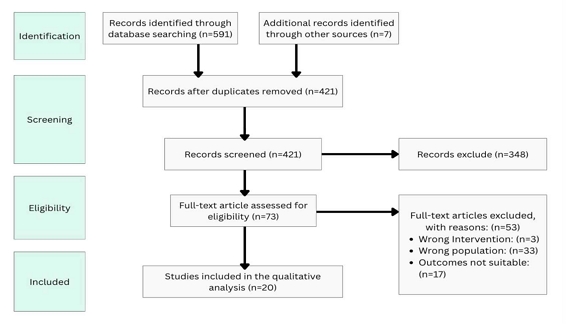
Process of selecting literature for analysis
Included studies were organized into two groups according to how completely they satisfied the eligibility criteria elaborated below. Studies meeting all four criteria are referred to as fully eligible studies, and those satisfying them only partially are referred to as partially eligible studies. These labels describe only how well each study fit our inclusion criteria. They were created for this review to facilitate narrative synthesis of a heterogeneous literature, and are not a formal rating of study quality, risk of bias, or evidence strength. The criteria were not pre-registered: they were developed during full-text review of the retrieved records and finalized before data extraction and synthesis.
Fully eligible studies were defined as those meeting all of the following criteria: (a) a Korean university-student sample; (b) exercise or physical activity as the independent variable (an intervention program); (c) anxiety measured directly with a standardized instrument (STAI, SCL-90 anxiety subscale, Self-rating Anxiety Scale (SAS), State Anxiety Index (SAI)); and (d) anxiety analyzed as a primary, not incidental, outcome.
Partially eligible studies were defined as those in which one of these criteria was only partially satisfied, specifically: (a) anxiety was assessed only as a secondary or subscale outcome, or through a physiological proxy rather than a validated anxiety questionnaire; (b) the design was correlational, mediational, or observational (assessing participation-level physical activity rather than an intervention program), precluding causal inference; or (c) a study met the formal STAI/SAI direct-measurement criterion but the direction of the reported effect could not be reconciled with the authors' own operational definition of anxiety, and this inconsistency could not be resolved from the published text.
Studies were excluded when anxiety was not measured at all, when a Korean-language publication drew its sample from a non-Korean student population, or when participants were not university students. Following screening, eleven studies were retained as fully eligible and nine as partially eligible (N = 20 total).
Ⅲ. Results
1. Overview of included studies
The eleven fully eligible studies spanned aerobic exercise (k = 3) (Han, 2003; Kang, 2016; Park, 2007), resistance/strength‑oriented exercise (k = 1) (Kang, 2016) combined aerobic-resistance exercise (k = 2) (Kang, 2016; Lee & Yu, 2018), mind-body exercise (k = 4) (Park & Kim, 2016; Kwak, 2023; Kim et al., 2023; Yook et al., 2024), and other movement-based activities (k = 3) (Kim, 2016; Kim & Park, 2000; Jung, 2015). Study designs varied, including a single-blind randomized controlled trial (k = 1) (Yook et al., 2024), multi-arm controlled trials or nonequivalent-control pre-post designs (k = 4) (Kang, 2016; Park, 2007; Lee & Yu, 2018; Park & Kim, 2016), two-group or quasi-experimental pre-post designs (k = 3) (Kwak, 2023; Kim, 2016; Kim & Park, 2000), and single-group pre-post designs with no comparison group (k = 3) (Han, 2003; Kim et al., 2023; Jung, 2015). Sample sizes were generally small, ranging from 16 to 109 (median < 30), with several fully eligible studies enrolling single-sex cohorts, which limits generalizability by sex.

Summary of Fully Eligible Studies on Exercise and Anxiety in Korean University Students
2. Partially eligible studies evidence
Nine additional studies were classified as partially eligible, providing directionally informative but methodologically weaker or ambiguous evidence. To avoid conflating evidence of different types, these studies are divided into two subgroups and summarized separately in Table 2a and 2b.
Summary of Partially Eligible Studies
Table 2a summarizes five studies that used an exercise intervention but did not fully meet the eligibility criteria above (Jang & Kim, 2013; Kim, 2015; Kim et al., 2004; Sim, 2023; Song & Shin, 2022), most often because the reported anxiety effect was non-significant, indirectly measured, or showed an unresolved scoring inconsistency. Among these, Kim et al. (2004) met the formal direct-measurement criterion for anxiety, but the study was reclassified from fully eligible to partially eligible because the reported score change (an increase) was logically inconsistent with the original authors' own case definition of anxiety, which most likely reflects an unresolved item-coding issue rather than a genuine anxiolytic effect.
Table 2b summarizes four studies that examined the association between physical activity and anxiety using an observational or correlational design rather than an intervention (Jung & Yook, 2022; Kim & Kim, 2007; Kim et al., 2025; Kim, 2009). Because these studies did not administer an exercise intervention, they are interpreted as descriptive, hypothesis-generating evidence on the exercise-anxiety association rather than as evidence of intervention effect, and are not used to support causal claims elsewhere in this review.
3. Level of evidence
Because fully eligible status alone does not equate to methodological rigor, the eleven fully eligible studies were further stratified by design strength (Table 3). Only one randomized controlled trial was identified (Yook et al., 2024). The remaining fully eligible studies relied on nonequivalent control groups, two-group or quasi-experimental comparisons, or single-group pre-post designs without a comparison group, which cannot rule out regression to the mean, maturation, or practice effects as alternative explanations for observed anxiety changes.
Level of Evidence of Fully Eligible Studies
4. Exercise-prescription parameters
Table 4 summarizes explicit frequency, intensity, time, and type (FITT) parameters for the interventions in the eleven fully eligible studies as these variables are crucial for physical therapists’ exercise prescription. Reporting was inconsistent across studies: intensity was unreported or vaguely described (“individualized”) in several studies (Park, 2007; Kwak, 2023, Kim et al., 2023, Yook et al., 2024, Kim, 2016, Kim & Park, 2000), and frequency or session length was missing entirely in the two lowest-quality single-group studies (Kim & Park, 2000; Jung, 2015). Total program duration ranged widely, from 4 weeks (Yook et al., 2024) to 15 weeks (Kim et al., 2023), with no discernible dose-response pattern. A significant within-group reduction in state anxiety was observed in the 7-week Tai Chi program (Park & Kim, 2016), whereas the 15-week Pilates program showed a significant increase (Kim et al., 2023). Duration alone does not appear to predict the direction of the effect in this literature.
Exercise Prescription Parameters (FITT Framework) of Interventions in the Fully Eligible Studies
5. Findings by exercise category
Aerobic exercise studies included swimming, treadmill walking, and an individualized program. A 14-week swimming program showed only a trend-level reduction in trait anxiety (p = .07) (Han, 2003). A five-arm parallel trial (total N = 91: treadmill walking n = 18, resistance training n = 17, combined aerobic-resistance training n = 19, transcranial direct current stimulation or tDCS n = 20, control n = 17) found that the treadmill-walking arm produced a significant reduction in both state and trait anxiety (p < .001) (Kang, 2016). Numerically, the pre-post reduction was largest in the combined aerobic-resistance arm (state -15.4 points; trait -14.6 points), followed by the aerobic-only arm (-13.9 points for both) and the resistance-only arm (-11.7 state, -10.7 trait). The untreated control arm showed no significant change in state anxiety (p = .074). Although trait anxiety in the control arm reached nominal statistical significance (p = .035), the magnitude of this change was negligible (+0.03 points), indicating no clinically meaningful change. However, the original study did not report a formal between-arm statistical comparison for these differences, so this numerical ordering should be read as a descriptive observation rather than evidence that one exercise type was more effective than another. A 10-week individualized aerobic program also reduced SCL-90 anxiety scores relative to a nonequivalent control group (Park, 2007).
As noted above, the pre-post reduction in the combined aerobic-resistance arm of the same five-arm trial was numerically larger than in the aerobic-only and resistance-only arms for both state and trait anxiety (Kang, 2016); however, as noted, the absence of a formal between-arm statistical test in the original study means this pattern cannot be interpreted as evidence of superior efficacy. A separate 12-week physical education course that combined aerobic and resistance components in male students also reduced SCL-90 anxiety scores (p < .001) (Lee & Yu, 2018). Because the multi-arm trial was not designed with combined exercise as a pre-specified primary comparison, and the physical education course relied on a non-randomized, single-sex sample, both findings should be interpreted as promising but preliminary.
Mind-body exercise (Tai Chi, yoga, Pilates, and online mindful somatic movement) was the most frequently represented category among the fully eligible studies, and it produced the most heterogeneous pattern of results. A 7-week Tai Chi program in nursing students reported a significant within-group reduction in state anxiety (STAI -22.9 points, p < .001) (Park & Kim, 2016), and a 4-week single-blind randomized trial of an online mindful somatic movement and psychoeducation program also produced a significant reduction (STAI -26.2 points, p < .001), the only randomized evidence in the fully eligible studies (Yook et al., 2024). An 8-week online program with separate yoga (n = 22) and Pilates (n = 20) arms showed a significant reduction in state anxiety in both arms (yoga p < .001; Pilates p < .01), but the reduction in trait anxiety was not significant in either arm (both p > .05), which suggests a state-level rather than trait-level effect (Kwak, 2023).
By contrast, a 15-week Pilates course reported a significant increase rather than a decrease in anxiety (SCL-90, +0.32, p = .015) (Kim et al., 2023). Its 15-week duration and pre-post design are not, in themselves, grounds for exclusion, so the finding is reported here in its original direction and interpreted on its own terms. The original authors attributed the counter-directional result to two factors: the once-weekly session frequency, which they judged too infrequent to produce a meaningful psychological effect, and the timing of the post-test, which coincided with the final-examination period and likely elevated participants’ anxiety through exam-related stress. Similarly, a 6-week meridian-exercise trial (Kim et al., 2004) also showed a numerical increase in SAI scores, though the authors interpreted their findings as an anxiety reduction. This study met the direct measurement criterion but was reassigned to the partially eligible group (Table 2a), because the discrepancy between the reported score direction and the authors’ interpretation most plausibly reflects an unresolved item-coding issue rather than a genuine counter directional effect.
Other movement-based approaches included movement-centered expressive-arts therapy, dance learning, and a general physical-education course. Expressive-arts therapy over six weeks significantly reduced both trait and state anxiety (p < .001) (Kim, 2016). A 9-week program that compared two separate interventions found that dance learning (n = 23) significantly reduced state anxiety (p < .01), whereas sport activity (n = 16) did not (p > .05) (Kim & Park, 2000). Lastly, a 4-month general physical education course in both male and female students was associated with a significant reduction in SCL-90 anxiety scores (Jung, 2015).
Ⅳ. Discussion
Across the eleven fully eligible studies, significant within-group reductions in anxiety were reported in most exercise categories, although not every study reported a significant change. Reductions were reported across aerobic, resistance, combined aerobic-resistance, mind-body, and other movement-based programs, and proposed mechanisms common to these modalities include the regulation of physiological arousal and the cardiovascular and musculoskeletal adaptations relevant to emotional regulation (Mahindru et al., 2023). Because the reviewed studies used different anxiety instruments and different score metrics, these findings indicate a consistent direction of change rather than a ranking of modalities. However, these findings should not be interpreted as an unqualified endorsement of exercise as an anxiety intervention in this population.
First, only one of the eleven fully eligible studies used randomization (Yook et al., 2024), and most relied on single-group or nonequivalent-control pre-post designs, which cannot rule out regression to the mean, academic-calendar effects (proximity to examinations), or simple practice effects on repeated anxiety questionnaires. Second, sample sizes were consistently small; total sample sizes across fully eligible studies ranged from 16 to 109, and the median group size across intervention arms was below 30. This limited statistical power increases the risk of Type II errors and restricts the generalizability of the findings (Kang, 2016). Third, unexpected or inconsistent findings were reported across the literature rather than selectively omitted. Among the fully eligible intervention studies, one program (a 15-week Pilates course) showed a significant increase, rather than a decrease, in anxiety (Kim et al., 2023), and a related but methodologically ambiguous intervention study displayed an internal scoring-direction inconsistency in the same direction (Kim et al., 2004). Separately, among the observational studies, a cross-sectional survey found that higher self-reported sport participation was associated with higher, not lower, state anxiety (Kim & Kim, 2007); because this study did not involve an intervention, it is interpreted as a directionally consistent but non-causal counter-example rather than as evidence equivalent to the Pilates finding. Fourth, several partially eligible studies operationalized anxiety only indirectly (a Profile of Mood States (POMS) subscale, an EEG frontal-asymmetry index, or an autonomic pulse-wave measure) which limits confidence that an anxiety-specific, rather than a broader stress- or arousal-related, effect was captured (Jang & Kim, 2013; Kim, 2015; Sim 2023).
Fifth, as shown in Table 4, exercise dose was highly heterogeneous and inconsistently reported across studies.
Specifically, the exercise dose ranged from a single session to 15 weeks of structured training, at widely varying intensities (from “low-intensity, relaxation-focused” to “moderate-to-vigorous”). This means no dose-response conclusion can be drawn at this stage.
Taken together, these methodological limitations and divergent findings underscore why exercise cannot be treated as an unqualified or universal intervention for anxiety in this population.
1. Implications for physical therapy practice
From a physical therapy standpoint, three observations stand out.
First, none of the eleven fully eligible studies were designed or delivered as a formal therapeutic-exercise prescription in the sense used in physical therapy practice, that is, with individualized progression criteria, objective load monitoring, and symptom-based dose adjustment. The programs were instead delivered by nursing, sport-science, psychology, or general-education instructors, and intensity and progression were frequently undocumented (Table 4). This represents a concrete opportunity for physical therapists, who are trained in exercise prescription and dosing, to design and test anxiety-focused exercise programs with the same rigor already applied in musculoskeletal or cardiopulmonary rehabilitation.
Second, one of the two most methodologically rigorous studies in this review, the single-blind randomized trial of an online mindful somatic movement program, was co-authored by a physical therapy researcher (Yook et al., 2024). This suggests that physical therapy expertise is already contributing meaningfully to this evidence base and supports the relevance of this topic to physical therapy science. We specifically looked for additional studies in which a physical therapist was directly involved in intervention delivery or exercise prescription, but none could be identified among the twenty studies screened. This absence is itself informative: it suggests that physical therapy-led exercise trials for anxiety in this population remain largely unexplored, and it tempers any claim that physical therapy involvement has already been shown to improve outcomes in this literature.
Third, the pattern of unexpected results identified in this review carries a clinically important point for physical therapists who prescribe exercise for psychological outcomes. Among the fully eligible studies, a 15-week Pilates program showed a significant increase in anxiety (Kim et al., 2023), and a related but methodologically ambiguous study showed a similar numerical pattern that could not be reconciled with the authors' own scoring criteria (Kim et al., 2004). Among the observational studies, higher self-reported sport participation was associated with higher, not lower, state anxiety (Kim & Kim, 2007), and unsupervised participation-level exposure showed inconsistent or null associations with anxiety in two further studies (Kim et al., 2025; Kim, 2009). None of these counter-directional or null findings arose from a program that was individually dosed, progressed, or monitored by a trained professional; each involved either an unsupervised participation measure or a fixed, non-individualized group protocol. This pattern is consistent with the broader principle in physical therapy practice that a therapeutic exercise program requires ongoing, symptom-based adjustment to remain both safe and effective, rather than a uniform prescription applied without monitoring. Taken together, these findings suggest that not every exercise modality or delivery format produces an anxiolytic effect in every subgroup, and that unsupervised, self-reported participation, as opposed to a dosed, monitored intervention, appears particularly prone to null or paradoxical results. This underscores a concrete role for physical therapists, whose training in individualized assessment, progression, and symptom monitoring positions them to supervise exercise programs in which anxiety is tracked as an explicit outcome and adjusted for in real time, rather than relying on general, unguided activity participation delivered by non-specialist instructors.
2. Methodological considerations & confounders
Several methodological considerations are worth noting when interpreting the findings in this review.
First, a clear divergence was observed between state and trait anxiety outcomes. Trait anxiety reached statistical significance only in the intervention with higher session frequency and total duration (three sessions per week over 36 sessions) (Kang, 2016), whereas the lower-dose online program reduced state anxiety alone, without a significant change in trait anxiety (Kwak, 2023). While consistent with the theoretical distinction between transient state anxiety and stable dispositional traits, this observation remains hypothesis-generating as only three fully eligible studies evaluated both subscales.
Second, because exercise modality, session frequency, total duration, and sample demographics covary almost completely across the literature, it is impossible to isolate the true effect of exercise type from these confounded design features. Any apparent superiority of specific modalities must be interpreted with caution.
3. Limitations
This review has several limitations. As a narrative rather than a systematic review, the search was limited to five databases without a structured PRISMA flow, dual-reviewer screening, or a formal risk-of-bias assessment. In addition, none of the twenty included studies reported an a priori sample size or power calculation. Because most studies enrolled fewer than 30 participants per arm, it remains unclear whether they were adequately powered to detect anxiety reductions; this raises the possibility that some non-significant findings reflect insufficient power rather than a true absence of effect, and conversely that some significant findings may be inflated in a small-sample literature. Additionally, Google Scholar does not permit reproducible, bounded searching. Retrieval was therefore terminated at the point where results ceased to be topically relevant, and this cut-off reflects a judgment by the reviewers rather than a predefined stopping rule. Records ranked beyond this point may have included eligible studies. Furthermore, reliance on Korean-language sources and a small number of international sources may have introduced publication or language bias. Finally, extracted statistics (particularly for the multi-arm trial, mediation analyses, and scoring directions in the Pilates and meridian-exercise studies) warrant careful re-verification against original manuscripts.
Ⅴ. Conclusion
The available literature suggests that exercise across various modalities, including aerobic, resistance, combined, and mind-body, may be associated with reduced anxiety among Korean university students, although the findings were inconsistent and the heterogeneity in study design and anxiety instruments precludes any comparison of relative effectiveness between exercise types. The evidence base remains limited, being mostly non-randomized, skewed toward female samples, and inclusive of at least one counter-directional finding that warrants transparent discussion. Additionally, none of the reviewed interventions reflected a formal physical therapy exercise-prescription approach, which suggests both a gap and an opportunity for physical therapy-led research in this population. Future studies should prioritize adequately powered randomized controlled trials with standardized anxiety instruments, explicit FITT-based exercise prescription, and physical therapist involvement in program design and delivery.
References
-
Beavers KM, Brinkley TE, Nicklas BJ. Effect of exercise training on chronic inflammation. Clin Chim Acta. 2010;411(11-12):785-793.
[https://doi.org/10.1016/j.cca.2010.02.069]

-
Chang MK, Lee HJ, Kim YM. The Relationship between Physical Activity and Sleep Disturbance Factors among University Students: Mediating Effects of Psychological Anxiety and Perceived Stress. J Converg Consilience. 2025;8(5):1-17.
[https://doi.org/10.33090/SFCC.8.5.1]
- Chung SB. The Effect of Body Composition and Health Fitness of Students in College on Mental Health. Korea J Sports Sci. 2015;24(3):331-346.
-
Davis ME, McGrane N. Exercise as a treatment for clinical depression in adults and progressing the physiotherapist's role: a systematic review and meta-analysis. Physiother Pract Res. 2021;42(2):105-118.
[https://doi.org/10.3233/PPR-210512]
-
Forteza F, Giorgini G, Raymond F. Neurobiological processes induced by aerobic exercise through the endocannabinoidome. Cells. 2021;10(4):938.
[https://doi.org/10.3390/cells10040938]
-
Han MW. Effects of Swimming on the Trait Anxiety and Reaction Times of University Students. J Sport Leis Stud. 2003;19:1475-1483.
[https://doi.org/10.51979/KSSLS.2003.05.19.1475]
- Ho A, Barker KD, Kasitinon D. Exercise prescription and basic principles of therapeutic exercise. Rosemont(IL): American Academy of Physical Medicine and Rehabilitation; 2022.
-
Hodgson P, Hemmings L, Stubbs B, et al. Physiotherapy within inpatient mental health wards: involvement, diagnoses, and lifestyle characteristics. Healthcare (Basel). 2025;13(3):279.
[https://doi.org/10.3390/healthcare13030279]
- Jang SY, Kim SC. Analysis of Psychological Effects on Green Exercise: Effects on Attention and Mood States. Korean J Phys Educ. 2013;52(2):127-138.
-
Jung HW, Yook YS. COVID-19, the Effect of Body Awareness through Online Yoga on Positive/Negative Affect and Anxiety in Female College Students: Verification of the Mediating Effect of Acceptance Behavior. Korean J Converg Sci. 2022;11(8):19-44.
[https://doi.org/10.24826/KSCS.11.8.2]
- Kang BN. The Effects of Transcranial Direct Current Stimulation and Exercise Type on Body Composition, Depression, and Quality of Life in Female College Students [dissertation]. Dongguk Univ.; 2016.
- Kim DJ, Kim YK. The Relationships among Participation of Regular Exercise, Type A Behavior Pattern and State Anxiety in Women University Students. Korean J Phys Educ. 2007;46(3):351-359.
-
Kim J, Oh J, Rajaguru V. Job-seeking anxiety and job preparation behavior of undergraduate students. Healthcare (Basel). 2022;10(2):288.
[https://doi.org/10.3390/healthcare10020288]
- Kim JH. Effect of movement-oriented expressive arts therapy program on college students' depression, anxiety and emotional expression [dissertation]. Changwon(Korea): Changwon National Univ.; 2016.
-
Kim JS. The Effect of the Exercise Performance of Yoga and Pilates on the Autonomic Nervous System. J Korea Acad Ind Coop Soc. 2015;16(7):4450-4458.
[https://doi.org/10.5762/KAIS.2015.16.7.4450]
- Kim JW. A Study on the Leisure Satisfaction and Mood States of University Students According to Participating Exercise. Korea J Sports Sci. 2009;18(4):447-455.
-
Kim KB, Cohen SM, Oh HK, et al. The effects of meridian exercise on anxiety, depression, and self-esteem of female university students in Korea. Holist Nurs Pract. 2004;18(5):230-234.
[https://doi.org/10.1097/00004650-200409000-00004]
- Kim SC, Park JH. A Study on the Effects of Dance Class on Anxiety. Korean J Phys Educ. 2000;39(1):275-281.
-
Kim YJ, Lee JM, Kim NH, et al. Effects of 15-weeks Pilates Classes on Body Composition, Physical Function, Self-esteem, Depression, and Anxiety in College Students. J Sport Leis Stud. 2023;91:99-108.
[https://doi.org/10.51979/KSSLS.2023.01.91.99]
- Kwak JH. A Study on Non-face-to-face Programs for Promoting Mind-Body Health of College Students: Focusing on Yoga and Pilates. Korean J Meditation. 2023;13(2):51-73.
-
Lee KW, Yu YK. The Effect of Health Exercise Program on Health Fitness & Mental Health in College Students. Korea J Sports Sci. 2018;27(6):1241-1253.
[https://doi.org/10.35159/kjss.2018.12.27.6.1241]
-
Li W, Zhao Z, Chen D, et al. Prevalence and associated factors of depression and anxiety symptoms among college students: a systematic review and meta-analysis. J Child Psychol Psychiatry. 2022;63(11):1222-1230.
[https://doi.org/10.1111/jcpp.13606]
-
Mahindru A, Patil P, Agrawal V. Role of physical activity on mental health and well-being: a review. Cureus. 2023;15(1):e33475.
[https://doi.org/10.7759/cureus.33475]
- Park BN. Effects of the Tailored Exercise Program on Health and Life Satisfaction in College Students. J Health Inform Stat. 2007;32(1):49-69.
-
Park YJ, Kim JO. Effect of Tai Chi Exercise on Fatigue, Anxiety, and Sleep Patterns in Nursing Students. J Muscle Jt Health. 2016;23(1):61-69.
[https://doi.org/10.5953/JMJH.2016.23.1.61]
- Sim JH. Effect of aerobic exercise on brain activation in young adults during video learning [master's thesis]. Seoul: Seoul National Univ. of Science and Technology; 2023.
-
Singh B, Olds T, Curtis R, et al. Effectiveness of physical activity interventions for improving depression, anxiety and distress: an overview of systematic reviews. Br J Sports Med. 2023;57(18):1203-1209.
[https://doi.org/10.1136/bjsports-2022-106195]
-
Song JB, Shin JT. The Effect of Physical Activity-Based Positive Psychology Program on the Mental Health of University Students. J Korea Soc Wellness. 2022;17(4):479-487.
[https://doi.org/10.21097/ksw.2022.11.17.4.479]
-
Stavrinou PS, Astorino TA, Giannaki CD, et al. Customizing intense interval exercise training prescription using the “frequency, intensity, time, and type of exercise” (FITT) principle. Front Physiol. 2025;16:1553846.
[https://doi.org/10.3389/fphys.2025.1553846]
-
Xiang J, Gao J, Gao Y. The effect of subjective exercise experience on anxiety disorder in university freshmen: the chain-mediated role of self-efficacy and interpersonal relationship. Front Psychol. 2024;15:1292203.
[https://doi.org/10.3389/fpsyg.2024.1292203]
-
Yook YS, Park I, Lee JH, et al. Effects of online mindful somatic psychoeducation program on mental health during the COVID-19 pandemic. Psychiatry Investig. 2024;21(1):63-73.
[https://doi.org/10.30773/pi.2023.0304]
-
Cho H-y, Kim S-u. The Moderated Mediation Effect of Age on the Relationship Between Ego-Resilience, Subjective Well-being, and Depression in the 2030 Generation. The Journal of Korean Academy of Physical Therapy Science. 2025;32(4):59-69
[https://doi.org/10.26862/jkpts.2025.12.32.4.59]
-
Kim S-u, Lee B-h, Kim J-m, et al. Relationship Between Occupational Stress and Depression Among Unmarried Female Physical Therapists In Their 20s to 30s: Focusing on the Moderating Effect of Res. The Journal of Korean Academy of Physical Therapy Science. 2025;32(3):102-116
[https://doi.org/10.26862/jkpts.2025.09.32.3.102]