
만성 뇌졸중 환자를 위한 점진적 자세 조절 운동 기반 지역사회 원격재활 프로그램의 유효성 평가: 예비연구
© 2026 by the Korean Physical Therapy Science
Abstract
Telerehabilitation has emerged as an effective approach to support functional recovery in stroke patients. However, evidence regarding the most efficient exercise interventions is limited. This study aimed to develop a progressive postural control exercise–based, community-based telerehabilitation program for chronic stroke patients and to evaluate its preliminary feasibility.
A single-group pre- and post-intervention study.
Six community-dwelling patients with chronic stroke, aged ≥50 years and more than one year post-stroke, participated in an 8-week program, consisting of two sessions per week (16 sessions in total). Each session included a 5-minute warm-up, 50-minute main exercise, and 5-minute cool-down. Functional outcomes were assessed one week before and after the intervention using the Motor Assessment Scale (MAS), Senior Fitness Test (SFT), active range of motion (AROM), and EuroQol Visual Analog Scale (EQ-VAS).
After the intervention, participants showed significant improvements in MAS, affected and unaffected Arm Curl Test (30 s), unaffected Back Scratch Test, 8-Foot Up & Go Test, and Step in Place Test (p < 0.05). AROM showed significant increases in unaffected shoulder flexion, forearm supination, elbow flexion, sitting knee extension, affected and unaffected elbow extension, affected hip abduction, and hip flexion (p < 0.05). EQ-VAS scores indicated improvement in perceived health status.
The progressive postural control exercise–based, community-based telerehabilitation program demonstrated positive effects on physical function in chronic stroke patients. These findings suggest its potential to enhance functional outcomes and contribute to health management. Further large-scale studies are warranted to confirm its effectiveness.
Keywords:
Chronic Stroke, Community-Based Rehabilitation, Feasibility, Progressive Postural Control Exercise, TelerehabilitationⅠ. 서 론
뇌졸중은 높은 사망률과 장애 부담을 동반하는 대표적인 신경계 질환으로 알려져 있으며, 발병 이후 장기간의 기능 제한을 초래할 수 있다(Thrift 등, 2017). 뇌졸중 이후 환자들은 운동기능 저하뿐 아니라 언어, 감각, 시지각 및 인지기능의 손상을 경험할 수 있으며, 이러한 기능 회복은 장기간에 걸쳐 부분적으로 이루어지는 경우가 많다(Crichton 등, 2016; Langhorne 등, 2011). 기능적 손상은 일상생활 수행능력을 감소시키고 사회 참여를 제한함으로써 장기적인 장애 상태로 이어질 가능성을 높인다. 그러나 체계적이고 지속적인 뇌졸중에 대한 재활은 장기 장애 발생 가능성을 줄이고 일상생활 활동의 독립성을 증가시킨다고 알려져 있다(Kalra 등, 2007; Pollock 등, 2014).
하지만 국내 보건의료 체계에서는 지역사회 뇌졸중 장애인은 병원에서와 같은 지속적인 재활 서비스를 가정에서 받기가 어려운 여건이다. 최근에는 재활서비스 접근성의 한계를 보완하기 위한 방법으로 원격재활 서비스의 활용 가능성이 적극적으로 논의되고 있다. 원격재활은 정보통신기술(Brennan 등, 2009)을 활용하여 지역사회의 장애인에게 재활 서비스를 제공하며 환자와 재활 전문가 간의 소통은 전화, 인터넷 기반 화상 회의 등 다양한 기술을 통해 이루어질 수 있다(Rogante 등, 2010). 또한 디지털 기술의 발전과 보급 확대는 재활서비스를 의료기관 외 환경에서도 제공할 수 있게 하였으며, 이는 환자의 지역사회 복귀를 지원하는 새로운 접근법으로 평가받고 있다(신윤찬과 박지혁, 2018; Brochard 등, 2010; Galea과 Marinella DeFre, 2019).
선행 연구에서는 원격재활이 뇌졸중 환자의 상·하지 운동기능(Motor function) 개선, 균형 능력, 보행 기능 향상에 긍정적인 영향, 일상생활동작(Activities of Daily Living, ADL)의 독립성을 증진시키는 것으로 나타났다(Sharififar 등, 2023; Wang 등, 2024). 또한, 체계적인 모니터링이 동반된 원격재활은 근력 강화와 관절가동범위(ROM) 유지를 통해 뇌졸중 환자의 신체적 기능 저하를 효과적으로 방지하는 중재 방안으로 평가받고있다(유경태, 2024). 그러나 이는 원격재활의 전반적인 효과성에 집중하고 있어, 임상 현장에서 적용 가능한 가장 효율적인 운동 중재 프로토콜이나 환자의 안전을 보장하는 체계적인 자세 조절 기법에 관한 구체적인 근거는 여전히 부족한 실정이다(Gutierrez-Arias 등, 2025; Alwadai 등, 2024).
이에 본 연구에서는 기능적 평가도구로서 유효성이 검증된 Motor Assessment Scale (MAS) 결과를 활용하고(Torunn Askim 등, 2010), 누운자세, 옆으로 눕기, 앉기, 앉아서 일어서기, 걷기 순으로 점진적 자세 조절 단계에 기반한 안전한 원격재활 운동 프로그램을 구성하였다.
따라서 본 연구에서는 지역사회에 거주하는 만성 뇌졸중 장애인을 대상으로 8주간의 점진적 자세 조절 기반 원격재활 프로그램을 적용하고, 이에 따른 운동기능, 체력, 능동 관절가동범위 및 삶의 질 변화를 탐색함으로써 프로그램의 적용 가능성과 예비적 효과를 검토하고자 하였다.
Ⅱ. 연구방법
1. 연구대상
본 연구에는 뇌졸중 발병 후 1년 이상 경과하였으며 지역사회에서 생활하고 있는 만성 뇌졸중 장애인 6명이 참여하였다. 모든 대상자는 독립적인 보행이 가능하였으며 연구 기간 동안 중도 탈락자는 발생하지 않았다.
표본 수는 원격재활 분야의 예비연구에서 보고된 선행연구(Sarfo 등, 2018; Fujii 등, 2024)를 참고하여 설정하였다. 연구 참여 기준은 미국스포츠의학회(American College of Sports Medicine)의 위험도 분류 기준에 따라 중강도 운동 수행이 가능하고, 독립보행과 의사소통이 가능하며 연구 목적을 이해하고 참여에 동의한 자로 정하였다. 반면 연구 참여에 동의하지 않거나 연구 내용을 이해하기 어려운 경우, 심혈관계 질환과 같이 운동 수행 시 위험이 예상되는 질환이 있는 경우, 최근 3개월 이내에 다른 운동 프로그램에 정기적으로 참여한 경우는 제외하였다. 또한 임신 중이거나 임신 가능성이 있는 여성은 연구 대상에서 제외하였다.
참여자의 운동 회복 수준은 Brunnstrom 회복단계를 기준으로 평가하였으며, 상지와 하지 모두 2~4단계 범위에 해당하였다. 이는 본 연구에서 적용한 운동프로그램을 수행할 수 있는 기능 수준으로 판단되었다(Naghdi 등, 2010; Shah 등, 1986).
연구는 국립재활원 기관생명윤리위원회의 승인을 받은 후 진행되었으며(IRB No. NRC-2022-04-030), 모든 대상자에게 연구 목적과 절차, 예상되는 위험성 및 이익을 충분히 설명한 뒤 서면 동의를 획득하였다.
2. 연구절차
참여자는 초기 평가 및 교육을 마친 후 8주 동안 주 2회 화상 기반 재활운동 프로그램에 참여하였다(Coulter 등, 2017). 원격 재활은 온라인 화상미팅 플랫폼(Zoom)을 이용하였고 연구대상자는 각자의 집에서 스마트폰 또는 노트북 또는 데스크탑을 이용하여 함께 운동을 수행하였다. 운효율적인 프로그램 수행을 위하여 중재 시작 전 대면교육을 실시하였다. 초기 교육에서는 전반기 4주 동안 수행할 운동방법과 원격재활 시스템 사용법을 안내하였다. 이후 프로그램 4주 경과 시점에 중간교육을 실시하여 후반기 운동 내용을 설명하고 참여 과정에서 경험한 어려움과 개선 사항을 확인하였다.. 8주간 원격재활 운동프로그램 수행 전과후에 대면으로 Motor Assessment Scale(MAS)를 이용한 운동기능평가, 노인체력검사(Senior Fitness Test, SFT)를 통한 상지 근력, 하지 근력, 상지 유연성, 균형, 심폐능력 평가, 고니오메터(Goniometer)를 이용한 능동 관절가동범위(Active Range of Motion, AROM), Euro Quality of life – Visual analogue Scale(EQ-VAS)을 이용한 삶의 질을 평가하였다. 점진적 자세 조절 기반 원격재활 운동프로그램은 준비운동 5분, 본운동 50분, 마무리운동 5분으로 구성되었으며, 총 운동시간은 회기당 60분이었다. 본운동은 관절가동성 향상, 자세 안정성 확보 및 기능적 움직임 증진을 목표로 구성하였다.
3. 점진적 자세 조절 기반 원격재활 운동프로그램 구성
MAS 평가 결과를 참고하여 대상자의 기능 수준에 적합한 자세 단계와 보조 전략을 설정하고, 원격 환경에서도 안전하게 수행 가능한 운동 프로토콜을 구성하였다(Figure 1). 이 프로토콜을 기반으로 연구대상자의 사전 MAS 평가 점수를 기반으로 원격재활이 가능한 안전한 자세를 먼저 선정하였고, 보호자의 보조는 자세의 보조와 운동동작의 보조 두가지의 상황을 구분하여 중재를 적용할 수 있도록 운동프로그램을 구성하였다.
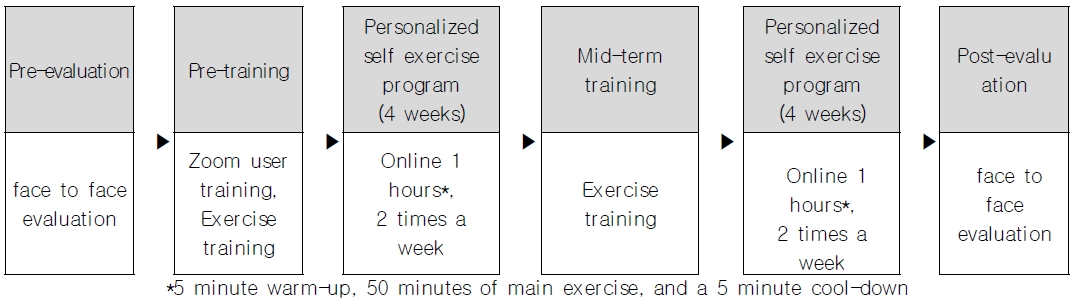
Experimental procedure
운동 난이도는 자세 안정성이 높은 단계에서 시작하여 점차 균형 조절 요구도가 증가하는 단계로 전환되도록 설계하였고 바로누운자세(Supine)에서부터 무릎 굽히고 바로누운자세(hook-lying), 옆으로 누운자세(side-lying), 팔꿈치 데고 엎드려 누운자세(prone on elbow), 네발기기 자세(quadruped), 무릎으로 선자세(kneeling), 한쪽 무릎 세우고 무릎으로 선자세(half-kneeling), 앉은자세(sitting), 선자세(standing)로 진행되며 난이도의 증가는 자세에 따른 시간을 늘려가는 방식으로 조절하였지만 각 대상자에 따라 난이도 조절은 개인의 기능 수준에 맞춰 수행하였다. 그리고 대상자가 자세조절에 소요되는 시간과 노력이 높은 뇌졸중 장애인이라는 특성을 고려하여 자세조절 횟수를 최소화하고 자세 유지에 필요한 힘의 필요가 작은 자세에서 큰 자세로 점진적으로 높여가도록 하였다.
운동프로그램의 운동 유형은 Physical therapy exercise 플랫폼에서 질환에 따라 추천하고 있는 운동 동작 중에서 지역사회 만성 뇌졸중 장애인 대상자의 의학적 특성을 고려하여 선택하였다(Harvey 등, 2009; Harvey 등, 2014; Scharrer 등, 2012). 정적 스트레칭은 15-30초를 적용하여 부상을 예방하고 점진적인 가동범위 향상을 도모하하였고 마비가 있는 환측은 덤벨과 같이 악력이 필요한 도구를 사용하기에 부적합하여 고횟수의 무중량 훈련 방식의 관절가동 운동을 수행하였다(Schoenfeld 등, 2017). 그리고 균형능력은 자세를 점진적으로 조절하면서 정적균형(Static balance)에 점진적으로 동적균형(Dynamic balance) 훈련을 접목하여 나가는 방법을 이용하였다. 또한 원격재활 운동프로그램을 안전하게 적용하기 위해성 연구대상자의 최대심박수 75%를 운동중 심박수가 넘지않도록 확인을 하면서 수행하였다. 유지하는 중강도 이상의 강도로 운동을 적용하였다. 이를 위해 사전 교육시 연구대상자에게 스마트 밴드를 나눠주고 사용방식을 교육하였다(Borg, 1998).
8주간의 주차별 프로그램 진행내용은 부록 1에 상세히 제시하였다. 1~2주차 (누운 자세, Lying Down)로 체간 안정성과 초기 근력 회복을 목표로, 무릎 굽힘·신전, 목 굽힘, 팔·다리 들어 올리기, 가슴 쪽으로 무릎 당기기, 골반 들기 등의 동작을 수행하였다. 3~4주차 (옆으로 눕기, Side-Lying / 엎드린 자세, Prone): 측면 및 엎드린 자세에서 체간 안정성, 하체 근력 강화, 요추 안정성을 위해 상체 회전, 다리 들어 올리기, 다리 굽힘 및 좌우 이동, 케겔 운동 등을 포함하였다. 5~6주차 (앉은 자세, Sitting / 서기 자세, Standing): 앉은 자세에서 상지-체간 협응과 균형 조절, 서기 자세에서 하체 근력과 체중 이동, 균형 회복을 목표로 목 회전, 상체 굽힘, 팔·무릎 들어 올리기, 사이드 런지, 스쿼트, 제자리 무릎 들기 등의 동작을 수행하였다. 7~8주차 (혼합/기능적 자세, Other/Mixed): 다양한 자세와 복합 운동을 수행하여 실생활 동작과 유사한 기능적 움직임을 회복하도록 하였으며, 무릎 굽힘 후 일어서기, 팔꿈치 굽힘 및 등 근육 사용, 손목 뒤로 당기기, 상체 굽힘 및 회전 등의 동작을 포함하였다. 모든 운동은 원격 환경에서 수행하였으며, 필요 시 보호자 지원과 화상 피드백을 통해 안전하게 진행되도록 하였다.
4. 측정 방법
연구대상자의 일반적인 특성 측정 항목은 성별, 나이, 결혼 상태, 직업 유무, 최종학력 수준, 생활비 수준이었고 장애특성 측정 항목은 장애유형, 장애 정도, 장애 등록 기간이었다.
운동기능 측정은 Carr 등(1985)이 개발한 Motor Assessment Scale (MAS)를 사용하였다. 뇌졸중 환자의 일상생활 동작에 기반하여 측정항목이 구성되어 있어 자세 조절 기반 운동 프로그램의 운동기능 유효성을 파악하는데 유용한다. 이 측정 도구의 신뢰도는 모든 항목에서 ICC=0.99 이상으로 높게 보고되고 있으며 지역사회 만성 뇌졸중 장애인의 기능적 능력을 평가하기 위한 신뢰도가 높은 임상 도구로 알려지고 있다(차유리 등, 2013). 그리고 MAS는 바로 누운자세에서 옆으로 눕기, 바로 누운 자세에서 침대 끝에 앉기, 앉은 자세 균형, 앉은 자세에서 서기, 보행, 상지 기능, 손 움직임, 고도의 손 활동으로 구성되어 있고 각 항목에 대해 6점으로 점수를 매기고, 총점은 48점이다.
Rikli와 Jones(1999)에 의해 개발된 노인체력검사(Senior Fitness Test, SFT)는 일상생활동작(ADL)을 수행하는 데 필요한 상지 근력, 하지 근력, 상지 유연성, 하지 유연성, 균형, 심폐지구력 등을 종합적으로 측정하는 평가도구이다. 본 연구에서는 5개의 측정항목을 사용하여 체력을 평가하였다. 첫번째, 상지근력은 30초 동안 2kg 아령을 들어 올리고 내린(Arm Curl Test) 횟수를 측정하였다. 두번째, 하지근력은 30초 동안 의자에 앉았다 일어나기(Chair Stand Test) 횟수를 측정하였다. 세번째, 상지 유연성은 등뒤에 손을 맞대기(Back Scratch Test) 한 후 가운데 손가락 사이 거리를 측정하였다. 네번째, 균형은 의자에서 일어나 2.44m(Up-and-Go Test) 앞으로 가서 돌아와 앉기 시간을 측정하였다. 마지막으로 심폐지구력은 2분 동안 무릎을 허리 중간 높이까지 들어 제자리 걷기(2-Minute Step Test) 횟수 측정하였다. 이 측정 도구의 신뢰도는 ICC > 0.85로 높은 신뢰도를 보고하였다(홍승연, 2018; Ho 등, 2021; Duan 등, 2022).
능동 관절가동범위(Active range of motion exercise, AROM)는 임상·재활 평가에서 관절의 움직임 범위를 축정하는 대표적인 방법이다. 이 측정은 대상자가 의자에 앉거나 선 자세로 스스로 최대 범위까지 움직이게 한후에 움직임 범위를 측정하였다. 본 연구의 측정 동작은 체간에서는 굴곡, 왼쪽 회전, 오른쪽 회전 3개 동작과 상지에서는 견관절 외전, 굴곡, 외회전, 내회전 4개 동작, 전완 회외 1개 동작, 주관절 굴곡, 신전 2개 동작으로 총 7개 동작의 양측을 측정하였다. 그리고 하지에서는 고관절 외전, 굴곡 2개 동작, 슬관절 신전, 굴곡 2개 동작으로 총 4개 동작의 양측을 측정하였다. 뇌졸중 대상 고니오미터(goniometer)를 이용한 능동 관절가동범위 측정의 신뢰도는 ICC = 0.88~0.94로 높은 신뢰도를 보였다(Brosseau 등, 2001).
EuroQol Group(1990)에 의해 개발된 (Euro Quality of life – Visual analogue Scale, EQ-VAS)을 사용를 활용하여 삶의 질 측정하였다. 자신의 현재 전반적인 건강 상태를 직접 평가하기 위해 100점 시각적 아날로그 척도(Visual Analogue Scale)로 온도계 형식의 척도를 이용하였고, “오늘 당신의 건강 상태를 가장 잘 나타내는 숫자에 표시하세요.”라고 안내 후, 대상자는 0~100 사이의 숫자를 직접 표시하게 하였다. 이 측정 도구는 검사-재검사법 분석에서 스피어만 상관계수(Spearman correlation coefficient)는 0.99(p<0.001)이었고, 크론바흐 알파 값(Cronbach’s alpha value)은 0.93로 높은 신뢰도를 보였다(Senanayake 등, 2020).
5. 자료분석
본 연구에서는 통계 프로그램 SPSS ver. 27.0(IBM Corporation, Armonk, NY, USA)를 사용하여 진행하였다. 대상자 6명에 대한 일반적 및 의학적 특성은 평균점수와 표준편차를 분석하였고, 예비적 효과는 운동기능, 체력, 능동 관절가동범위, 삶의 질에 대한 점진적 자세 조절 기반 원격재활 중재 적용 전과후 차이를 비모수 통계인 Wilcoxon signed rank를 통해 분석하였다. 유의수준은 .05로 설정하였다.
Ⅲ. 연구결과
1. 연구 대상자의 일반적 및 장애적 특성
6명의 연구 대상자에 대한 성별은 남성 3명(50.0%), 여성 3명(50.0%), 평균 연령은 66.00±7.04세, 결혼여부는 기혼 3명(50.0%), 이혼 또는 별거 2명(33.3%), 사별 1명(16.7%), 직업 보유는 5명(83.3%), 최종 학력은 중학교 2명(33.3%), 고등학교 1명(16.7%), 대학교 3명(50.0%), 월소득 구간은 50~100만원 1명(16.7%), 100~200만원 4명(66.7%), 200-300만원은 1명(16.7%), 마비측 왼쪽 3명(50.0%), 오른쪽 3명(50.0%), 장애정도는 중증 3명(50.0%), 경증 3명(50.0%)과 장애등록기간은 10년 미만 1명(16.7%), 10년 이상 20년 미만 5명(83.3%) 이었다. 환측의 상지는 브런스트럼(Brunnstrom) 3단계 3명(50.0%), 4단계 3명(50.0%), 하지는 2단계 1명(16.7%), 3단계 3명(50.0%), 4단계 2명(33.3%)이었다(Table 1).

General characteristic of subjects(N = 6)
2. 원격재활 운동프로그램의 예비적 유효성 검증 결과
점진적 자세 조절 기반 원격재활 운동로그램 중재 적용 전과후 Table 2와 같이 운동기능, 환측 및 건측 상지근력, 건측 상지 유연성, 균형, 심폐지구력에서 유의한 변화를 보였다(p<0.05). 능동 관절가동범위에서는 견관절의 건측 굴곡 및 내회전, 전완의 건측 회외, 주관절의 건측 굴곡과 양측 신전, 고관절 환측 외전 및 굴곡, 슬관절의 건측 신전에서 통계적으로 유의한 개선을(p<0.05)을 보이며 신체적 기능 개선에서 긍정적인 예비적 유효성 결과를 보였다.
Pre-Post Comparison of physical function & EQ-VAS(N= 6)
Ⅳ. 고 찰
본 연구에서는 지역사회 거주 만성 뇌졸중 환자를 대상으로 단계적 자세 조절 전략을 적용한 원격재활 프로그램을 실시하고 그 효과를 다각적으로 분석하였다.
연구결과, 점진적 자세조절 기반 원격재활 운동 프로그램 적용 후, 만성 뇌졸중 장애인의 MAS, 환측 및 건측 Arm Curl Test(30초), 건측 Back Scratch Test, 8-Foot Up & Go Test, Step in Place Test에서 모두 통계적으로 유의한 향상(p<0.05)이 나타났다. 중재 후 체력 및 기능평가 점수의 변화는 참여자들의 신체 수행능력이 향상되었음을 반영하는 결과로 볼 수 있다. 특히 이러한 변화는 일상생활 수행에 필요한 움직임 능력의 향상과 관련되었을 것으로 생각된다.
선행연구들을 살펴보면, 가정 기반 원격재활 운동프로그램이 뇌졸중 환자의 운동기능과 상지 관절가동범위를 향상을 보였다(Chen 등, 2020). 유경태(2024)는 원격재활이 장애인의 관절가동범위와 체력 향상에 도움이 될 수 있다고 보고하였다. 본 연구에서도 운동기능과 체력, 관절가동범위에서 유사한 변화가 확인되었다. 신윤찬과 박지혁(2018)은 뇌졸중 환자를 대상으로 한 원격재활 체계적 고찰 연구에서 운동기능, 근력, 유연성, 균형 및 체력 개선 효과를 확인하였으며, 대면재활과 동등하거나 일부 지표에서는 더 우수한 효과가 있음을 보고하였다.
무작위 대조군 연구에서도, 원격재활 그룹이 지구력 및 균형능력과 운동기능에서 병원기반 재활과 유사하거나 더 나은 개선 효과를 보였다(Saywell 등, 2020).
능동 관절가동범위(Active Range of Motion, AROM) 평가에서 건측의 어깨 굴곡(Shoulder flexion), 전완 회외(Forearm supination), 팔꿈치 굴곡(Elbow flexion), 앉은 자세 무릎 신전(Sitting knee extension)에서 유의한 개선(p<0.05)이 나타났다.본 연구에서는 관절가동범위의 향상이 확인되었으며, 이러한 변화는 단계적으로 구성된 자세 조절 운동과 관련이 있는 것으로 생각된다. De Vlieger 등(2025)과 Khallaf(2018)는 보행훈련과 과제 중심 운동이 상지 및 하지 관절가동범위 향상과 관련된다고 보고하였다. 본 연구에서도 유사한 변화 양상이 확인되었다.
본 연구 결과를 종합하면 점진적 자세 조절 기반 원격재활 운동은 기능 회복을 위한 중재 방법으로 적용 가능성이 있는 것으로 판단된다. 다만 대상자 수가 제한적이므로 향후 다양한 환자를 포함한 후속 연구를 통해 효과의 지속성과 적용 범위를 추가적으로 확인할 필요가 있다.
반면 건측의 어깨 외회전(Shoulder external rotation)에서 관절 가동범위가 통계적으로 유의하게 감소함을 확인하였다(p<0.05). 건측 어깨 외회전 감소는 뇌졸중 이후 나타나는 비대칭적 움직임 양상과 근육 사용 패턴의 영향을 반영한 결과로 해석될 수 있다(Shao 등, 2023; Tang 등, 2023; Qi 등, 2023). 향후 재활 프로그램 설계 시 건측 상지 기능 유지 및 근력 강화 전략이 필수적이다.
환측 팔꿈치 신전(Elbow extension) 관절가동범위가 유의하게 향상되었으며, 건측에서도 일정한 증가 경향이 관찰되었다. 본 연구에서 관찰된 변화는 원격재활 운동이 환측 기능 회복뿐 아니라 건측 상지의 기능 유지와 움직임 향상에도 기여할 가능성이 있음을 보여준다(Sato 등, 2021; Zhou 등, 2022).
환측 엉덩관절의 외전(Hip Abduction)과 굴곡(Hip Flexion)에서 통계적으로 유의한 관절 가동범위 향상(p<0.05)이 나타났다. 이러한 결과는 고관절 가동성 향상과 체간 안정화 운동의 효과를 보고한 선행연구와 유사한 경향을 나타냈으며, 보행 수행능력 및 일상생활 기능 개선과도 관련이 있을 것으로 판단된다(Arabzadeh 등, 2023; Thijs 등, 2023). 또한 하지 관절의 운동 패턴과 지표를 이용해 Brunnstrom 회복단계를 판별·평가할 수 있다는 Chen 등(2022)의 연구와도 부합하여, 고관절 외전 및 굴곡 범위의 증가는 근력과 균형능력 향상에 영향을 주었을 가능성이 있으며, 이러한 변화는 Brunnstrom 회복단계 향상과도 관련될 수 있다.
Nikolaev과 Nikolaev(2022)는 뇌졸중 환자를 대상으로 한 원격재활이 운동기능과 삶의 질 개선에 도움이 될 수 있다고 보고하였다. 한편, 본 연구에서 점진적 자세 기반 원격재활 운동 프로그램은 상지 및 하지 기능 향상 등 객관적 신체 기능 지표에서는 유의한 효과를 나타냈지만, EQ-VAS를 통한 주관적 삶의 질은 긍정적 경향이 관찰되었지만 통계적으로 유의하지 않았다. 삶의 질 점수는 중재 기간 외에도 참여자의 심리 상태, 운동 참여 의지, 생활환경 등 여러 요인의 영향을 받을 수 있다. 유사한 결과는 기존 연구에서도 보고된 바 있다. 예를 들어, Laver 등(2022)은 원격재활이 운동 기능 향상에는 효과적이었으나, 삶의 질 측면에서는 단기간 내 유의한 변화를 나타내지 못했다고 보고하였다. 또한, EQ-VAS는 참여자의 주관적 평가에 기반하므로, 기대감, 만족도, 정서 상태에 민감하게 반응하여 신체 기능이 향상되더라도 점수 변화가 나타나지 않을 가능성이 있다(Gurková 등, 2023; Taroza 등, 2023). 따라서 향후 연구에서는 참여자의 동기와 정서적 지지를 강화하는 요소를 포함한 프로그램 설계를 통해 삶의 질 변화를 보다 명확히 평가하고, 장기적인 효과를 검증할 필요가 있다.
본 연구는 뇌병변 장애인을 위한 점진적 자세 조절 기반 원격재활 운동프로그램을 개발하고, 그 적용 가능성과 효과를 예비적으로 검증하였다는 점에서 의의가 있다. 본 프로그램은 자세 안정성의 단계적 변화를 중심으로 한 체계적 운동 단계 설계와 기능 수준별 맞춤형 중재 구성을 통해, 기존 재활운동의 단일 과제 중심 접근에서 벗어나 보다 구조적이고 적용 가능한 운동 체계를 제시하였다. 이러한 개발 과정은 전문가 자문, 선행연구 고찰, 실제 지역사회 환경 분석을 기반으로 이루어져, 프로그램의 내용 타당도와 실효성을 확보하였다는 점에서 의미가 있다.
또한, 본 연구는 해당 운동 프로그램을 원격 기반 환경에 적용할 수 있도록 설계함으로써, 뇌병변 장애인의 재활 접근성 향상과 지속적 운동 수행을 가능하게 하였다. 본 연구 결과는 원격 기반 재활서비스가 대면 재활을 보완하는 수단으로 활용될 수 있음을 보여주었다.
본 연구의 한계점으로 첫째, 대상자가 6명으로 매우 소규모이며 단일군 전후비교 설계를 적용했기 때문에 인과관계를 명확히 증명하기 어렵다. 둘째, 중재 기간이 8주로 짧아 운동기능과 체력에서 나타난 긍정적 효과가 장기적으로 유지되는지를 확인하기 어렵다. 셋째, 원격재활의 효과는 환자의 디지털 활용 능력, 보호자의 참여 여부, 인터넷 환경 등에 따라 달라질 수 있다. 그러므로 향후 연구에서는 대규모 무작위 대조군 연구, 장기 추적조사, 다양한 환자군과 질환군을 대상으로 한 확장 연구가 필요할 것으로 생각된다.
Ⅴ. 결 론
본 연구에서는 점진적 자세조절 기반 원격재활 운동프로그램 적용 후 운동기능, 체력 및 능동 관절가동범위와 관련된 변화가 관찰되었다. 본 연구를 통해 원격 환경에서도 단계적으로 구성된 운동 프로그램의 적용이 가능함을 확인하였으며, 향후 지역사회 재활서비스의 한 형태로 활용될 수 있는 가능성을 확인하였다.
향후 연구에서는 대규모 무작위 대조군 연구와 장기 추적 관찰을 통해 원격재활 운동프로그램을 확대 검증하고, 심리사회적 요인을 포함한 통합적 재활 모델을 개발할 필요가 있을 것으로 생각된다.
Acknowledgments
본 연구는 국립재활원 재활연구소 내부연구사업(#22-H-02, #25-H-02)으로 수행되었습니다.
References
- 신윤찬, 박지혁. 뇌졸중 환자의 운동기능에 원격재활이 미치는 효과. 재활치료과학. 2018;7(4):7-18.
- 유경태. 원격재활을 활용한 물리치료 서비스의 현황과 전망. 대한물리의학회지. 2024;19(2):47-54.
- 임영명, 이지용, 조성준, 등. 뇌졸중 환자를 위한 가상현실 기반의 원격재활 효과에 관한 체계적 고찰. 대한지역사회작업치료학회지. 2017;7(1):59-70.
- 차유리, 정경심, 정이정. 뇌졸중 환자들을 위한 한국어판 Motor Assessment Scale 의 신뢰도. 특수교육재활과학연구. 2013;52(1), 279-293.
- 홍승연. 한국 여성 고령자의 노인체력검사(Senior Fitness Test: SFT) 결과의 외국 기준치 비교. 한국체육학회지. 2008;47(5):405-13.
-
Alayat MS, Almatrafi NA, Almutairi AA, et al. The effectiveness of telerehabilitation on balance and functional mobility in patients with stroke: A systematic review and meta-analysis. International journal of telerehabilitation. 2022;14(2):e6532.
[https://doi.org/10.5195/ijt.2022.6532]

-
Alwadai B, Alharbi M, Alghamdi M, et al. Telerehabilitation and Its Impact Following Stroke: An Umbrella Review of Systematic Reviews. Journal of Clinical Medicine. 2024;13(24):7817.
[https://doi.org/10.3390/jcm14010050]
-
Arabzadeh S, Kamali F, Bervis S, et al. Hip joint mobilization with movement technique improves muscle activity, postural stability, functional and dynamic balance in hemiplegia secondary to chronic stroke: a blinded randomized controlled trial. BMC Neurol. 2023;23:262.
[https://doi.org/10.1186/s12883-023-03315-2]
-
Askim T, Mørkved S, Engen A, et al. Effects of a community-based intensive motor training program combined with early supported discharge after treatment in a comprehensive stroke unit: a randomized, controlled trial. Stroke. 2010;41(8):1697-703.
[https://doi.org/10.1161/STROKEAHA.110.584284]
-
Askim, T, Indredavik B, Håberg, A. Internally and externally paced finger movements differ in reorganization after acute ischemic stroke. Archives of physical medicine and rehabilitation. 2010; 91(10), 1529-1536
[https://doi.org/10.1016/j.apmr.2010.07.217]
-
Borg GA. Psychophysical bases of perceived exertion. Med Sci Sports Exerc. 1982;14(5):377-81.
[https://doi.org/10.1249/00005768-198205000-00012]
-
Borg GA. Psychophysical bases of perceived exertion. Med Sci Sports Exerc. 1998;14(5):377-81.
[https://doi.org/10.1249/00005768-198205000-00012]
- Brennan DM, Mawson S, Brownsell S. Telerehabilitation: enabling the remote delivery of healthcare, rehabilitation, and self management. Advanced technologies in rehabilitation: IOS Press; 2009. p. 231-48.
-
Brochard S, Robertson J, Medee B, et al. What's new in new technologies for upper extremity rehabilitation? Current opinion in neurology. 2010;23(6):683-7.
[https://doi.org/10.1097/WCO.0b013e32833f61ce]
-
Brosseau L, Balmer S, Tousignant M, et al. Intra-and intertester reliability and criterion validity of the parallelogram and universal goniometers for measuring maximum active knee flexion and extension of patients with knee restrictions. Archives of physical medicine and rehabilitation. 2001;82(3):396-402.
[https://doi.org/10.1053/apmr.2001.19250]
-
Brosseau L, Tousignant M, Budd J, et al. Intratester and intertester reliability and criterion validity of the parallelogram and universal goniometers for active knee flexion in healthy subjects. Physiotherapy Research International. 1997;2(3):150-66.
[https://doi.org/10.1002/pri.97]
-
Carr JH, Shepherd RB, Nordholm L, et al. Investigation of a new motor assessment scale for stroke patients. Physical therapy. 1985;65(2):175-80.
[https://doi.org/10.1093/ptj/65.2.175]
-
Chen J, Sun D, Zhang S, et al. Effects of home-based telerehabilitation in patients with stroke: a randomized controlled trial. Neurology. 2020;95(17):e2318-e30.
[https://doi.org/10.1212/WNL.0000000000010821]
-
Chen X, Hu DX, Zhang RQ, et al. Interpretable evaluation for the Brunnstrom recovery stage of the lower limb based on wearable sensors. Neuroinformatics. 2022;20(1):1-13.
[https://doi.org/10.3389/fninf.2022.1006494]
-
Chung S, Jung Y. Age norms for older adults among Koreans: perceptions and influencing factors. Ageing & Society. 2014;34(8):1335-55.
[https://doi.org/10.1017/S0144686X13000111]
-
Coulter C, Perriman DM, Neeman TM, et al. Supervised or unsupervised rehabilitation after total hip replacement provides similar improvements for patients: a randomized controlled trial. Archives of physical medicine and rehabilitation. 2017;98(11):2253-64.
[https://doi.org/10.1016/j.apmr.2017.03.032]
-
Cramer SC, Dodakian L, Le V, et al. A feasibility study of expanded home-based telerehabilitation after stroke. Frontiers in Neurology. 2021;11:611453.
[https://doi.org/10.3389/fneur.2020.611453]
-
Crichton SL, Bray BD, McKevitt C, et al. Patient outcomes up to 15 years after stroke: survival, disability, quality of life, cognition and mental health. Journal of Neurology, Neurosurgery & Psychiatry. 2016;87(10):1091-8.
[https://doi.org/10.1136/jnnp-2016-313361]
-
De Vlieger D, Defour A, Bar-On L, et al. Speed-dependent changes in the arm swing during independent walking in individuals after stroke. PLoS ONE. 2025;20(1):e0315332.
[https://doi.org/10.1371/journal.pone.0315332]
-
Duan H, Yu L, Tian Q, et al. Health-related physical fitness as a risk factor for falls in elderly people living in the community: A prospective study. Front Public Health. 2022;10:823927.
[https://doi.org/10.3389/fpubh.2022.874993]
-
Federico S, Cacciante L, De Icco R, et al. Telerehabilitation for stroke: A personalized multi-domain approach in a pilot study. Journal of Personalized Medicine. 2023;13(12):1692.
[https://doi.org/10.3390/jpm13121692]
-
Fujii, R., Tateishi, T., Tanaka, S. (2024). A pilot trial of telerehabilitation for chronic stroke survivors: A case-series study of three individuals. Progress in Rehabilitation Medicine, 9(0), 20240033.
[https://doi.org/10.2490/prm.20240033]
-
Galea MD. Telemedicine in rehabilitation. Physical Medicine and Rehabilitation Clinics. 2019;30(2):473-83.
[https://doi.org/10.1016/j.pmr.2018.12.002]
-
Gurková E, Štureková L, Mandysová P, et al. Factors affecting the quality of life after ischemic stroke in young adults: a scoping review. Health Qual Life Outcomes. 2023;21:4.
[https://doi.org/10.1186/s12955-023-02090-5]
-
Gutierrez-Arias R, Palma J, Cartes-Velásquez R, et al. Measures to ensure safety during telerehabilitation of people with stroke: A scoping review. Journal of Telemedicine and Telecare. 2025;31(2):101-114.
[https://doi.org/10.1177/1357633X231181426]
-
Harvey LA. The effectiveness of physical interventions for people with spinal cord injuries: a systematic review. Spinal Cord. 2009;47:737–748.
[https://doi.org/10.1038/sc.2008.100]
-
Harvey LA, Glinsky JV, Walsh J. How well do randomised controlled trials of physical interventions for people with spinal cord injury adhere to the CONSORT guidelines? An analysis of trials published over a 10-year period. Spinal Cord. 2014;52:794–800.
[https://doi.org/10.1038/sc.2014.49]
-
Ho HH, Chen HC, Lan TY, et al. Is functional fitness performance a useful predictor of risk of falling and functional decline? Arch Public Health. 2021;79(1):113.
[https://doi.org/10.1186/s13690-021-00608-1]
-
Kalra L, Ratan R. Recent advances in stroke rehabilitation 2006. Stroke. 2007;38(2):235-7.
[https://doi.org/10.1161/01.STR.0000254944.91297.a3]
-
Khallaf ME. Effect of task-specific training on trunk control and trunk range of motion among subacute stroke patients. J Rehabil Res Dev. 2020;57(8):e5090193.
[https://doi.org/10.1155/2020/5090193]
- Laver K, Adey-Wakeling Z, Crotty M, et al. Telerehabilitation services for stroke. Cochrane Database Syst Rev. 2022;9:CD010255.
-
Langhorne P, Bernhardt J, Kwakkel G. Stroke rehabilitation. The Lancet. 2011;377(9778):1693-702.
[https://doi.org/10.1016/S0140-6736(11)60325-5]
-
Laver K, Walker M, Ward N. Telerehabilitation for stroke is here to stay. But at what cost? Neurorehabilitation and Neural Repair. 2022;36(6):331-4.
[https://doi.org/10.1177/15459683221100492]
-
Mahesh P, Gunathunga M, Jayasinghe S, et al. Post-stroke Quality of Life Index: A quality of life tool for stroke survivors from Sri Lanka. Health and Quality of Life Outcomes. 2020;18(1):239.
[https://doi.org/10.1186/s12955-020-01436-7]
-
Naghdi S, Ansari NN, Nakhostin-Ansari N, et al. A neurophysiological and clinical study of Brunnstrom recovery stages in the upper limb following stroke. Neurorehabil Neural Repair. 2010;24(5):441-448.
[https://doi.org/10.3109/02699052.2010.506860]
-
Nikolaev VA, Nikolaev AA. Recent trends in telerehabilitation of stroke patients: A narrative review. NeuroRehabilitation. 2022;51(1):1-22.
[https://doi.org/10.3233/NRE-210330]
-
Park H-y, Hwang U-j, Kwon O-y. The reliability and validity of the digital goniometer and smart phone to determine trunk active range of motion in stroke patients. Physicla Therapy Korea. 2022;29(3):225-34.
[https://doi.org/10.12674/ptk.2022.29.3.225]
-
Pollock A, Farmer SE, Brady MC, et al. Interventions for improving upper limb function after stroke. Cochrane Database of Systematic Reviews. 2014(11).
[https://doi.org/10.1002/14651858.CD010820.pub2]
-
Qi H, Zhang Y, Zhang Y, et al. Pathophysiological changes of muscle after ischemic stroke. Front Neurol. 2023;14:106410.
[https://doi.org/10.3389/fneur.2023.1130748]
-
Rikli RE, Jones CJ. Functional fitness normative scores for community-residing older adults, ages 60-94. Journal of aging and physical activity. 1999;7(2):162-81.
[https://doi.org/10.1123/japa.7.2.162]
-
Rogante M, Grigioni M, Cordella D, et al. Ten years of telerehabilitation: A literature overview of technologies and clinical applications. NeuroRehabilitation. 2010;27(4):287-304.
[https://doi.org/10.3233/NRE-2010-0612]
-
Sarfo, F. S., Owusu, F., Ofori, E. (2018). Pilot trial of a tele-rehab intervention to improve outcomes after stroke in Ghana: A feasibility and user satisfaction study. Journal of Neurological Sciences, 387, 96–101.
[https://doi.org/10.1016/j.jns.2018.01.039]
-
Sato S, Hamaoka T, Higuchi T, et al. Cross-education and detraining effects of eccentric vs. concentric training of the elbow flexors. BMC Sports Science, Medicine and Rehabilitation. 2021;13(1):99.
[https://doi.org/10.1186/s13102-021-00298-w]
-
Schoenfeld BJ, Grgic J, Ogborn D, et al. Strength and hypertrophy adaptations between low-vs. high-load resistance training: a systematic review and meta-analysis. The Journal of Strength & Conditioning Research. 2017;31(12):3508-3523.
[https://doi.org/10.1519/JSC.0000000000002200]
-
Senanayake S, Gunaratne P, Gamage R, et al. Construct validity and reliability of EQ-5D-3L for stroke survivors in a lower middle income setting. Ceylon Med J. 2019 Jun;64(2):47-52. PMID:31455067.
[https://doi.org/10.4038/cmj.v64i2.8891]
- Scharrer M, Ebenbichler G, Pieber K, et al. A systematic review on the effectiveness of medical training therapy for subacute and chronic low back pain. European journal of physical and rehabilitation medicine. 2012;48(3):361-70.
-
Schoenfeld BJ, Grgic J, Ogborn D,et al. Strength and hypertrophy adaptations between low-vs. high-load resistance training: a systematic review and meta-analysis. The Journal of Strength & Conditioning Research. 2017;31(12):3508-23.
[https://doi.org/10.1519/JSC.0000000000002200]
- Shah SK, Harasymiw J, McLellan DL. Outcome based on Brunnstrom recovery stages following comprehensive rehabilitation. Aust J Physiother. 1986;32(3):155-160.
- Shao C, Zhang Y, Li Y, et al. Strength training of the nonhemiplegic side promotes recovery of balance, mobility, and muscle strength of the paretic side of patients with stroke. Arch Phys Med Rehabil. 2023;104(6):1091-1097.
-
Sharififar S, Veisani Y, Soroush A, et al. Telerehabilitation service impact on physical function and adherence compared to face-to-face rehabilitation in patients with stroke: A systematic review and meta-analysis. PM&R. 2023;15(12):1513-1525.
[https://doi.org/10.1002/pmrj.12988]
-
Shepherd RB, Carr JH. The shoulder following stroke: preserving musculoskeletal integrity for function. Topics in stroke Rehabilitation. 1998;4(4):35-53.
[https://doi.org/10.1310/U7QR-A17D-16XR-5GBT]
- Swain DP, Leutholtz BC. Exercise Prescription: A Case Study Approach to the ACSM Guidelines. 2nd ed. Champaign, IL: Human Kinetics; 2007.
-
Tang C, Yuan R, Qiao X, et al. Bilateral upper limb robot-assisted rehabilitation improves upper limb motor function in stroke patients: A study based on quantitative EEG. Eur J Med Res. 2023;28(1):1-9.
[https://doi.org/10.1186/s40001-023-01565-x]
-
Taroza S, Kazukauskiene N, Podlipskyte A. Psychometrics and validation of the EQ-5D-5L instrument in individuals with ischemic stroke in Lithuania. Front Psychol. 2023;14:1284859.
[https://doi.org/10.3389/fpsyg.2023.1284859]
-
Thijs L, Voet E, Denissen S, et al. Trunk training following stroke. Cochrane Database Syst Rev. 2023;(2):CD013712.
[https://doi.org/10.1002/14651858.CD013712.pub2]
-
Thrift AG, Thayabaranathan T, Howard G, et al. Global stroke statistics. International journal of stroke. 2017;12(1):13-32.
[https://doi.org/10.1177/1747493016676285]
-
Wang R, Zhang Y, Li X. The effectiveness of telerehabilitation on independence, balance, disability and function in stroke patients: A meta-analysis of randomized controlled trials. Neurology Asia. 2024;29(1):53-63.
[https://doi.org/10.54029/2024pnp]
-
Xing Y, Xiao J, Zeng B, et al. ICTs and interventions in telerehabilitation and their effects on stroke recovery. Frontiers in Neurology. 2023;14:1234003.
[https://doi.org/10.3389/fneur.2023.1234003]
-
Zhou S, Meiklejohn J, Phillips B,et al. A scoping review of the contralateral effects of unilateral training. PLOS ONE. 2022;17(8):e0271847.
[https://doi.org/10.1371/journal.pone.0263662]
Appendix
Type of telerehabilitation Exercise Program