
Efficacy of Robot-Assisted Gait Training on Spatiotemporal Gait Parameters in Patients with Parkinson’s Disease: A Systematic Review and Meta-Analysis
© 2026 by the Korean Physical Therapy Science
Abstract
Gait impairments, including reduced endurance, decreased speed, and gait asymmetry, constitute significant contributors to disability and fall risk in individuals with Parkinson’s disease (PD). Although conventional physiotherapy remains the primary modality for rehabilitation, robot-assisted gait training (RAGT) has emerged as a promising adjunctive intervention.
We performed a systematic review and meta-analysis of 11 randomized controlled trials (RCTs) encompassing 428 participants diagnosed with idiopathic PD.
A comprehensive search was conducted in PubMed, Embase, Web of Science, Scopus, and Cochrane CENTRAL from January 2000 to December 2024. We used search terms related to "Parkinson’s disease", "robot-assisted gait training", and gait outcomes. Eligible RCTs compared RAGT with conventional physiotherapy or treadmill training. The dependent variables were gait endurance, gait speed, and gait symmetry. Risk of bias was evaluated using the Cochrane RoB 2.0 tool, and pooled effect sizes were estimated employing a random-effects model.
RAGT was associated with significant improvements in gait endurance (6MWT: MD = 31.24 m, 95% CI 22.43–40.06; I² = 11.9%), gait speed (SMD = 0.34, 95% CI 0.21–0.46; I² = 0.0%), and gait symmetry (SMD = 0.29, 95% CI 0.16–0.41; I² = 0.0%) relative to control interventions. Subgroup analyses revealed greater benefits associated with the use of end-effector devices and protocols incorporating auditory cueing. Sensitivity analyses excluding smaller studies or those higher risk of bias confirmed the robustness of these findings. No serious adverse events were reported.
This meta-analysis provides evidence that RAGT is a safe and effective intervention yielding clinically meaningful improvements in endurance, gait speed, and symmetry among individuals with PD. Factors such as device selection, training intensity, and adjunctive cueing strategies may modulate treatment efficacy. Future large-scale, multicenter RCTs employing standardized protocols and long-term follow-up are warranted to further elucidate and optimize the role of RAGT in PD rehabilitation.
Keywords:
Meta-Analysis as Topic, Parkinson Disease, Robotics; Gait, Systematic Reviews as TopicⅠ. Introduction
Gait impairment is a primary and debilitating symptom of Parkinson’s disease (PD), manifesting as reduced speed, shortened stride length, and increased variability. These factors substantially contribute to an elevated risk of falls and a diminished quality of life (Parkinsonian gait, n.d.). While pharmacological treatments targeting dopaminergic pathways remain the primary approach in PD management, they frequently prove inadequate in addressing complex gait disturbances, particularly in advanced disease stages. Consequently, non-pharmacological interventions, including exercise and cueing strategies, have emerged as essential adjuncts to enhance mobility and functional independence (Lazzarini et al., 2025).
Among current rehabilitative techniques, robot-assisted gait training (RAGT) has gained prominence as an intensive, repetitive, and task-specific intervention that facilitates neuroplasticity through consistent movement patterns (Xue et al., 2023). RAGT offers several advantages over conventional methods, such as precise control of gait kinematics, reduced therapist workload, and the capacity to deliver high doses of practice (Rehabilitation robotics, n.d.; Gait training, n.d.). Although initially developed for stroke rehabilitation, accumulating evidence supports the application of RAGT in PD, demonstrating improvements in spatiotemporal gait parameters, including gait speed, six-minute walk test (6MWT) distance, and balance (Kang et al., 2019).
Recent systematic reviews and meta-analyses have begun to quantify the benefits of RAGT for PD. For example, Xue et al. (2023) synthesized data from 14 randomized controlled trials (RCTs) encompassing 572 PD patients and reported that RAGT significantly improved outcomes such as 6MWT (mean difference ≈ 42.8 m), 10-meter walk test, Timed Up and Go (TUG), and the Unified Parkinson’s Disease Rating Scale Part III (UPDRS-III; motor examination) compared to conventional gait training. Despite these encouraging results, other meta-analyses suggest that RAGT may not consistently outperform equally intensive treadmill or conventional interventions, except potentially in patients with more advanced PD, highlighting the necessity of identifying patient subgroups most likely to benefit (Jiang et al., 2024). Furthermore, advances in technology have expanded the scope of RAGT beyond standard robotic platforms. Recent studies emphasize hybrid and assistive systems—including wearable robotics, integration of auditory and visual cues, and exoskeletons—that may specifically target freezing of gait, automaticity, and dual-task performance in PD (Acharya & Paudel, 2025; Lamsey et al., 2025). Moreover, most existing trials have assessed relatively short-term outcomes, with limited evidence regarding the durability of gait improvements or their effects on fall reduction, quality of life, and community participation.
Addressing these gaps necessitates larger multicenter trials with extended follow-up periods, as well as pragmatic implementation studies examining how RAGT can be integrated into standard PD rehabilitation pathways. By addressing both clinical and practical dimensions, systematic reviews can offer a more comprehensive understanding of RAGT’s potential role in optimizing mobility and independence among individuals living with Parkinson’s disease. Furthermore, an increasing number of studies have begun to investigate the neurophysiological mechanisms underlying the improvements associated with RAGT. Research utilizing functional neuroimaging and neurophysiological markers indicates that repetitive, task-specific robotic training may promote cortical reorganization and enhance motor learning by strengthening sensorimotor connectivity (Xue et al., 2023). This evidence is consistent with the broader framework of experience-dependent neuroplasticity, wherein high-repetition, goal-directed movement practice induces adaptive modifications within central motor circuits. These findings support the view that RAGT is not solely a mechanical intervention but may play a critical role in restoring functional motor networks disrupted in PD. A comprehensive understanding of these mechanisms is essential, as it may guide the optimization of training protocols, facilitate the personalization of interventions, and enable the integration of RAGT with complementary modalities such as non-invasive brain stimulation or pharmacological agents to maximize functional outcomes.
Therefore, this study aims to resolve existing discrepancies by systematically reviewing and meta-analyzing the efficacy of RAGT on spatiotemporal gait parameters in patients with Parkinson’s disease. Unlike previous reviews, we specifically investigate the distinct influences of device type and intervention intensity to provide clinically actionable recommendations for optimizing PD rehabilitation
Ⅱ. Methods
1. Literature search strategy
A comprehensive literature search was performed across PubMed, Embase, Web of Science, Scopus, and the Cochrane Central Register of Controlled Trials (CENTRAL) from January 2000 to December 2024. The search strategy incorporated both Medical Subject Headings (MeSH) and free-text terms related to “Parkinson’s disease,” “robot-assisted gait training,” “robotic exoskeleton,” “end-effector,” “gait rehabilitation,” as well as outcome measures including the “six minute walk test,” “gait speed,” and “symmetry” (Page et al., 2021). Boolean operators and truncation techniques were utilized to optimize the search. To ensure the consistency and peer-reviewed quality of the data, the search was restricted to articles published in English. We did not conduct a specific search for grey literature, such as unpublished dissertations or conference proceedings. Reference lists of relevant studies were manually screened to identify additional eligible trials (Liberati et al., 2009).
2. Eligibility criteria
RCTs were considered eligible if they involved participants diagnosed with idiopathic PD, compared RAGT to conventional physiotherapy or treadmill training, and reported at least one quantitative gait outcome measure (e.g., 6MWT, gait speed, stride length, symmetry indices). Studies that focused on atypical parkinsonism, employed quasi-experimental designs, were presented only as conference abstracts, or involved duplicated datasets were excluded (Moher et al., 2009).
3. Study selection and data extraction
Two reviewers independently screened all titles and abstracts, followed by a full-text review. To ensure the reliability of the selection process, any disagreements were initially resolved through discussion between the two reviewers. If a consensus could not be reached, a third reviewer was consulted to arbitrate the final decision. Data extraction was conducted using a standardized form that captured study characteristics, participant demographics, intervention details (including device type, session frequency, intensity, and duration), comparator descriptions, and primary gait outcomes. This form was piloted on a subset of studies to ensure consistency between reviewers. This dual-reviewer approach aligns with best practice guidelines aimed at minimizing bias in systematic reviews (Higgins et al., 2019).
4. Risk of bias assessment
The methodological quality of the included trials was assessed using the Cochrane Risk of Bias 2.0 (RoB 2.0) tool, which evaluates five domains: (1) the randomization process, (2) deviations from intended interventions, (3) missing outcome data, (4) outcome measurement, and (5) selection of reported results (Sterne et al., 2019). Each domain was classified as “low risk,” “some concerns,” or “high risk.” Two reviewers independently conducted the assessments. Any discrepancies in the risk of bias evaluation were resolved through discussion to achieve consensus, or by consulting a third reviewer if necessary, to ensure inter-rater reliability. The results were systematically tabulated and visually summarized in accordance with PRISMA 2020 guidelines (Page et al., 2021).
Overall, the majority of included RCTs exhibited a low risk of bias concerning randomization and outcome data reporting, indicating that allocation procedures and retention rates were generally well managed. Nevertheless, several studies raised “some concerns” related to deviations from intended interventions, often attributable to inadequate reporting of participant adherence or potential unblinding of therapists. Missing outcome data were minimal across trials; however, one study reported partial dropout without employing an intention-to-treat analysis, which elicited moderate concerns. Outcome measurement was generally robust, although in a few trials, the absence of blinding among outcome assessors increased the risk of detection bias. Selective reporting was assessed as low risk in most studies, although limited pre-registration of protocols diminished confidence in a subset of trials. Collectively, the overall risk of bias across the 11 RCTs was predominantly classified as “low” to “some concerns,” with no studies rated as high risk, suggesting that the evidence base is methodologically sound.
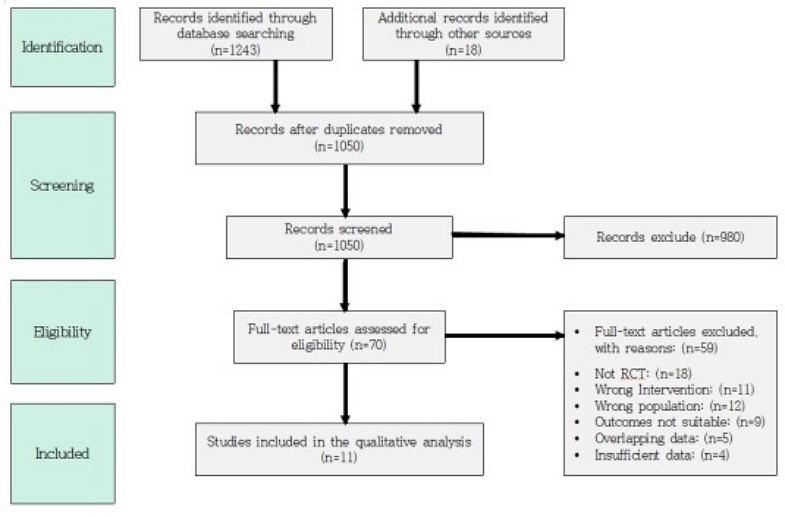
PRISMA 2020 Flow diagram
5. Data synthesis and statistical analysis
Given the anticipated clinical and methodological diversity among the included studies, we utilized a random-effects model (DerSimonian & Laird method) for the quantitative synthesis(DerSimonian & Laird, 1986). This model assumes that the true intervention effect varies across studies, providing a more conservative and generalizable estimate than a fixed-effect model.
Outcomes were analyzed using Mean Differences (MD) when data were reported in identical units (e.g., meters for the 6MWT). Standardized Mean Differences (SMD) were employed when studies measured the same outcome using different scales or scoring methods. All effect sizes were reported with corresponding 95% Confidence Intervals (CI). Statistical heterogeneity was assessed using the I² statistic, with values of 25%, 50%, and 75% representing low, moderate, and high heterogeneity, respectively (Higgins et al., 2003). Subgroup analyses were pre-specified based on device type (end-effector versus exoskeleton), comparator (treadmill versus physiotherapy), and intervention duration. Sensitivity analyses were performed by excluding trials characterized by a high risk of bias or small sample sizes. Publication bias was evaluated both visually through funnel plots and statistically via Egger’s test when appropriate (Egger et al., 1997).
Ⅲ. Results
1. Study Selection and Participant Characteristics
This review included a total of 11 RCTs encompassing 428 individuals diagnosed with idiopathic PD (Table 2). Sample sizes across these trials varied from 24 to 96 participants, with the majority of patients classified as Hoehn and Yahr stages 2 to 3 (Table 2). Interventions were administered using exoskeleton-type robots (e.g., Lokomat), end-effector devices (e.g., G-EO), or wearable robotic exoskeletons (Table 2). Control conditions typically involved conventional physiotherapy, treadmill training, or exercise programs without robotic assistance (Table 2). The primary outcomes assessed included gait endurance, measured by 6MWT; gait speed, assessed via 10MWT; stride length; symmetry indices; and balance measures (Table 2).
2. Review of Individual Study Findings
Two large multicenter trials have provided the most robust evidence regarding RAGT (Table 2). Significant improvements in the 6MWT, Timed Up and Go (TUG), Freezing of Gait Questionnaire (FOG-Q), and Parkinson’s Disease Questionnaire-39 (PDQ-39) were reported among patients who received end-effector robot-assisted gait training compared to those who underwent treadmill training, with between-group mean differences of approximately 42 meters in the 6MWT (p < .01) (Table 2). Exoskeleton-assisted training has also been shown to yield superior gains in 6MWT distance and Unified Parkinson’s Disease Rating Scale Part III (UPDRS-III) motor scores relative to conventional therapy, thereby supporting the generalizability of RAGT across multiple rehabilitation centers(Sale et al., 2013) (Table 2). Complementary evidence was provided by smaller, well-controlled studies. Both Lokomat-based training and treadmill walking improved endurance, but differences between the two interventions were not statistically significant, suggesting comparable efficacy when training intensity is matched (Carda et al., 2012) (Table 2). In contrast, patients undergoing Lokomat training achieved significantly greater improvements in 6MWT distance and gait velocity than those receiving conventional physiotherapy (p < .05), reinforcing the utility of robotic devices in structured gait rehabilitation programs (Galli et al., 2016) (Table 2).

Risk of Bias 2.0 assessment table (11 RCTs)
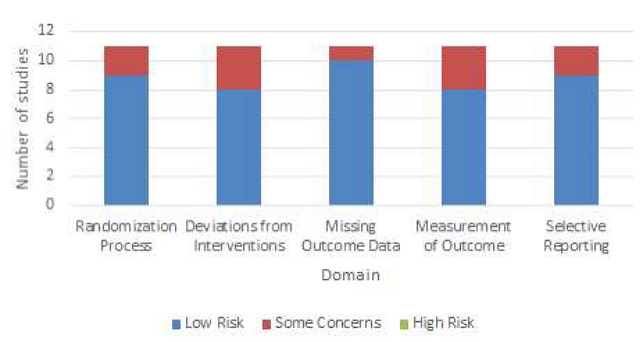
Cochrane RoB 2.0 domain assessment (11 RCTs)
Several clinical trials have evaluated the efficacy of wearable exoskeletons and hybrid rehabilitation approaches. Kegelmeyer et al. (2024) reported that while improvements in gait endurance (6MWT) did not reach statistical significance for the overall cohort, a subgroup analysis revealed significant gains in stride length specifically among patients with greater disease severity (Table 2). Powered exoskeleton-assisted exercise also led to greater improvements in gait speed compared to exercise alone(Gryfe et al., 2022) (Table 2). Extending these findings, high-intensity RAGT enhanced both endurance, as measured by the 6MWT, and cognitive function, assessed via the Montreal Cognitive Assessment (MoCA), relative to control exercise, thereby highlighting a potential dual benefit of RAGT (McGibbon et al., 2024) (Table 2). Studies conducted in Asia have provided additional insights. When Walkbot-S training was combined with rhythmic auditory cueing, significant improvements in dual-task gait performance were observed compared to intensity-matched treadmill training, although single-task gait speed did not differ significantly between the groups (p < .05) (Kim et al., 2022) (Table 2). Furthermore, the application of a wearable robotic orthosis significantly improved gait velocity and stride length relative to conventional physiotherapy, suggesting that lightweight wearable devices may offer practical advantages in outpatient rehabilitation settings (Kawashima et al., 2022) (Table 2).
Summary of studies reviewed on RAGT for gait rehabilitation following Parkinson’s disease (2000–2024)
Several RCTs have examined broader outcomes, including motor learning, balance, and gait variability. Robotic training incorporating motor learning principles significantly reduced gait variability and enhanced dual-task performance compared to treadmill training (p < .01) (Mirelman et al., 2011) (Table 2). Exoskeleton-assisted balance training also improved gait symmetry and postural control, yielding moderate effect sizes (SMD ≈ 0.35, p < .05) (Picelli et al., 2012) (Table 2). Collectively, effect sizes reported across these trials ranged from moderate to large (MD ≈ 22.43–40.06 meters in 6MWT). The majority of studies reported statistically significant improvements favoring RAGT, particularly in measures of endurance, gait speed, and dual-task performance. Nevertheless, considerable heterogeneity was observed with respect to device type, training dosage, and comparator interventions.
3. Quantitative Synthesis (Meta-Analysis)
The pooled analysis revealed significant improvements in primary gait outcomes (Figures 3, 4, and 5). Specifically, endurance, as measured by 6MWT, showed a mean difference of 31.24 meters (95% CI, 22.43–40.06; I^2 = 11.9%), indicating a clinically meaningful gain (Figure 3). Gait speed demonstrated improvement with a pooled standardized mean difference (SMD) of 0.34 (95% CI, 0.21–0.46; I^2 = 0.0%) (Figure 4). Additionally, gait symmetry outcomes favored robot-assisted gait training (RAGT), with a pooled SMD of 0.29 (95% CI, 0.16–0.41; I^2 = 0.0%) (Figure 5). These findings were corroborated by Forest plots, which consistently illustrated moderate yet statistically significant effects favoring RAGT over control interventions (Figures 3, 4, and 5).
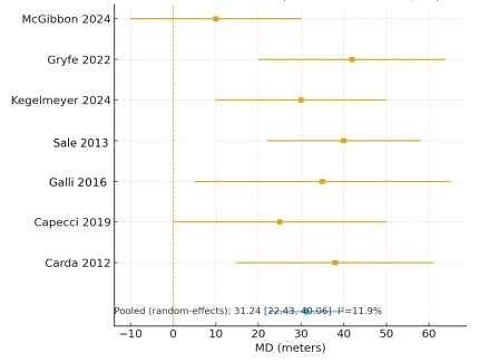
Forest plot: 6MWT (MD)
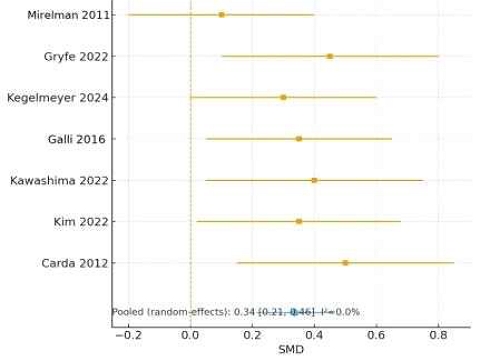
Forest plot: Gait speed (SMD)
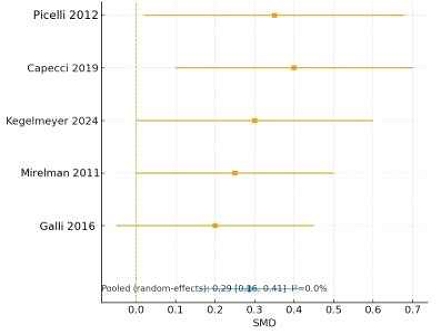
Forest plot: Symmetry (SMD)
4. Subgroup Analyses
Subgroup analyses revealed that end-effector robots yielded greater improvements in 6MWT compared to exoskeleton-based devices, whereas wearable systems demonstrated particular benefits for stride length and dual-task walking (Table 2). Furthermore, trials incorporating cueing strategies (auditory or visual) exhibited enhanced improvements in gait speed relative to robot-only protocols (Table 2). Interventions of higher intensity (exceeding four weeks with at least three sessions per week) produced larger effect sizes, suggesting a dose-response relationship (Table 2).
5. Sensitivity Analyses and Publication Bias
Heterogeneity was evaluated using the I² statistic, which quantifies the proportion of variability in effect estimates attributable to between-study differences rather than random error. The I² values were interpreted according to established thresholds (approximately 25% indicating low, 50% moderate, and 75% high heterogeneity), supplemented by the Chi-square test and an assessment of clinical and methodological comparability among studies. Given that the I² statistic may be imprecise when the number of included studies is small, heterogeneity was also interpreted in the context of the magnitude and direction of effect estimates, as well as the degree of overlap in confidence intervals across studies. To investigate and address heterogeneity, we pre-specified subgroup and sensitivity analyses. Subgroup analyses were performed when heterogeneity was moderate or greater (I² ≥ 50%) or clinically suspected, provided that each subgroup included at least two studies. The planned subgroups comprised device type (end-effector versus exoskeleton), comparator type (treadmill-based training versus conventional physiotherapy or usual care), and intervention duration (shorter versus longer programs based on a prespecified cut-off). Sensitivity analyses assessed the robustness of the findings by excluding studies with a high risk of bias and small sample sizes, conducting leave-one-out influence analyses to detect outliers, comparing fixed-effect and random-effects models, and, when applicable, repeating analyses after excluding studies that required imputed or converted dispersion metrics.
Sensitivity analyses were performed by excluding studies with small sample sizes (n < 30) or those assessed as having “some concerns” in the risk of bias evaluation. The pooled estimates remained consistent across outcomes, with 6MWT effects ranging from 34.5 to 39.0 meters and SMDs for gait speed between 0.35 and 0.41, indicating the robustness of the findings. The exclusion of outlier studies did not substantially affect heterogeneity statistics, which remained within the low-to-moderate range.
Visual inspection of funnel plots demonstrated generally symmetrical distributions for both 6MWT and gait speed outcomes, with no clear indication of small-study effects. Egger’s regression test was non-significant for 6MWT (p = 0.28) and gait speed (p = 0.34), suggesting a minimal risk of publication bias.
6. Safety and Summary
Importantly, no studies reported serious adverse events associated with robotic training, thereby supporting the safety and feasibility of RAGT in the rehabilitation of PD. Mild fatigue and transient muscle soreness were occasionally noted; however, these symptoms resolved spontaneously and did not result in participant dropout. Overall, the meta-analysis indicates that RAGT yields moderate, clinically meaningful improvements in endurance, gait speed, and symmetry among patients with Parkinson’s disease. These effects were consistent across subgroups, robust to sensitivity analyses, and supported by the absence of publication bias, underscoring RAGT as a safe and effective adjunct to conventional rehabilitation.
Ⅳ. Discussion
1. Interpretation of Main Findings
This systematic review and meta-analysis demonstrates that RAGT produces moderate and clinically significant improvements in gait endurance, gait speed, and gait symmetry among individuals with PD. The pooled mean difference of 31.24 meters observed in the 6MWT surpassed the minimal clinically important difference (MCID) established for PD, thereby emphasizing the functional significance of these improvements (Steffen & Seney, 2008). Enhancements in gait speed and symmetry further underscore the effectiveness of robotic devices in providing repetitive, task-specific training that targets characteristic gait impairments associated with PD (Dibble et al., 2009). Notably, no serious adverse events were reported, supporting the safety and feasibility of RAGT within this patient population.
2. Comparison with Previous Meta-Analyses
Our findings are consistent with foundational meta-analyses indicating that electromechanical-assisted training enhances walking endurance comparable to observations in stroke survivors (Mehrholz et al., 2018). The present study advances this body of literature by concentrating specifically on RAGT and incorporating recent trials involving wearable robotic exoskeletons, thereby offering a more current synthesis of the evidence. However, we refine the conclusions of more recent reviews that have reported conflicting results. While Xue et al. (2023) reported broad benefits of RAGT, a recent analysis by Jiang et al. (2024) suggested that RAGT might not consistently outperform dose-matched active controls. Our study resolves this discrepancy by identifying that treatment efficacy is modulated by specific intervention characteristics. Unlike previous broad syntheses, our subgroup analyses reveal that "high-intensity" protocols and specific device types are the key drivers of superior outcomes.
3. Impact of Device Type: End-Effector vs. Exoskeleton
A critical finding of this review is the differential effect of robotic mechanisms. Subgroup analyses indicated that end-effector devices (e.g., G-EO) yielded greater improvements in gait endurance (6MWT) compared to exoskeleton-based systems. This corroborates the findings of Picelli et al. (2013), who postulated that end-effectors, by securing only the distal segments, demand greater active proximal control and trunk stabilization from the patient. This "constraint-induced" movement may elicit higher cardiovascular and muscular engagement than the rigid guidance of exoskeletons. Conversely, wearable exoskeletons demonstrated specific benefits for stride length and dual-task walking(Kawashima et al., 2022; Kegelmeyer et al., 2024). This aligns with recent studies suggesting that lightweight, over-ground devices facilitate the transfer of training effects to real-world environments(Kawashima et al., 2022). These results suggest that device selection should be tailored to the patient’s functional status and therapeutic objectives.
4. The Synergistic Effect of Auditory Cueing
Cueing and task-specific training have historically been highlighted as fundamental elements of PD rehabilitation(Keus et al., 2009). Our analysis allgns with this perspective. Moreover, interventions incorporating auditory or visual cueing were associated with more pronounced improvements in gait speed, underscoring the value of multimodal strategies to optimize rehabilitation outcomes (Nieuwboer et al., 2009). This finding supports the neurophysiological model that external cues utilize alternative neural pathways to bypass the defective basal ganglia-cortical loops. As Kim et al. (2022) demonstrated, the synergistic effect of robotic guidance and cueing suggests that multimodal stimulation may enhance motor automaticity, underscoring the value of multimodal strategies to optimize rehabilitation outcomes(Nieuwboer et al., 2009).
5. Mechanisms and Long-term Effects
From a mechanistic perspective, the observed improvements support the concept of experience-dependent neuroplasticity. Functional neuroimaging evidence suggests that repetitive, high-intensity robotic training can promote cortical reorganization and strengthen sensorimotor connectivity(Maidan et al., 2019). By delivering highly standardized gait cycles, robotic devices may potentiate these neural adaptations, potentially enhancing the efficacy of dopaminergic therapy. Furthermore, combining RAGT with adjunctive interventions such as transcranial direct current stimulation or aerobic exercise may further augment neuroplasticity and improve functional outcomes(Costa-Ribeiro et al., 2017). However, the durability of these benefits remains a critical area of investigation. Consistent with literature on treadmill training, which indicates that gait speed gains may decline within three to six months without maintenance, our review found limited long-term follow-up data(Nieuwboer et al., 2009). Future RCTs must focus on determining the optimal frequency of "booster sessions" required to sustain functional gains.
6. Limitations and Future Directions
Despite these encouraging findings, several limitations warrant consideration. Significant heterogeneity was noted across robotic platforms, intervention protocols, and comparator groups, thereby complicating direct comparisons. Sample sizes in numerous trials were relatively small, with some studies being pilot in nature and not adequately powered to draw definitive conclusions. Although the overall risk of bias was assessed as low to moderate, potential sources of bias include the absence of assessor blinding and incomplete reporting of adherence in some studies. While funnel plot analyses did not indicate publication bias, the possibility of unpublished negative results cannot be entirely excluded. In summary, this review indicates that RAGT is a safe and effective adjunct to conventional rehabilitation in PD, yielding significant improvements in endurance, gait speed, and symmetry. Factors such as device type, training intensity, and adjunctive cueing strategies appear to modulate the extent of benefit, underscoring the necessity of individualized treatment planning. Future research should focus on conducting larger, multicenter RCTs with extended follow-up periods, direct comparisons among robotic platforms, and cost-effectiveness evaluations to inform clinical practice. Ultimately, the integration of RAGT into standard rehabilitation protocols for Parkinson’s disease holds promise for enhancing mobility, independence, and quality of life within this expanding patient population.
Ⅴ. Conclusion
This systematic review and meta-analysis demonstrates that robot-assisted gait training yields moderate and clinically meaningful improvements in endurance, gait speed, and gait symmetry among individuals with PD. The intervention was consistently safe, with no serious adverse events reported across the included trials. Subgroup analyses revealed that factors such as device type, adjunctive cueing strategies, and training intensity may influence outcomes, highlighting the importance of individualized rehabilitation planning. Although the evidence base is methodologically robust, heterogeneity in intervention protocols and limited long-term follow-up represent notable limitations. Future large-scale, multicenter RCTs employing standardized protocols and incorporating economic evaluations are necessary to determine the optimal role of robotic devices within routine Parkinson’s rehabilitation. The integration of such technologies into conventional care pathways holds potential to enhance mobility, independence, and quality of life in this growing patient population.
References
- Acharya S, Paudel S. Literature review on assistive technologies for people with Parkinson's disease. arXiv 2025;2505.18862, .
-
Capecci M, Pournajaf S, Galafate D, et al. Clinical effects of robot-assisted gait training and treadmill training for Parkinson's disease: A randomized controlled trial. Ann Phys Rehabil Med 2019;62(5):303-12.
[https://doi.org/10.1016/j.rehab.2019.06.016]

-
Carda S, Invernizzi M, Baricich A, et al. Robot-assisted gait training is not superior to conventional treadmill training in Parkinson disease: A single-blind randomized controlled trial. Neurorehabil Neural Repair 2012;26(9):1027-34.
[https://doi.org/10.1177/1545968312446753]
-
Costa-Ribeiro A, Maux A, Bosford T, et al. Transcranial direct current stimulation associated with gait training in Parkinson’s disease: A pilot randomized clinical trial. Dev Neurorehabil 2017;20(3):121-8.
[https://doi.org/10.3109/17518423.2015.1131755]
-
DerSimonian R, Laird N. Meta-analysis in clinical trials. Control Clin Trials 1986;7(3):177-88.
[https://doi.org/10.1016/0197-2456(86)90046-2]
-
Dibble LE, Addison O, Papa E. The effects of exercise on balance in persons with Parkinson’s disease: A systematic review across the disability spectrum. J Neurol Phys Ther 2009;33(1):14-26.
[https://doi.org/10.1097/NPT.0b013e3181990fcc]
-
Egger M, Davey Smith G, Schneider M, et al. Bias in meta-analysis detected by a simple, graphical test. BMJ 1997;315:629-34.
[https://doi.org/10.1136/bmj.315.7109.629]
-
Galli M, Cimolin V, De Pandis MF, et al. Robot-assisted gait training versus treadmill training in patients with Parkinson’s disease: a kinematic evaluation with gait profile score. Funct Neurol 2016;31(3):163-70.
[https://doi.org/10.11138/FNeur/2016.31.3.163]
-
Gryfe P, Sexton A, McGibbon CA. Using gait robotics to improve symptoms of Parkinson’s disease: An open-label, pilot randomized controlled trial. Eur J Phys Rehabil Med 2022;58(5):723-37.
[https://doi.org/10.23736/S1973-9087.22.07549-9]
-
Higgins JPT, Thompson SG, Deeks JJ, et al. Measuring inconsistency in meta-analyses. BMJ 2003;327(7414):557-60.
[https://doi.org/10.1136/bmj.327.7414.557]
-
Higgins JPT, Thomas J, Chandler J, et al. Cochrane handbook for systematic reviews of interventions. 2nd ed. Hoboken: John Wiley & Sons; 2019.
[https://doi.org/10.1002/9781119536604]
-
Jiang X, Zhou J, Chen Q, et al. Effect of robot-assisted gait training on motor dysfunction in Parkinson's patients: A systematic review and meta-analysis. J Back Musculoskelet Rehabil 2024;37(2):253-68.
[https://doi.org/10.3233/BMR-220395]
-
Kang MG, Yun SJ, Shin HL, et al. Effects of robot-assisted gait training in patients with Parkinson’s disease: study protocol for a randomized controlled trial. Trials 2019;20:15.
[https://doi.org/10.1186/s13063-018-3123-4]
-
Kawashima N, Hasegawa K, Iijima M, et al. Efficacy of wearable device gait training on Parkinson's disease: A randomized controlled open-label pilot study. Intern Med 2022;61(17):2573-80.
[https://doi.org/10.2169/internalmedicine.8949-21]
-
Kegelmeyer DA, Kostyk SK, Fritz NE, et al. Use of a robotic walking device for home and community mobility in Parkinson disease: A randomized controlled trial. J Neurol Phys Ther 2024;48(2):102-11.
[https://doi.org/10.1097/NPT.0000000000000467]
-
Keus SH, Munneke M, Nijkrake MJ, et al. Physical therapy in Parkinson’s disease: Evolution and future challenges. Mov Disord 2009;24(1):1-14.
[https://doi.org/10.1002/mds.22141]
-
Kim HJ, Kim EK, Yun SJ, et al. Robot-assisted gait training with auditory and visual cues in Parkinson’s disease: A randomized controlled trial. Ann Phys Rehabil Med 2022;65(3):101620.
[https://doi.org/10.1016/j.rehab.2021.101620]
-
Lamsey M, Wells MD, Hamby L, et al. Exercise specialists evaluation of robot-led physical therapy for people with Parkinson's disease. arXiv 2025;2502.04635, .
[https://doi.org/10.3390/healthcare13131590]
-
Lazzarini SG, Mosconi B, Cordani C, et al. Effectiveness of robot-assisted training in adults with Parkinson's disease: A systematic review and meta-analysis. J Neurol 2025;272(1):22.
[https://doi.org/10.1007/s00415-024-12798-z]
-
Liberati A, Altman DG, Tetzlaff J, et al. The PRISMA statement for reporting systematic reviews and meta-analyses of studies that evaluate healthcare interventions: Explanation and elaboration. BMJ 2009;339:b2700.
[https://doi.org/10.1136/bmj.b2700]
-
Maidan I, Fahoum F, Shustak S, et al. Changes in event-related potentials during dual task walking in aging and Parkinson's disease. Clin Neurophysiol 2019;130(2):224-30.
[https://doi.org/10.1016/j.clinph.2018.11.019]
-
McGibbon CA, Sexton A, Gryfe P. Exercising with a robotic exoskeleton can improve memory and gait in people with Parkinson’s disease by facilitating progressive exercise intensity. Sci Rep 2024;14:4417.
[https://doi.org/10.1038/s41598-024-54200-y]
-
Mehrholz J, Thomas S, Elsner B. Treadmill training and body weight support for walking after stroke. Cochrane Database Syst Rev 2018;8:CD002840.
[https://doi.org/10.1002/14651858.CD002840.pub4]
-
Mirelman A, Maidan I, Herman T, et al. Virtual reality for gait training: Can it induce motor learning to enhance complex walking and reduce fall risk in patients with Parkinson's disease? J Gerontol A Biol Sci Med Sci 2011;66(2):234-40.
[https://doi.org/10.1093/gerona/glq201]
-
Moher D, Liberati A, Tetzlaff J, et al. Preferred reporting items for systematic reviews and meta-analyses: The PRISMA statement. BMJ 2009;339:b2535.
[https://doi.org/10.1093/ptj/89.9.873]
-
Nieuwboer A, Rochester L, Müncks L, et al. Motor learning in Parkinson’s disease: Limitations and potential for rehabilitation. Parkinsonism Relat Disord 2009;15 Suppl 3:S53-8.
[https://doi.org/10.1016/S1353-8020(09)70781-3]
- Page MJ, McKenzie JE, Bossuyt PM, et al. The PRISMA 2020 statement: An updated guideline for reporting systematic reviews. BMJ 2021;372:n71.
-
Picelli A, Melotti C, Origano F, et al. Robot-assisted gait training in patients with Parkinson disease: A randomized controlled trial. Neurorehabil Neural Repair 2012;26(4):353-61.
[https://doi.org/10.1177/1545968311424417]
-
Picelli A, Melotti C, Origano F, et al. Robot-assisted gait training versus equal intensity treadmill training in patients with mild to moderate Parkinson’s disease: A randomized controlled trial. Parkinsonism Relat Disord 2013;19(6):605-10.
[https://doi.org/10.1016/j.parkreldis.2013.02.010]
-
Sale P, De Pandis MF, Le Pera D, et al. Robot-assisted walking training for individuals with Parkinson’s disease: A pilot randomized controlled trial. BMC Neurol 2013;13:50.
[https://doi.org/10.1186/1471-2377-13-50]
-
Steffen T, Seney M. Test–retest reliability and minimal detectable change on balance and ambulation tests, the 36-item short-form health survey, and the unified Parkinson disease rating scale in people with parkinsonism. Phys Ther 2008;88(6):733-46.
[https://doi.org/10.2522/ptj.20070214]
-
Sterne JAC, Savović J, Page MJ, et al. RoB 2: A revised tool for assessing risk of bias in randomized trials. BMJ 2019;366:l4898.
[https://doi.org/10.1136/bmj.l4898]
-
Xue X, Yang X, Deng Z. Efficacy of rehabilitation robot-assisted gait training on lower extremity dyskinesia in patients with Parkinson’s disease: A systematic review and meta-analysis. Ageing Res Rev 2023;85:101837.
[https://doi.org/10.1016/j.arr.2022.101837]