
3D 동작 인식 엑서게임 훈련이 뇌졸중 환자의 균형 및 인지기능에 미치는 영향
© 2026 by the Korean Physical Therapy Science
Abstract
This study aimed to investigate the effects of 3D motion recognition exergame training on balance and cognitive function in stroke patients.
Randomized Controlled Trial(RCT)
This study employed a randomized controlled trial design. A total of 30 individuals with stroke were allocated to either a 3D exergame group or a conventional physical therapy group using a computer-based randomization procedure, with 15 participants in each group. For balance assessment, PhysioSensing Solution III was used to measure area of movement, weight distribution, and limits of stability, while cognitive function was evaluated using the Korean version of the Montreal Cognitive Assessment(K-MoCA) to assess total scores. The intervention lasted for 8 weeks, conducted 5 days per week. Paired t-tests were used for within-group analysis, and ANCOVA was applied for between-group analysis.
Significant improvements were observed in both groups for area of movement, weight distribution, and limits of stability(p<0.05). However, in the between-group analysis, the 3D exergame group showed significantly greater improvements compared to the conventional physical therapy group(p<0.05). Regarding cognitive function, only the 3D exergame group showed a statistically significant improvement(p<0.05), whereas no significant change was observed in the conventional physical therapy group.
This study confirmed that 3D exergame training is an effective intervention for improving balance and cognitive function in stroke patients. Notably, the 3D exergame group demonstrated greater improvements in balance and showed significant cognitive function enhancement compared to the conventional physical therapy group. These findings suggest that 3D exergames may serve as an effective alternative for stroke rehabilitation, and further research with diverse patient populations is warranted.
Keywords:
Balance, Cognitive. Exergame, Stroke, 3D Motion RecognitionⅠ. 서 론
뇌졸중은 매년 전 세계적으로 약 1,200만 명에서 발생하며, 사망 원인 중 2위를 차지한다(GBD 2019 Stroke Collaborators, 2021). 뇌졸중은 뇌혈관의 출혈 및 경색으로 인해 신경학적 문제가 발생하는 중추신경계 질환이며, 손상 부위와 크기에 따라 근력 약화, 근긴장도 이상, 운동 조절 장애, 경직, 편측무시, 편마비 등의 문제가 발생한다(Lee 등, 2020; Triandafilou과 Kamper, 2012). 특히 약 80저널명 약어로 수정하세요%의 환자가 운동 장애로 인해 균형 능력과 보행 능력에 어려움을 겪으며(Langhorne 등, 2009), 이러한 신체적 기능 문제는 일상생활 활동에 어려움을 초래한다(Beyaert 등, 2015).
균형은 신체가 움직이는 동안에도 지지면 내에서 중심을 안정적으로 조절하는 능력으로, 효과적인 운동 수행과 안전성을 위해 필수적인 신체적 요소이다(Haddas 등, 2019). 그러나 뇌졸중 환자는 균형 능력 저하로 인해 비대칭적인 체중 지지와 자세의 흔들림이 심하게 나타나며(Shen 등, 2023; Sonavane과 Limaye, 2020), 매년 약 40%는 낙상을 경험하게 된다(Punt 등, 2017). 또한 뇌졸중 환자는 인지기능에도 장애가 나타난다(O'Sullivan 등, 2019).
인지기능에 문제가 있는 환자는 기억력, 사고력, 언어력, 집중력, 판단력, 및 학습 능력이 저하되어, 자기조절 능력과 동작 수행에 문제가 발생하며(Yang 등, 2020), 환자는 정보 처리 능력의 감소로 인해 보행 및 균형에도 영향을 미치게 된다(Baydan 등, 2019). 특히 균형 및 보행 능력은 신체적 기능뿐만 아니라 주의력, 계획 능력, 정보 처리 속도 등의 다양한 인지적 요소들이 필수적이다(Pal 등, 2016). 인지기능이 저하된 환자는 환경 변화에 적응하기 어렵고, 보행 중 복잡한 동작을 수행하거나 장애물을 피하는 데 어려움을 겪는다(Song, 2023). 또한 균형 능력과 보행 능력이 저하된 뇌졸중 환자는 이중과제 수행 시 더욱 두드러지며, 이는 인지적 부하가 운동 조절에 필요한 자원을 제한하기 때문이다(Plummer 등, 2013). 따라서 인지 재활은 균형 및 보행 회복에 중요한 역할을 한다(Chiaramonte 등, 2022). 또한 뇌졸중 환자 재활에 있어 긍정적인 결과를 위해서는 환자의 참여가 필수적이다(Trombetta 등, 2017). 최근에는 환자의 적극적인 치료 참여와 기능 회복을 위해 신체적 움직임과 비디오 게임을 결합한 엑서게임 훈련이 제시되고 있다(Huang 등, 2017; Sin과 Lee, 2013).
엑서게임은 동작 인식 센서를 사용하여 사용자의 움직임을 감지하고, 신체와의 물리적 상호작용을 촉진하는 비디오 게임이다(Van Santen 등, 2018). 엑서게임은 통합적이고 자극적인 특성으로 인해 환자의 흥미를 유발하고 몰입감 높은 환경을 제공하여 기능 회복에 동기를 부여할 수 있다. 특히 시각적·청각적 피드백은 치료 효과와 환자의 참여도를 높이며(Popović 등, 2014), 엑서게임은 반복적인 고강도 훈련, 팔다리 훈련, 피드백 제공, 자가통제 연습이 가능하다(Choi 등, 2016). 또한 엑서게임은 운동 기능을 향상시키는 데 효과적이다(Choi 등, 2016; Trombetta 등, 2017). 선행 연구에 의하면 Sun과 Chen(2020)은 파킨슨 환자 60명을 대상으로 SilverFit 시스템을 이용한 엑서 게임을 12주 동안 적용하여 균형 능력, 운동 능력에 유의미한 효과가 있다고 하였으며, Santos 등(2015)은 노인을 대상으로 센서를 활용한 게임 기반 운동을 적용하였을 때, 근력 및 균형에 효과가 있다고 보고하였다.
뇌졸중 발병률은 고령화와 함께 매년 증가하고 있으며, 이에 따라 다양한 중재 방법이 제시되고 있다. 특히 뇌졸중 환자에게 엑서게임은 효과적인 치료방법으로 제시되고 있다. 그러나 엑서게임 관련 연구는 이루어지고 있지만, 아직까지 임상적 연구는 부족한 실정이다. 따라서 본 연구의 목적은 뇌졸중 환자를 대상으로 3D 동작 인식 엑서게임 훈련이 균형 및 인지기능에 미치는 효과를 검증하는 것이다.
Ⅱ. 연구방법
1. 연구대상
본 연구는 전라남도 M시에 위치한 OO병원에서 뇌졸중 진단을 받고 회복을 위해 입원 중인 뇌졸중 환자 30명을 대상으로 실시되었다. 연구대상자의 선정기준은 뇌졸중 진단을 받고 1년 미만인 자, 도움 없이 15초 동안 서 있을 수 있으며 자세 교란이 2번 이상 가능한 자, 간이정신상태 검사 점수 24점 이상인 자로 소통이 가능한 자로 하였다. 뇌졸중 외 다른 신경학적 문제가 있는 자, 관절 질환이 있는 자, 지시사항을 따르지 못하는 자는 제외하였다. 본 연구 참여 전에 연구에 대한 구체적인 설명 후 실험에 참여하고자 동의서에 서명한 자를 대상자로 하였다. 연구 대상자는 컴퓨터 생성 난수표를 사용하여 홀수는 3D 동작 인식 엑서게임 그룹(n=15)으로 짝수는 일반적인 물리치료 그룹(n=15)으로 무작위 배정하였다.
2. 측정 도구 및 방법
균형 측정은 PhysioSensiong solutionⅢ(RM Ingenierie, Portugal)을 사용하여 이동면적 (surface area ellipse, SA), 체중 분배율 (weight distribution, WD), 안정성 한계 (limited of stability, LOS)를 측정하였다. 본 장비는 컴퓨터와 모니터, 사각형 모양의 기립용 발판(61.0cm × 58.0cm × 1.0cm)으로 구성되어 있다. 발판에는 총 1600개의 압력 감지 센서가 있으며, 균형 능력과 체중 지지 대칭성도 측정이 가능하다(Ma 등, 2016). 이동면적은 중력 중심점(center of pressure, COP)이 이동한 경로를 기준으로 계산된 타원형의 면적으로, 측정값이 작을수록 체간 안정성이 우수함을 의미한다(Strang 등, 2011). 체중분배율은 양발에 체중이 분배된 비율로, 양쪽 비율이 50%에 가까운 값은 체중분배가 균등하다는 것을 의미한다(St-Amant, 2019). 안정성 한계는 중력중심점을 이동하여 측정한 최대 범위를 의미하며, 측정 값이 증가할수록 균형 유지 능력이 우수하다는 것을 의미한다(Jo 등, 2014). 측정하기 전 방법과 절차를 설명 후 시범을 통해 사전 교육을 진행하였다. 균형 측정을 위해 대상자는 60초 동안 두 발로 서서 중력중심점 이동 면적과 체중 분배율을 측정하였으며, 모니터에 표시된 8개의 방향으로 체중 이동을 통해 중심점 거리를 측정하여 안정성 한계를 측정하였다. 모든 평가는 3회 측정 후 평균값을 결과값으로 하였다(Rodrigues 등, 2022)(Figure 1).
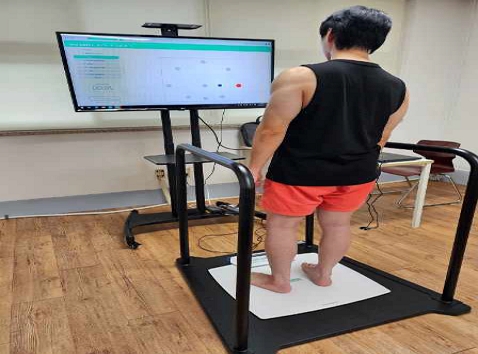
PhysioSensiong SolutionⅢ
인지기능 측정은 한국형 몬트리올 인지평가(Korean version of montreal cognitive assessment, K-MoCA,)를 사용하여 측정하였다. 이 평가지는 Nasreddine 등(2005)이 개발한 MoCA를 Lee 등(2008)이 한국의 문화와 특성에 맞게 수정 보완한 것이다. 평가는 총 7개로 구성되며, 시공간/집행기능(5점), 이름 대기(3점), 주의력(6점), 언어력(3점), 추상력(2점), 지연 회상(5점), 지남력(6점)을 평가한다(Khaw 등, 2021). 총 30점 만점이며, 컷오프 값 22/23점 적용 시 특이도 70%, 민감도 82%라고 하였으며 신뢰도는 0.75이다(Salvadori 등, 2022; Potocnik 등, 2020).
3. 중재 방법 및 절차
본 연구에서 실험군은 일반적인 물리치료를 30분 실시 후 추가로 3D 동작 인식 엑서게임 훈련을 30분 실시하였으며, 대조군은 일반적인 물리치료를 30분 씩 2회 실시하였다. 각 그룹의 중재 시간은 60분으로 동일하며 연구는 주 5일, 8주간 진행하였다.
3D 동작 인식 엑서게임 훈련은 3차원 대근육 운동 및 일상생활 동작 훈련 시스템(SilverFit 3D, SilverFit BV, Netherlands)을 사용하였다(Figure 2). 이 장비는 3D 동작 감지 카메라와 시각적 피드백을 제공하기 위한 디스플레이로 구성되며, 소프트웨어를 통해 27가지 이상의 훈련과 3개의 임상적 평가가 가능하다(Van der Kooij 등, 2019). 또한 3D 동작 감지 카메라로 대상자의 움직임을 감지하여 디스플레이에 출력된 게임을 플레이하며, 다양한 훈련 프로그램을 통한 실시간 피드백으로 대상자의 흥미를 유발하고, 지속적 훈련을 제공하며, 근력, 균형, 보행 및 인지기능을 향상시킬 수 있다(Skjæret 등, 2015). 훈련은 화면에 나타나는 두더지를 잡기 위해 신체를 앞으로 기울이거나 움직이는 게임과, 특정 숫자가 나타날 때마다 참가자가 해당하는 숫자에 이동하도록 하는 산술 게임으로 진행하였다(Piech과 Czernicki, 2021: Stanmore 등, 2019)
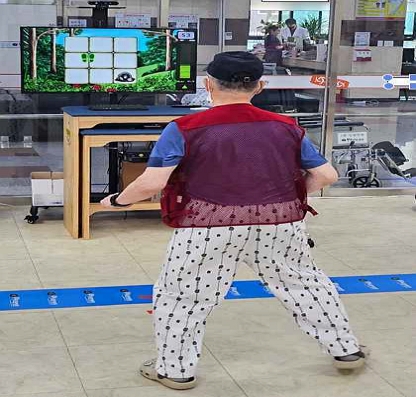
Silverfit 3D
일반적인 물리치료는 임상에 있는 5년차 이상의 물리치료사 4명이 참여하여 실시하였다. 치료는 30분 동안 매트 위에서 관절 가동 범위 운동, 근력 강화 운동, 자세 조절 훈련, 일상생활동작 훈련 및 스트레칭 순으로 진행하였다. 관절 가동 범위 운동은 관절의 유연성 향상을 위해 수동 및 능동으로 마비측 관절의 굽힘과 폄 동작을 실시하였다. 근력 강화 운동은 무릎 및 엉덩 관절의 굽힘과 폄, 누운 자세에서 다리 들기, 교각 운동, 앉았다 일어서기를 실시하였으며, 자세 조절 훈련은 마비측 하지에 무게 중심을 이동시킨 후 균형을 유지하도록 하였다. 또한 치료사의 도움하에 한 발 서기 연습도 함께 실시하였다. 일상생활훈련은 기능적 동작의 개선을 위해 앉기, 걷기 및 일어서기 등의 동작을 수행하였으며, 마지막으로 근육 긴장의 완화 및 유연성 증진을 위해 스트레칭을 실시하였다.
4. 자료 분석
본 연구에서 수집된 자료는 SPSS 29.0 for Windows 프로그램을 이용하여 분석하였다. 대상자의 일반적 특성은 Levene의 등분산 검정(Levene's test)을 통해 동질성을 확인하였으며, 등분산이 성립된 변수는 추가로 독립표본 t-검정(independent t-test)을 통해 집단 간 동질성을 확인하였다. 각 집단의 정규성 검정은 Shapiro-Wilk 검정을 사용하였으며 두 집단 내 균형 및 인지기능 분석은 대응표본 t-검정(paired t-test)을 시행하였고, 두 집단 간 균형 및 인지기능을 비교하기 위해 공분산 분석(ANCOVA)을 실시하였다. 공분산 분석의 공변량은 각 변수의 사전 측정값으로 설정하였으며, 집단 간 비교는 사후 측정값을 기준으로 분석하였다. 통계적 유의수준은 α=.05로 하였다.
Ⅲ. 연구결과
1. 연구대상자의 일반적 특성
본 연구는 뇌졸중 환자 30명을 대상으로 실시되었으며, 대상자의 일반적인 특성은 다음과 같다. 연령은 실험군 74.09±2.81세, 대조군 73.27±3.52세, 신장은 실험군 159.45±2.59㎝, 대조군 162.54±4.01㎝, 몸무게는 실험군 60.68±3.37㎏, 대조군 55.54±4.51㎏, 유병기간은 실험군 6.33±1.83개월, 대조군 6.20±2.24개월로 나타났다<Table 1>.

General characteristics of subjects(n=30)
2. 집단 내 중재에 따른 변화
집단 내 중재 전·후 비교 결과, 실험군과 대조군 모두 이동 면적, 체중 분배율, 안정성 한계 항목에서 통계적으로 유의한 차이가 있었으며(p<0.05), 인지기능은 실험군에서만 유의한 차이가 있었다<Table 2>.
Change according to intervention within the group (n=30)
Ⅳ. 고 찰
고령화로 인해 근골격계와 신경계를 포함한 다양한 병변이 빈번히 발생하고 있으며, 이에 따른 예방과 치료 방안의 중요성이 강조되고 있다. 특히 뇌졸중은 전 세계적으로 발병률이 지속해서 증가하고 있으며, 주요 사망 원인 중 하나로 세계에서 두 번째로 높은 비중을 차지하고 있다. 이러한 배경에서 뇌졸중 환자에 대한 치료와 관련된 연구가 주목받고 있다.
본 연구는 뇌졸중 환자 30명을 대상으로 3D 동작 인식 엑서게임 훈련을 적용하여, 균형 능력 및 인지기능에 대한 효과를 검증하고자 하였다. 본 연구는 3차원 대근육운동 및 일상생활동작 훈련 시스템 장비를 사용하여, 훈련을 중재하였다. 본 연구에서는 균형 능력 측정을 위해 PhysioSensiong SolutionⅢ 장비를 사용하였으며, 집단 내 중재 전·후 분석 결과 3D 동작 인식 엑서게임 훈련 그룹과 일반적인 물리치료 그룹 모두 이동 면적, 체중 분배율, 안정성 한계에서 통계적으로 유의한 차이가 있었으며(p<.05), 그룹 간 분석 결과에서 3D 동작 인식 엑서게임 훈련 그룹이 일반적인 물리치료 그룹에 비해 균형 능력이 향상되었으며, 통계적으로 유의한 차이가 있었다(p<.05). Stanmore 등(2019)은 노인 106명을 대상으로 12주간 SilverFit 3D를 이용한 엑서게임 훈련을 중재하였으며, 그 결과 균형 능력과 낙상 예방에 효과적이라고 보고하였으며, Luo 등(2021)은 뇌졸중 환자 30명을 대상으로 8주간 SilverFit을 적용한 가상현실 훈련을 중재하여 효과를 검증하고자 하였으며, 그 결과 균형 능력, 보행 기능에 효율적이라고 보고하였다. Rodríguez-Almagro 등(2024)은 노인 20명을 대상으로 6주간 SilverFit을 이용해 훈련을 중재하였으며, 그 결과 균형 능력 개선에 도움이 된다고 보고하였다. 이는 본 연구와 유사한 결과를 보이고 있다. 3D 동작 인식 엑서게임 훈련 그룹의 균형 능력이 크게 향상된 것은 체계적인 과제 수행 과정에서 동작 계획과 반복적인 실행이 이루어진 데 기인한 것으로 보인다. 이 과정에서 고유 감각이 지속적으로 활성화됨으로써, 보다 정교한 움직임 조절이 가능해졌으며, 신체의 생체역학적 요구가 충족되어 균형 능력과 안정성이 향상된 것으로 생각된다.
본 연구에서는 인지기능 측정을 위해 한국형 몬트리올 인지평가(K-MoCA)를 사용하였으며, 집단 내 중재 전·후 분석 결과 3D 동작 인식 엑서게임 훈련 그룹에서 인지기능 점수에 통계적으로 유의한 차이가 있었으며(p<.05), 그룹 간 분석 결과에서 3D 동작 인식 엑서게임 훈련 그룹이 일반적인 물리치료 그룹에 비해 인지기능 점수가 향상되었으며, 통계적으로 유의한 차이가 있었다(p<.05). Park과 Ha(2023)는 뇌졸중 환자 30명을 대상으로 8주간 가상현실 기반 인지 재활 훈련을 중재하였으며, 그 결과 인지기능, 시각적 인지, 일상생활 수행능력 및 삶의 질에 효과가 있다고 보고하였으며, Yang 등(2022)은 경도 인지 장애가 있는 노인을 대상으로 12주간 가상현실 훈련을 통해 기억력, 주의력, 집행 기능에 효과를 검증하고자 하였으며, 그 결과 인지기능 향상에 변화가 있다고 보고하였다. Piech과 Czernicki(2021)은 노인을 대상으로 SilverFit을 사용한 운동을 중재하였으며, 그 결과 주의력과 기억력에 긍정적인 효과가 있다고 보고 하였으며, 특히 몰임감과 실시간 피드백을 통해 인지기능을 효율적으로 자극할 수 있다고 하였다. 이는 본 연구와 유사한 결과를 보이고 있다. 본 연구에서 3D 동작 인식 엑서게임 그룹의 집중력과 주의력이 높아지고, 기억력이 자극된 것은 훈련 중 제공된 실시간 피드백과 몰입감 높은 게임 환경의 영향으로 생각된다. 실시간 피드백은 대상자가 목표를 달성하거나 동작을 수행할 때 즉각적인 시각적 및 청각적 자극을 제공하여, 동작을 수정하고 학습을 유도에 중요한 역할을 한다. 이러한 기전은 선행 연구들과 유사하다. 또한 엑서게임 훈련은 문제 해결과 시퀀스 학습(sequence learning)을 포함하여 기억력을 자극하는 효과가 있다. 또한 특정 동작을 반복하거나, 정해진 순서에 맞춰 목표를 달성하는 훈련 과정은 기억력과 작업 기억을 활성화하는 데 기여한 것으로 생각된다.
본 연구 결과 3D 동작 인식 엑서게임 훈련은 뇌졸중 환자의 균형 및 인지기능에 효율적임을 확인하였다. 본 연구의 제한점은 연구 기간이 짧고, 대상자의 수가 적으며, 모든 환자에게 일반화 하기 어려우며, 각 환자에게 동일한 훈련 제공에 제한이 있다. 또한 뇌졸중 환자를 대상으로 하였기 때문에 다른 환자에 대한 효과가 불확실하다. 따라서 향후 연구에서는 연구 기간가 대상자의 수를 늘리고 다른 질환을 가지고 있는 환자에게 제공하여, 균형 및 인지기능에 대한 다양한 연구가 필요할 것으로 사료된다.
Ⅴ. 결 론
본 연구는 3D 동작 인식 엑서게임 훈련이 뇌졸중 환자의 균형 및 인지기능에 대한 변화를 알아보고자 실시하였다. 본 연구 결과 3D 동작 인식 엑서게임 훈련 그룹과 일반적인 물리치료 그룹 모두 균형 및 인지기능에 유의미한 차이가 나타났다. 특히 그룹 간 비교에서 3D 동작 인식 엑서게임 훈련 그룹이 일반적인 물리치료 그룹에 비해 큰 변화를 보이며, 통계적으로 유의한 차이가 나타났다. 이러한 결과는 바탕으로 뇌졸중 환자에게 3D 동작 인식 엑서게임 훈련은 균형 및 인지기능에 효율적이며 임상적으로 가치가 있다고 사료된다.
References
- Baydan M, Caliskan H, Balam-Yavuz B, et al. Balance and motor functioning in subjects with different stages of cognitive disorders. Exp Gerontol. 2019;110785-110785.
-
Beyaert C, Vasa R, Frykberg GE. Gait post-stroke: Pathophysiology and rehabilitation strategies. Neurophysiol Clin. 2015;45(4-5):335-355.
[https://doi.org/10.1016/j.neucli.2015.09.005]

-
Chiaramonte R, Bonfiglio M, Leonforte P, et al. Proprioceptive and dual-task training: the key of stroke rehabilitation, a systematic review. J Funct Morphol Kinesiol. 2022;7(3):53.
[https://doi.org/10.3390/jfmk7030053]
-
Choi YH, Ku J, Lim H, et al. Mobile game-based virtual reality rehabilitation program for upper limb dysfunction after ischemic stroke. Restor Neurol Neurosci. 2016;34(3):455-463.
[https://doi.org/10.3233/RNN-150626]
- GBD 2019 Stroke Collaborators. Global, regional, and national burden of stroke and its risk factors, 1990–2019: a systematic analysis for the Global Burden of Disease Study 2019. Lancet Neurol. 2021;(21)00252-0.
-
Haddas R, Lieberman I, Boah A, et al. Functional balance testing in cervical spondylotic myelopathy patients. Spine. 2019;44(2):103-109.
[https://doi.org/10.1097/BRS.0000000000002768]
-
Huang HC, Wong MK, Lu J, et al. Can using exergames improve physical fitness? A 12-week randomized controlled trial. Comput Human Behav. 2017;70:310-316.
[https://doi.org/10.1016/j.chb.2016.12.086]
- Jo AR, Min JW, Son KH, et al. The effect of functional leg length inequality in center of pressure and limits of stability. PNF and Movement. 2014;12(4):201-207.
-
Khaw J, Subramaniam P, Abd Aziz NA, et al. Current update on the clinical utility of MMSE and MoCA for stroke patients in Asia: a systematic review. Int J Environ Res Public Health. 2021;18(17):8962.
[https://doi.org/10.3390/ijerph18178962]
-
Langhorne P, Coupar F, Pollock A. Motor recovery after stroke: a systematic review. Lancet Neurol. 2009;8(8):741-754.
[https://doi.org/10.1016/S1474-4422(09)70150-4]
-
Lee J, Jeon J, Lee D, et al. Effect of trunk stabilization exercise on abdominal muscle thickness, balance and gait abilities of patients with hemiplegic stroke: A randomized controlled trial. NeuroRehabil. 2020;47(4):435-442.
[https://doi.org/10.3233/NRE-203133]
-
Lee JY, Lee DW, Cho SJ, et al. Brief screening for mild cognitive impairment in elderly outpatient clinic: validation of the Korean version of the Montreal Cognitive Assessment. J Geriatr Psychiatry Neurol. 2008;21(2):104-110.
[https://doi.org/10.1177/0891988708316855]
- Luo Z, Wang H, Zhang Y, et al. Virtual reality training using SilverFit: Effectiveness on balance and gait in stroke patients over an 8-week period. Neurorehabil Neural Repair, 2021; 35(4):123-130.
-
Ma CZH, Wong DWC, Lam WK, et al. Balance improvement effects of biofeedback systems with state-of-the-art wearable sensors: A systematic review. Sensors. 2016;16(4):434.
[https://doi.org/10.3390/s16040434]
-
Nasreddine ZS, Phillips NA, Bédirian V, et al. The Montreal Cognitive Assessment, MoCA: a brief screening tool for mild cognitive impairment. J Am Geriatr Soc. 2005;53(4):695-699.
[https://doi.org/10.1111/j.1532-5415.2005.53221.x]
-
Pal G, O’Keefe J, Robertson-Dick E, et al. Global cognitive function and processing speed are associated with gait and balance dysfunction in Parkinson’s disease. J NeuroEng Rehabil. 2016;13:1-8.
[https://doi.org/10.1186/s12984-016-0205-y]
- Park SH, Ha JY. Cognitive rehabilitation in stroke patients using virtual reality: Improvements in cognitive and visual-motor skills after 8 weeks. J Clin Neurosci, 2023; 32(3):211-218.
-
Piech J, Czernicki K. Virtual reality rehabilitation and exergames—Physical and psychological impact on fall prevention among the elderly—A literature review. Appl Sci. 2021;11(9):4098.
[https://doi.org/10.3390/app11094098]
-
Plummer P, Eskes G, Wallace S, et al. Cognitive-motor interference during functional mobility after stroke: state of the science and implications for future research. Arch Phys Med Rehabil. 2013;94(12):2565-2574.
[https://doi.org/10.1016/j.apmr.2013.08.002]
-
Popović MD, Kostić MD, Rodić SZ, et al. Feedback-mediated upper extremities exercise: Increasing patient motivation in post-stroke rehabilitation. Biomed Res Int. 2014;2014:520374.
[https://doi.org/10.1155/2014/520374]
-
Potocnik J, Ovcar Stante K, Rakusa M. The validity of the Montreal cognitive assessment (MoCA) for the screening of vascular cognitive impairment after ischemic stroke. Acta Neurol Belg. 2020;120:681-685.
[https://doi.org/10.1007/s13760-020-01330-5]
-
Punt M, Bruijn SM, Wittink H, et al. Virtual obstacle crossing: Reliability and differences in stroke survivors who prospectively experienced falls or no falls. Gait Posture. 2017;58:533-538.
[https://doi.org/10.1016/j.gaitpost.2017.09.013]
-
Rodrigues RN, Carballeira E, Silva F, et al. The effect of a resistance training, detraining and retraining cycle on postural stability and estimated fall risk in institutionalized older persons: A 40-week intervention. Healthcare. 2022;10(5):776.
[https://doi.org/10.3390/healthcare10050776]
- Rodríguez-Almagro D, García-Sánchez M, Torres-Rosado J, et al. Impact of a 6-week SilverFit exergaming intervention on balance in elderly individuals. J Geriatr Phys Ther, 2024; 47(1):75-80.
-
Salvadori E, Cova I, Mele F, et al. Prediction of post-stroke cognitive impairment by Montreal Cognitive Assessment (MoCA) performances in acute stroke: comparison of three normative datasets. Aging Clin Exp Res. 2022;34(8):1855-1863.
[https://doi.org/10.1007/s40520-022-02133-9]
-
Santos A, Guimarães V, Matos N, et al. Multi-sensor exercise-based interactive games for fall prevention and rehabilitation. In: 2015 9th International Conference on Pervasive Computing Technologies for Healthcare (PervasiveHealth); 2015 May; IEEE. p. 65-71.
[https://doi.org/10.4108/icst.pervasivehealth.2015.259115]
-
Shen J, Gu X, Yao Y, et al. Effects of virtual reality–based exercise on balance in patients with stroke: a systematic review and meta-analysis. Am J Phys Med Rehabil. 2023;102(4):316-322.
[https://doi.org/10.1097/PHM.0000000000002096]
-
Sin H, Lee G. Additional virtual reality training using Xbox Kinect in stroke survivors with hemiplegia. Am J Phys Med Rehabil. 2013;92(10):871-880.
[https://doi.org/10.1097/PHM.0b013e3182a38e40]
-
Skjæret N, Nawaz A, Ystmark K, et al. Designing for movement quality in exergames: lessons learned from observing senior citizens playing stepping games. Gerontology. 2015;61(2):186-194.
[https://doi.org/10.1159/000365755]
- Sonavane A, Limaye A. Prevalence of knee pain in chronic stroke patients with weight-bearing asymmetry. Indian J Physiother Occup Ther. 2020;14(4):1-6.
- Song MJ. Effect of obstacle walking training combined with cognitive tasks on balance, gait, and activities of daily living in patients with stroke: a single case study. PNF & Mov. 2023;21(1):11-18.
- St-Amant G. Understanding the hemodynamic response and sensory contributions to automatic postural control [doctoral dissertation/University of Ottawa, Canada. 2019.
-
Stanmore EK, Mavroeidi A, de Jong LD, et al. The effectiveness and cost-effectiveness of strength and balance exergames to reduce falls risk for people aged 55 years and older in UK assisted living facilities: a multi-centre, cluster randomised controlled trial. BMC Med. 2019;17:1-14.
[https://doi.org/10.1186/s12916-019-1278-9]
-
Strang AJ, Haworth J, Hieronymus M, et al. Structural changes in postural sway lend insight into effects of balance training, vision, and support surface on postural control in a healthy population. Eur J Appl Physiol. 2011;111(7):1485-1495.
[https://doi.org/10.1007/s00421-010-1770-6]
- Sun LC, Chen R. Effects of virtual reality balance games combined with muscle strength training on balance function and motor ability of Parkinson's patients. J Hainan Med Univ. 2020;26(9).
-
Triandafilou KM, Kamper DG. Investigation of hand muscle atrophy in stroke survivors. Clin Biomech. 2012;27(3):268-272.
[https://doi.org/10.1016/j.clinbiomech.2011.10.002]
-
Trombetta M, Henrique PPB, Brum MR, et al. Motion Rehab AVE 3D: A VR-based exergame for post-stroke rehabilitation. Comput Methods Programs Biomed. 2017;151:15-20.
[https://doi.org/10.1016/j.cmpb.2017.08.008]
-
Van der Kooij K, Van Dijsseldonk R, Van Veen M, et al. Gamification as a sustainable source of enjoyment during balance and gait exercises. Front Psychol. 2019;10:294.
[https://doi.org/10.3389/fpsyg.2019.00294]
-
Van Santen J, Dröes RM, Holstege M, et al. Effects of exergaming in people with dementia: results of a systematic literature review. J Alzheimers Dis. 2018;63(2):741-760.
[https://doi.org/10.3233/JAD-170667]
-
Yang C, Moore A, Mpofu E, et al. Effectiveness of combined cognitive and physical interventions to enhance functioning in older adults with mild cognitive impairment: a systematic review of randomized controlled trials. Gerontologist. 2020;60(8)
[https://doi.org/10.1093/geront/gnz149]
- Yang Q, Liu Z, Kim SJ, et al. Virtual reality interventions improve memory, attention, and executive functions in elderly individuals with mild cognitive impairment. Aging Ment Health, 2022;26(7):1056-1063.