
아급성기 뇌졸중 환자의 측면 스텝 업 검사(Lateral Step-Up Test)의 심리측정학적인 특성
© 2025 by the Korean Physical Therapy Science
Abstract
The lateral step-up test is a functional task that resembles the motion of descending stairs, requiring essential movements involving balance control and lower limb strength in daily activities. This study analyzed the test-retest reliability, standard error of measurement (SEM), minimal detectable change (MDC), and MDC(%), and concurrent validity of the Lateral Step-Up Test (LSUT) in relation to stroke-specific functional assessments.
Cross-sectional study
A cross-sectional study was conducted with 20 subacute stroke patients. To assess the test-retest reliability of the LSUT (ICC₃,₁), participants were reassessed seven days after the initial evaluation. The measurement agreement was analyzed using SEM, MDC, MDC(%), and Bland-Altman plots. Concurrent validity was examined by assessing the correlation between LSUT and stroke-specific functional assessments, including the Fugl-Meyer Assessment for Lower Extremity (FMA-LE), Five Times Sit to Stand Test (FTSTS), Berg Balance Scale (BBS), and Timed Up and Go Test (TUG).
The LSUT showed high test-retest reliability, with ICC values of 0.85 (95% CI: 0.67–0.93) for the paretic side and 0.89 (95% CI: 0.75–.95) for the non-paretic side. The MDC was 1.75 (paretic) and 1.44 (non-paretic), both below 20% of the maximum repetitions, with MDC(%) of 22.86% and 17.08%, indicating acceptable measurement error. The number of LSUT repetitions showed moderate to excellent correlations with FMA-LE (r = 0.452–0.498), FTSTS (r= -0.471 to -0.458), BBS (r = 0.565–0.589), and TUG (r= -0.464 to -0.478).
The LSUT is a reliable and valid tool for assessing lower limb strength, and balance in subacute stroke patients. It demonstrated excellent reliability with minimal measurement error. LSUT performance correlated well with lower limb function, strength, balance, and mobility, supporting its use in rehabilitation.
Keywords:
Balance, Lateral Step Up Test, Mobility, Rehabilitation, StrokeⅠ. 서 론
뇌졸중 후 편마비 환자는 동적 균형 장애로 인해 보행과 이동에 어려움을 겪는다(Cabanas-Valdés 등, 2025). 특히 마비측과 비마비측 하지 간 체중 부하의 비대칭성은 균형 장애의 주요 원인 중 하나로 작용하며(Inoue 등, 2024), 이는 하지 근력 약화와 협응력 저하를 유발해 대칭적인 체중 이동을 어렵게 만들고, 결과적으로 비마비측 하지에 대한 과도한 의존으로 이어진다(Darak와 Karthikbabu, 2020; Ribeiro 등, 2020).
이러한 불균형은 근 피로도 증가와 함께 일상생활의 독립성 유지에 큰 제약을 초래하므로, 균형 회복은 물리치료의 핵심 목표로 강조된다(Alzahrani 등, 2009). 실제로 뇌졸중 환자의 마비측 하지 근력은 비마비측의 32~61% 수준까지 저하되며(Carvalho 등, 2013), 이는 보행 속도, 이동성, 일상생활 동작 수행능력 전반에 부정적 영향을 미친다. 임상적인 기능 평가에서는 개방 운동 사슬(Open Kinetic Chain, OKC)과 폐쇄 운동 사슬(Closed Kinetic Chain, CKC) 기반 평가가 널리 활용된다(Pamboris 등, 2024). OKC 평가는 사지의 원위부가 자유롭게 움직이는 환경에서 개별 근육 기능을 측정하며, 주로 보행 및 이동성 평가에 초점을 둔다. 대표적인 OKC 검사로는 10m 보행 검사(10-meter Walk Test, 10mWT)(Tyson과 Connell, 2009), 6분 보행 검사(6-Minute Walk Test, 6MWT)(Kubo 등, 2020), 일어나 걸어가기 검사(Timed Up and Go Test, TUG)(Lee 등, 2022), 측면 보행 검사(Sideway Walk Test, SWT)(Ng 등, 2016) 등이 있다.
반면 CKC 평가는 원위부가 지면에 고정된 상태에서 이루어져, 보다 실제적인 기능 수행 능력과 체중지지, 균형 조절 능력을 종합적으로 측정한다. 대표적인 CKC 검사에는 기능적 팔 뻗기 검사(Functional Reach Test, FRT)(Omaña 등, 2021), 외발 서기 검사(One Leg Standing Test, OLST)(Khanal 등, 2021), 스텝 검사(Step Test, ST)(Hong 등, 2012; Liu 등, 2021), 측면 스텝 검사(Sideways Step Test, SST)(Pang 등, 2015), 5회 스텝 검사(5-times Step Test, 5-times ST)(Moon과 Bae, 2021; Ng et al, 2018), 교차 스텝 검사(Alternative Step Test, AST)(Chung 등, 2014; Lee 등, 2022), 5회 앉았다 일어서기 검사(Five Times Sit-to-Stand Test, FTSTST)(Lee 등, 2022; Mong 등, 2010), 측면 계단 오르기 검사(Lateral Step-Up Test, LSUT)(Batson 등, 2024; Kwong과 Ng, 2020; Moore 등, 2020; Muyor et al, 2020) 등이 포함된다. 이러한 CKC 평가는 뇌졸중 환자의 신경근 조절 및 기능적 회복을 파악하는 데 특히 효과적인 도구로 활용될 수 있다(Forelli 등, 2023; Pamboris 등, 2024). CKC 기반 평가는 OKC 평가보다 안정성 한계(Limits of Stability)를 극복하는 능력이 더 많이 요구되며, 이는 동적 균형 유지와 마비측 하지의 정교한 운동 조절이 중요함을 시사한다. 이 중 측면 스텝 업 검사(Lateral Step-Up Test, LSUT)는 하지 근력, 운동 조절, 균형 능력을 종합적으로 평가할 수 있는 도구로, 뇌졸중 환자의 기능적 회복 상태를 객관적으로 측정하는 데 유용하다(Pamboris 등, 2024; Sherrington과 Lord, 2005).
LSUT는 건강한 성인, 고관절 골절 노인, 무릎 절제술 환자, 뇌성마비 아동에서 신뢰도와 타당성이 입증되었으며(Beaston 등, 2024; Chrysagis 등, 2013; Ross, 1997; Sherrington 등, 2005), 만성 뇌졸중 환자에서 높은 측정 신뢰도(ICC=0.87∼0.99)와 함께 하지 근력, 균형, 기능 수행 평가 결과와 유의한 관련성이 있음이 보고되었다(Kwong et al, 2020). 반면 아급성기 뇌졸중 환자는 운동 기능이 회복 초기 단계에 있어 보상 전략이 미숙하고 신경 기능의 변동성이 커 일관된 평가가 어려운 특성을 지닌다(Lee와 Kim, 2024). 이로 인해 만성기 환자와는 다른 평가 기준이 요구되며, 회복 단계에 맞는 평가 도구 선정이 필수적이다. LSUT는 아급성기 환자에게는 도전적인 과제가 될 수 있지만, 균형과 이동성, 치료 반응성을 평가하는 데 잠재적으로 유용한 도구가 될 수 있다. 그러나 현재까지 아급성기 뇌졸중 환자 대상의 LSUT 신뢰도 및 타당도 연구는 부재하며, 국내에서도 관련 임상 적용 사례나 심리학적인 특성이 보고되지 않았다(Seamon 등, 2022).
따라서 본 연구의 목적은 첫째, LSUT의 검사-재검사 신뢰도와 측정의 표준 오차를 조사하고, 둘째, LSUT와 기능수행 평가 결과 간의 관련성을 분석하여 동시 타당도를 검증하려고 하였다. 이를 통해, 아급성기 뇌졸중 환자에서 LSUT가 동적 균형 능력을 평가하는 데 적절한 평가 도구로 활용될 수 있는지를 확인하고자 하였다.
Ⅱ. 연구방법
1. 연구대상
본 연구의 피실험자는 뇌졸중 후 편마비 진단을 받은 아급성기 뇌졸중 환자로, 서울 소재 회복기 재활 의료기관 S병원에서 입원 치료 중인 환자들을 대상으로 하였다. 모든 연구 대상자는 실험 참여 전 연구의 목적과 방법에 대해 충분한 설명을 듣고 자발적으로 동의한 사람들로 선정하였다.
연구 대상자의 선정 기준은 첫째, 한글판 간이 정신 검사(K-MMSE)에서 24점 이상인 자, 둘째, 연령이 60세 미만이며, 보행 보조 도구 없이 10m 이상 독립 보행이 가능한 자, 셋째, 마비측 족관절 저측 굴곡근 경직이 수정된 에시워스 척도(Modified Ashworth Scale, MAS)에서 Grade 2 미만인 자(Hiengkaew 등, 2012). 넷째, Berg 균형 척도(BBS) 점수가 45점 이상인 자(Berg 등, 1997). 제외기준은 첫째, 하지의 정형외과적 질환으로 인해 기능 수행 평가에 영향을 미칠 가능성이 있는 자, 둘째, 의학적으로 상태가 불안정하거나 동반된 신경학적 장애가 있는 자, 셋째, 이차 발병 또는 양측 편마비 환자는 제외하였다. 표본 수는 LSUT의 검사-재검사 간 신뢰도를 평가하기 위해 G*Power 프로그램(version 3.1.9.6, University of Kiel, Germany)을 이용하여 산출하였다. F-검정 결과, 효과 크기 0.5, 각 환자당 검사 횟수 2회, 유의수준 0.05, 검정력 85%에서 ICC=0.90을 검증하기 위한 최소 표본 수는 20명이었다. 연구 과정에서 탈락률 20%를 고려하여 총 24명을 모집하였으나, 최종적으로 불참석 1명, 중도 탈락 1명, 기타 사유 2명이 제외되어 총 20명의 데이터를 분석에 사용하였다.
2. 연구절차
본 연구는 단면적 교차 분석 연구로 설계되었으며, 참가자의 일반적 특성과 기능수행 평가 결과는 신경학적 장애 치료 경력이 20년 이상인 두 명의 물리치료사가 수집하였다. 이들은 연구 주제와 평가 도구에 대한 충분한 지식을 갖추고 있으며, 정확한 평가 수행이 가능한 전문가로 선정되었다. 또한, 연구 시작 전 평가 기준과 절차에 대한 충분한 교육과 훈련을 받았으며, 모든 평가가 일관된 방식으로 이루어지도록 철저히 관리하여 신뢰도를 확보하였다. LSUT의 검사-재검사 신뢰도(ICC3,1) 검증을 위해 학습 효과를 최소화하는 절차를 적용하였으며, 평가자는 하루 최소 2명의 환자를 검사하였다.
피험자는 첫 평가 후 7일 후 재평가하여 LSUT의 측정 일치도를 비교하였다(Kwong 등, 2020). 모든 검사 과정에서 피험자의 안전과 낙상 예방을 위해 보조자를 배치하였으며, 보조자는 평가를 방해하지 않는 범위 내에서 필요한 도움을 제공하였다. LSUT를 성공적으로 수행하기 위해서는 하지 운동 기능, 균형, 하지 근력이 필요하므로 LSUT의 동시 타당도는 뇌졸중 환자의 특이적 장애를 반영하는 평가 도구와의 상관성을 통해 검증하고자 하였다. 이를 위해 마비측 하지 운동 기능(FMA-LE), 하지 근력(FTSTST), 균형(BBS), 기능적 이동성(TUG) 등의 평가 도구와의 상관성을 통해 검증하였다(Chrysagis 등, 2013; Kwong 등, 2020). 모든 검사는 근 피로도를 최소화하기 위해 각 평가 사이 최소 2~3분의 휴식 시간을 제공하였으며, 무작위 순서로 1~2일에 걸쳐 진행하였다.
3. 측정도구
LSUT 검사는 피험자가 평소 착용하는 신발을 신은 상태로 양발을 어깨너비로 벌리고 평행하게 선 자세에서 검사 대상 다리를 15cm 높이의 나무 발판 위에 올리는 것으로 시작하였다. 검사자는 ‘시작’이라는 구령과 함께, "발판 위의 다리를 완전히 펴고, 다시 무릎을 굽혀 반대측 발이 바닥에 닿도록 하세요. 15초 동안 가능한 한 많이 반복하세요."라는 지시를 제공하였다. 이 검사는 보행 보조 기구 사용이 허용되지 않으며, 피험자가 균형을 잃거나 균형 유지에 도움이 필요한 경우 즉시 중단하였다. 검사는 1회 연습 후 양측 하지에 대해 각각 2회 시행하였으며, 피로를 최소화하기 위해 각 회차 사이 30초~1분간 휴식을 제공하였다. LSUT는 다양한 장애를 가진 환자의 하지 근력, 하지 운동 조절 기능, 그리고 동적 균형을 평가하는 검사로, 특정 상황에서는 보행 보조 도구 사용이 허용될 수 있다. 만성 뇌졸중 환자의 LSUT 측정자 간 신뢰도는 ICC는 0.87∼0.99로 보고되었다(Kwong 등, 2020).
FMA-L/E는 뇌졸중 환자의 마비측 하지에 대한 자발적인 움직임, 반사 활동, 협응력 등을 평가하여 하지의 운동 기능을 측정하는 도구이다. 총 17개 항목으로 구성되어 있으며, 각 항목은 0~2점으로 채점되며, 만점은 34점이다. 평가 결과는 점수 범위에 따라 34점은 정상, 29∼33점은 경미한 장애, 23∼28점은 중등도 장애, 18~22점은 현저한 장애, 17점 이하는 중증 장애로 분류된다(Fugl-Meyer 등, 1975). FMA-L/E의 측정자 간 신뢰도는 ICC는 0.92이다(Hsueh 등, 2008).
일어나 앉기 동작 평가는 FTSTST 검사를 이용하였다. 이 검사는 등받이가 있고 팔걸이가 없는 의자에 앉아 양팔을 가슴에 교차한 후 상지의 도움 없이 일어서 앉는 동작을 5회 실시하는 데 소요되는 시간을 측정하는 것이다. 이 검사의 측정자간 신뢰도 ICC는 0.99로 보고되었다(Mong 등, 2010).
BBS는 일반적인 균형 능력을 평가하는 것으로 평가 항목은 앉기, 서기 자세, 자세 변화 등 3개 영역으로 이루어져 있으며, 최소 0점에서 최대 4점을 적용하여, 14개 항목에 대한 총 점수는 56점이다(Berg et al, 1992). 점수가 높을수록 동적 균형 능력이 우수하며, 이 검사의 측정자간 신뢰도는 ICC는 0.95이다(Flansbjer 등, 2012).
이동성과 균형을 빠르게 평가할 수 있는 방법으로, 팔걸이가 있는 의자에 앉은 상태에서 출발 신호에 맞춰 의자에서 일어나 3m 거리를 걸어 다시 돌아와 의자에 앉는 데 걸리는 시간을 측정한다. 3회 시도 후 평균값을 사용하였으며, 이 검사의 검사-재검사 신뢰도는 ICC는 0.96이다(Flansbjer 등, 2005).
4. 자료분석
SPSS Ver. 21.0을 이용하여 자료를 분석하였다. 모든 데이터는 정규성과 동질성 검정을 위해 샤피로-윌크 검정(Shapiro-Wilk test)을 실시하였다. 일반적인 특성은 빈도 분석을 통해 제시하였으며, 기능수행 평가 결과는 기술통계를 이용하여 평균값, 표준편차, 사분위수, 최소값, 최대값으로 나타내었다. LSUT의 검사-재검사 신뢰도는 ICC3,1(2명의 평가자 고정, 이차원 혼합 모형, 절대동의서)을 이용하여 일치율을 비교하였으며, ICC값이 0.50∼0.69(양호), 0.70∼0.89(우수), ≥0.90(매우 우수)로 분류된다(De Menezes 등, 2015). 피험자가 동일한 측정을 반복적으로 수행했을 때, 수행 점수가 95% 신뢰 구간 내에서 일정하게 유지되는지, 혹은 무작위 변동이 발생하는지를 검토하기 위해 측정의 표준 오차(SEM=모든 검사-재검사의 표준편차 × √1-ICC)와 최소 감지 변화(MDC= 1.96 × SEM × √2)를 계산하였다(Lu 등, 2008; Seamon 등, 2022). SEM은 평균 수행 점수의 15% 미만이면 수용할 수 있고(De Menezes 등, 2015), MDC는 최대 수행 점수의 20% 미만인 경우 신뢰할 수 있으며, 10% 미만이면 매우 신뢰할 수 있다고 간주된다(Beckerman 등, 2001; Liaw 등, 2008). MDC % [ (MDC/평균 점수) × 100% ]는 30% 미만인 경우 측정 오차 수용이 가능하다(Liaw 등, 2012; Seamon 등, 2022). 또한 LSUT의 검사 –재검사 측정값 간 불일치 정도를 파악하기 위해 Bland-Altman 분석 방법(Bland와 Altman, 1986)을 적용하였다.
추가적으로, LSUT 마비측과 비마비측 횟수의 검사-재검사 간 평균값에 차이와 검사-재검사 간 마비측과 비마비측 간의 횟수에 차이가 있는지 비교하기 위하여 대응 표본 T-검정(paired t-test)을 하였다. LSUT의 동시 타당도는 FMA-LE, FTSTST, BBS, TUG와의 관련성을 스피어만 계수(Spearman coefficient)를 이용하여 분석하였다. 상관계수(r)가 0.25∼0.50은 양호, 0.50∼0.74는 우수, >0.75는 매우 우수한 상관관계를 나타낸다(Portney와 Watkins, 2000). 모든 통계학적 유의수준은 α=.05로 하였다.
Ⅲ. 연구결과
1. 피실험자들의 일반적인 특성과 기능수행 평가
본 연구에 참여한 피실험자들의 일반적인 특성과 기능수행 평가는 다음과 같다(Table 1).

The characteristics and outcome measures of the subject(n=20)
2. LSUT 마비측과 비마비측 횟수의 검사-재검사 신뢰도, SEM, MDC, MDC(%)
LSUT의 검사-재검사 신뢰도에서 마비측 횟수는 ICC 0.85, 비마비측 횟수는 ICC 0.89로 높은 일치율을 보였다. LSUT 마비측과 비마비측 횟수의 SEM은 각각 0.52회, 0.63회(평균 10% 미만), MDC는 각각 1.44회, 1.75회(최대 횟수 20% 미만)로 나타났다. 마비측 MDC(%)는 22.86%, 비마비측 MDC(%)는 17.08%로 30% 미만에 해당하므로 측정 오차 수준은 신뢰할 수 있는 수준이었다.
LSUT 검사-재검사 간 평균값에는 유의한 차이가 없었으나(p<0.234, p<0.379), 마비측과 비마비측 간에는 비마비측이 유의하게 더 많은 횟수를 보여 차이가 있었다(p<0.007, p<0.01). Bland-Altman 산점도에서 LSUT 마비측의 95% 일치 한계는 –2.03∼1.55, 비마비측은 –1.69∼1.39로 나타났다(Table 2)(Figure 1, 2).
The test-retest reliability of LSUT, SEM, MDC, and MDC(%)(n=20)
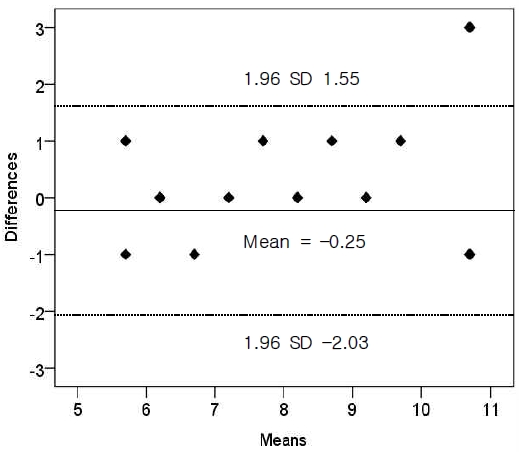
A Bland-Altman scatter plot for the LSUT paretic side(counts)___, mean difference; ......, the 95% LOAThe 2 dashed lines define: mean of difference ± 1.96 × SD). The LOA for the Lateral Step Up Test(Paretic side) ranged from -2.03 to 1.55
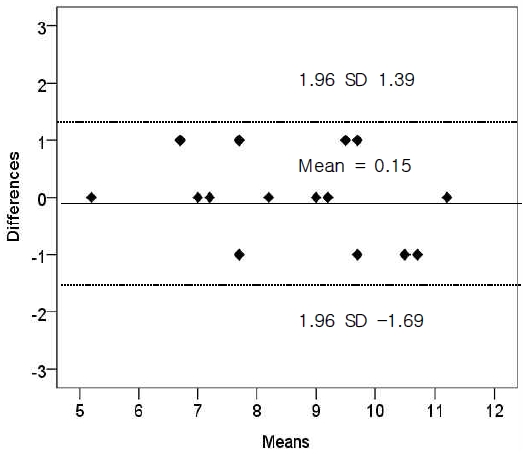
A Bland-Altman scatter plot for the LSUT non-paretic side(counts) ___, mean difference; ......, the 95% LOAThe 2 dashed lines define: (mean of difference ± 1.96 × SD)The LOA for the Lateral Step Up Test(Non-paretic side) ranged from –1.69 to 1.39
3. LSUT 마비측과 비마비측 횟수와 FMA-L/E, FTSTST, BBS, TUG와의 상관관계
LSUT 마비측 횟수와 FMA-L/E(r=0.452), FTSTST(r=-0.471), BBS(r=0.589), TUG(-0.464)간에 양호에서 우수한 관련성이 있었으며, LSUT 비마비측 횟수와 FMA-L/E(r=.0498), FTSTST(r=-0.458), BBS(r=0.565), TUG(-0.478)간에 양호에서 우수한 관련성이 있는 것으로 확인되었다(Table 3).
The correlation between LSUT counts and FMA-L/E, FTSTS, BBS, and TUG(n=20)
Ⅳ. 고 찰
측면 스텝 업 검사는 계단을 오르내리는 일상적 동작과 유사한 기능적 과제로, 균형 조절과 하지 근력을 동시에 요구한다. 특히 계단 이동은 보행의 연속성과 이동성 확보에 필수적인 요소이며, 뇌졸중 환자의 독립적인 일상생활과 밀접한 관련이 있다. 따라서 LSUT의 신뢰도와 타당성을 검증하는 것은 균형과 기능적 이동성을 효과적으로 평가하는 데 중요한 의미를 갖는다. 본 연구는 아급성기 뇌졸중 환자를 대상으로 LSUT가 이동과 동적 균형 평가에 적합한지를 검토하였다.
선행 연구에 따르면 LSUT는 다양한 집단에서 신뢰도는 검증되었다. 젊고 건강한 성인(ICC=0.90∼0.94)(Ross, 1997), 고관절 골절 노인 환자(Kappa=0.57∼0.75)(Sherrington 등, 2005), 뇌성마비 아동(ICC=0.89∼0.97(Beaston 등, 2024; Chrysagis 등, 2013), 만성 뇌졸중 환자(ICC=0.87∼0.90)(Kwong 등, 2020)로 보고되었다. 본 연구 또한 이와 일치하게, 마비측(ICC=0.85)과 비마비측(ICC=0.84)은 우수한 검사-재검사 신뢰도를 확인하였다(De Menezes 등, 2015).
LSUT의 절대적 신뢰도 지표인 SEM과 MDC는 ICC 값을 기반으로 산출되며, 일반적으로 ICC가 높을수록 SEM과 MDC는 낮아지는 역상관 관계를 보인다(Lu 등, 2008). SEM은 측정값의 일관성을 나타내며, MDC는 실제 변화를 감지할 수 있는 최소한의 변화량을 의미한다. 이러한 지표들은 측정 도구가 무작위 오차 없이 일관된 결과를 도출할 수 있는지를 평가하는 데 유용하다(Liaw 등, 2012; Seamon 등, 2022). 본 연구에서 LSUT 마비측의 SEM은 0.63회(평균 7.67회의 8.2%), 비마비측은 0.52회(평균 8.43회의 6.2%)로 나타났으며, 모두 10% 미만으로 매우 낮은 측정 오차 수준을 보였다. MDC는 마비측 1.75회(최대 12회의 14.6%), 비마비측 1.44회(최대 11회의 13.1%)로 수용 가능한 수준이었다. 환산된 MDC(%) 또한 마비측 22.86%, 비마비측 17.08%로 30% 미만을 유지하여, LSUT의 측정 안정성이 충분히 확보되었음을 나타낸다. 또한, 검사-재검사 간 평균값에서 유의한 차이가 없었으며, 이는 체계적인 오차 없이 측정이 일관되게 수행되었음을 의미한다.
LSUT의 높은 신뢰도는 몇 가지 요인에 기인한다. 첫째, 검사 프로토콜이 표준화되어 있으며, 평가자가 충분히 숙련되어 있어 절차의 일관성이 보장되었다. 둘째, 마비측과 비마비측 모두에서 ICC≥0.84로 높은 수준의 일치도를 유지하였다. 셋째, SEM과 MDC는 측정값의 오차 범위를 정량적으로 나타내는 지표로, ICC와 함께 신뢰도 해석에 중요한 역할을 한다(Beckerman 등, 2001; Lu 등, 2008). 특히 MDC는 치료 중재 후 변화가 임상적으로 의미 있는지를 판단하는 기준이 되며, 임상의사결정에 있어 핵심적인 지표로 활용된다(Seamon 등, 2022).
임상적으로 해석하면, 본 연구 대상자들은 LSUT 수행에서 마비측 1.75회, 비마비측 1.44회 이상의 변화가 발생할 경우, 이는 단순한 측정 오차가 아닌 실제 기능 향상을 의미한다(Liaw 등. 2012). 따라서 연구자와 임상가는 치료 결과를 평가할 때 SEM과 MDC의 의미를 정확히 이해하고 해석해야 하며, 이는 측정 도구의 선택과 적용에 있어 중요한 판단 기준이 된다. 다만, 본 연구에서 제시된 MDC 수치는 기존 연구들과 일부 차이를 보였다. 예를 들어, 건강한 성인의 평균 LSUT MDC는 2.24회(Ross, 1997), 뇌성마비 아동은 2.88회(Chrysagis 등, 2013), 만성 뇌졸중 환자의 경우 마비측과 비마비측 모두에서 1회로 보고된 바 있다(Kwong 등, 2020). 이러한 차이는 대상자의 질환 상태, 검사 환경 및 방법의 차이에 기인할 수 있으며, 향후 치료 전후의 실제 변화량을 통해 정량적으로 검증하는 과정이 필요하다.
흥미로운 점은 LSUT 수행에서 비마비측의 횟수가 마비측보다 유의하게 많았다는 점이다. 이는 뇌졸중 환자들이 일상생활에서 비마비측 하지에 더 많이 의존하는 경향을 반영하며, 다양한 보상 전략으로 이어질 수 있다. 예를 들어, 마비측 수행 시 무릎의 과신전, 비마비측 엉덩관절의 들기(hip hiking), 마비측 몸통 외측 굴곡, 상체 과사용 등이 관찰되었으며, 이는 비마비측 의존도를 높이는 요인으로 작용한다. 또한, 비마비측 착지 시 마비측 하지에 체중을 싣는 것을 회피하는 경향도 나타났는데, 이는 발목의 고유수용감각 저하(Hong 등, 2012)와 발목 내반으로 인한 불안정성 증가 때문으로 보인다(Mottram 등, 2014).
나아가, 뇌졸중 환자는 비대칭적인 운동 패턴으로 인해 정상적인 하지 협응이 어려워지며, 이로 인해 비마비측 사용 빈도가 자연스럽게 증가한다(Gray 등, 2015; Kwong 등, 2020). 이러한 경향은 LSUT뿐만 아니라 다양한 유사 과제에서도 관찰된다. 예를 들어, ST에서는 마비측 발 디딤 횟수(6.77∼8.1회)가 비마비측(7.87∼11.0회)보다 적었고(이병권 등, 2017; Hong 등, 2012), SWT에서는 마비측 이동 시 소요 시간(16.2초)이 더 길었으며, 걸음 수도 더 많았다(Ng 등, 2016). SST에서도 마비측 횟수(7.4회)가 비마비측(8.7회)보다 낮았고(Pang 등, 2015), LSUT의 경우에도 마비측(8.97회)보다 비마비측(9.44회)의 수행이 많았다(Kwong 등, 2020). 이는 마비측 하지의 운동 조절 능력과 근력이 상대적으로 낮다는 점을 반영하며, 특정 방향성에 관계없이 유사한 비대칭 패턴이 반복된다는 것을 보여준다(Inoue 등, 2024).
한편, Bland-Altman 산점도 분석 결과 LSUT의 마비측과 비마비측 횟수에 대한 95% LOA는 각각 –2.03∼1.55, –1.69∼1.39로 나타났으며, 대부분의 측정값이 해당 범위 내에 위치하였다. 이는 검사와 재검사 간 측정 오차가 허용 가능한 수준에 있으며, 측정값 간의 신뢰성이 높음을 의미한다. 일반적으로 LOA 범위가 좁을수록 검사 간 차이가 작고, 측정 도구로서의 안정성이 높다고 판단된다. 결론적으로, LSUT는 아급성기 뇌졸중 환자를 대상으로 한 검사-재검사에서 높은 일치도와 낮은 측정 오차를 보여주었으며, 측면으로 계단을 오르내리는 동작에 대한 기능적 평가 도구로서 임상적 타당성과 신뢰성을 확보하였다. 이는 치료 효과 평가 및 이동 기능 측정에 있어 LSUT가 유용한 지표가 될 수 있음을 시사한다.
본 연구에서 LSUT 수행 횟수와 기능적 이동성 및 균형 평가 간의 관련성을 조사하였다. LSUT의 마비측과 비마비측 수행 횟수는 FMA-L/E(r=0.452∼0.498)와 양호한 상관관계를 보였다. 이는 비마비측 LSUT수행 중에도도 마비측 하지의 협응과 족관절의 움직임이 필요함을 시사한다. 또한 LSUT 수행 횟수는 FTSTS(r=-0.458∼ -0.471), BBS(r=0.565∼0.589)와 양호에서 우수한 관련성이 있었다. LSUT는 빠른 체중 중심 이동과 한쪽 다리로 서는(single-leg standing) 동작을 포함하므로, 균형 및 고유수용감각에 큰 영향을 미친다. BBS 항목 중 스툴에 번갈아 발 올리기와 한 발 서기 역시 한쪽 다리로 서는 동작이 포함되어 있어, LSUT 수행 횟수와 우수한 상관관계를 보인 것으로 해석할 수 있다. FTSTST는 폐쇄 사슬 상태에서 하지의 기능적 근력을 평가하는 검사이며(Mong 등, 2010), LSUT 역시 체중을 지지하는 다리의 하지 근력을 활용하여 몸을 위아래로 움직이는 폐쇄 사슬 동작을 포함하므로, 두 평가 간의 유사성이 높다고 볼 수 있다(Kwong 등, 2020). 게다가 TUG는 일어서기, 앉기, 걷기, 회전 등 다양한 방향으로의 체중심 이동을 포함하며 동적 균형과 이동성을 평가하는 도구이다. LSUT 수행 횟수는 TUG(r=-0.464∼-0.478)와도 양호한 관련성을 보였으며, 이는 뇌졸중 환자의 TUG 수행시간이 보행 중 골반의 측면 이동 및 편측 하지에 가해지는 비대칭성과 밀접하게 연관되어 있기 때문으로 해석할 수 있다(De Bujanda 등, 2003). 이러한 해석은 뇌성마비 아동을 대상으로 한 연구에서도 지지된다. 해당 연구에서는 LSUT 수행 횟수가 TUG(r= –0.567), FTSTS(r= 0.721), 계단 오르내리기에 소요된 시간(r= –0.705)과 유의한 상관관계를 보여, LSUT가 기능적 이동성과 균형 능력을 반영하는 지표임을 입증하였다(Chrysagis 등, 2013). 또한, 만성 뇌졸중 환자를 대상으로 한 연구에서도 LSUT 수행 횟수는 FMA-LE(r= 0.511∼0.535), FTSTST(r= –0.477∼–0.544), BBS(r= 0.561∼0.585), TUG(r= –0.397∼–0.438)와 유의미한 상관성을 보였다(Kwong 등, 2020).
이러한 선행 결과와 본 연구의 일치성은 LSUT가 아급성기 뇌졸중 환자의 기능적 이동성과 균형 능력을 종합적으로 평가할 수 있는 유용한 도구임을 시사한다. 즉, 하지 근력과 동적 균형 능력이 우수할수록 LSUT 수행 횟수가 높아지는 경향이 있으며, 이는 LSUT가 단순한 반복 과제가 아닌 신체 기능 전반을 반영하는 정량적 지표로 활용될 수 있음을 뒷받침한다.
본 연구의 제한점으로 첫째, LSUT는 피실험자가 선호하는 움직임과 보상 전력을 허용하기 때문에 수행 횟수에 초점을 두었을 뿐 움직임의 질은 고려하지 않았다. 둘째, 마비측 족관절 저측 굴곡 경직, 하지 근력, 고유수용성 감각 등 수행 능력에 영향을 미치는 요인들을 평가하지 않았다. 셋째, LSUT는 보행 보조 도구 사용을 허용하므로 본 연구에서 20명 중 11명(55%)은 보행 보조 도구 없이 수행이 가능하였고, 9명(45%)은 보행 보조 도구를 사용하였다. 넷째, 표본수가 상대적으로 적고, 경미한 장애가 있는 환자(FMA-L/E: 26.60점, BBS: 49.10점)를 대상으로 진행되었으므로 연구 결과의 일반화는 유사한 특성을 지닌 집단에 한정될 수 있다. 따라서 추후 연구에서는 더 많은 표본 수와 다양한 균형과 보행 장애가 있는 환자를 대상으로 LSUT 수행 횟수에 미치는 다각적인 요인 분석이 필요하다. 아울러 장기 추적 연구를 통해 동적 기능 변화와 회복 과정을 얼마나 민감하게 반영하는지 확인하는 것 또한 중요하다.
Ⅴ. 결 론
LSUT의 검사-재검사 신뢰도는 마비측(ICC=0.85)과 비마비측(ICC=0.93) 모두 높은 일치율을 보였다. LSUT 마비측과 비마비측 횟수의 MDC는 각각 1.75회, 1.44회로 측정 오차 수준은 신뢰할 수 있는 수준이었다. 게다가 LSUT 수행 횟수는 하지 기능(FMA-LE), 하지 근력(FTSTS), 동적 균형(BBS), 이동성(TUG)과 양호에서 우수한 관련성이 있는 것으로 확인되었다. 따라서 LSUT는 아급성기 뇌졸중 환자의 동적 균형을 평가하는 데 신뢰도가 우수하여 적절한 평가 도구로 고려될 수 있다.
References
- 이병권, 최현수, 안승헌. 만성 뇌졸중 환자들의 Step Test의 상대적·절대적 신뢰도와 타당도. 대한통합의학회지. 2017;5(1):43-53.
-
Alzahrani MA, Dean CM, Ada L. Ability to negotiate stairs predicts free-living physical activity in community-dwelling people with stroke: an observational study. Australian Journal of Physiotherapy. 2009;55(4):277–281.
[https://doi.org/10.1016/S0004-9514(09)70008-X]

-
Batson T, Whitten SV, Singh H., et al. Estimates of functional muscle strength from a novel progressive lateral step-up test are feasible, reliable, and related to physical activity in children with cerebral palsy. Plos one, 2024;19(7): e0306529.
[https://doi.org/10.1371/journal.pone.0306529]
- Berg KO, Maki BE, Williams JI, et al. Clinical and laboratory measures of postural balance in an elderly population. Archives of physical medicine and rehabilitation. 1992;73(11):1073-1080.
-
Beckerman H, Roebroeck ME, Lankhorst GJ, et al. Smallest real difference, a link between reproducibility and responsiveness. Quality of Life Research. 2001;10(7):571-578.
[https://doi.org/10.1023/A:1013138911638]
-
Bland JM, & Altman DG. Statistical methods for assessing agreement between two methods of clinical measurement. Lancet. 1986;1(8476):307–310.
[https://doi.org/10.1016/S0140-6736(86)90837-8]
-
Bremander AB, Dahl LL, Roos EM. Validity and reliability of functional performance tests in meniscectomized patients with or without knee osteoarthritis.Scandinavian journal of medicine & science in sports. 2007;17(2):120-127.
[https://doi.org/10.1111/j.1600-0838.2006.00544.x]
- Cabanas-Valdés R, Boix-Sala L, Ferrer-Solà M, et al. The effectiveness of core stability exercises on functional outcomes in early subacute stroke recovery: a randomized controlled trial. Topics in Stroke Rehabilitation. 2025; 1-13.
-
Carvalho C, Sunnerhagen KS, Willén, C. Walking performance and muscle strength in the later stage poststroke: a nonlinear relationship. Archives of physical medicine and rehabilitation. 2013;94(5):845-850.
[https://doi.org/10.1016/j.apmr.2012.11.034]
-
Chrysagis N, Skordilis EK, Tsiganos G, et al. Validity evidence of the Lateral Step Up (LSU) test for adolescents with spastic cerebral palsy. Disability and rehabilitation. 2013;35(11):875-880.
[https://doi.org/10.3109/09638288.2012.711896]
-
Chung MM, Chan RW, Fung YK, et al. Reliability and validity of Alternate Step Test times in subjects with chronic stroke. Journal of rehabilitation medicine. 2014.
[https://doi.org/10.2340/16501977-1877]
-
Darak V, Karthikbabu S. Lower limb motor function and hip muscle weakness in stroke survivors and their relationship with pelvic tilt, weight-bearing asymmetry, and gait speed: A cross-sectional study. Current Journal of Neurology. 2020;19(1):1-7.
[https://doi.org/10.18502/ijnl.v19i1.3275]
-
De Bujanda E, Nadeau S, Bourbonnais D, et al. Associations between lower limb impairments, locomotor capacities and kinematic variables in the frontal plane during walking in adults with chronic stroke. Journal of rehabilitation medicine. 2003;35(6):259-264.
[https://doi.org/10.1080/16501970310012428]
-
De Menezes KK, Scianni AA, Faria-Fortini I, et al. Measurement properties of the lower extremity motor coordination test in individuals with stroke. Journal of rehabilitation medicine. 2015;47(6):502-507.
[https://doi.org/10.2340/16501977-1963]
-
Flansbjer UB, Blom J, Brogårdh C. The reproducibility of Berg balance scale and the single-leg stance in chronic stroke and the relationship between the two tests. Physical medicine and rehabilitation. 2012;4(3):165-170.
[https://doi.org/10.1016/j.pmrj.2011.11.004]
-
Flansbjer UB, Holmback AM, Downham D, et al. Reliability of gait performance tests in men and women with hemiparesis after stroke. Jounral of rehabilitation medicine. 2005;37(2):75–82.
[https://doi.org/10.1080/16501970410017215]
-
Forelli F, Barbar W, Kersante G, et al. Evaluation of muscle strength and graft laxity with early open kinetic chain exercise after ACL reconstruction: a cohort study. Orthopaedic Journal of Sports Medicine. 2023;11(6), 23259671231177594.
[https://doi.org/10.1177/23259671231177594]
-
Fugl-Meyer AR, Jaasko L, Leyman I, et al. The post-stroke hemiplegic patient. 1. a method for evaluation of physical performance. Scandinavian Journal of Rehabilitation Medicine. 1975;7(1):13-31.
[https://doi.org/10.2340/1650197771331]
-
Gray VL Pollock CL, Wakeling JM, et al. Patterns of muscle coordination during stepping responses post-stroke. Journal of Electromyography and Kinesiology. 2015;25(6):959-965.
[https://doi.org/10.1016/j.jelekin.2015.09.003]
-
Hiengkaew V, Jitaree K, Chaiyawat P. Minimal detectable changes of the Berg balance scale, Fugl-Meyer assessment scale, timed “up & go” test, gait speeds, and 2-minute walk test in individuals with chronic stroke with different degrees of ankle plantarflexor tone. Archives of physical medicine and rehabilitation. 2012;93(7):1201–1208.
[https://doi.org/10.1016/j.apmr.2012.01.014]
-
Hong SJ, Goh EY, Chua SY, et al. Reliability and validity of step test scores in subjects with chronic stroke. Archives of physical medicine and rehabilitation, 2012;93(6):1065-1071.
[https://doi.org/10.1016/j.apmr.2011.12.022]
-
Hsueh IP, Hsu MJ, Sheu CF, et al. Psychometric comparisons of 2 versions of the Fugl-Meyer motor scale and 2 versions of the Stroke Rehabilitation Assessment of Movement. Neurorehabilitation and neural repair. 2008;22(6):737-744.
[https://doi.org/10.1177/1545968308315999]
-
Inoue M, Amimoto K, Chiba Y, et al. Analyses of weight-bearing asymmetry pattern for standing in the early phase after stroke: a cross-sectional study. Physiotherapy theory and practice. 2024;40(6):1241-1248.
[https://doi.org/10.1080/09593985.2022.2163860]
-
Jung HY. Rehabilitation in subacute and chronic stage after stroke. Stroke revisited: diagnosis and treatment of ischemic stroke. 2017:351-360.
[https://doi.org/10.1007/978-981-10-1424-6_33]
-
Khanal P, He L, Stebbings GK, et al. Static one-leg standing balance test as a screening tool for low muscle mass in healthy elderly women. Aging clinical and experimental research. 2021;33(7):1831-1839.
[https://doi.org/10.1007/s40520-021-01818-x]
-
Kubo H, Nozoe M, Kanai M, et al. Reference value of 6-minute walk distance in patients with sub-acute stroke. Topics in Stroke Rehabilitation. 2020;27(5):337-343.
[https://doi.org/10.1080/10749357.2019.1704372]
-
Kwong PW, Ng SS. Reliability of the Lateral Step‐Up Test and Its Correlation with Motor Function and Activity in Chronic Stroke Survivors. BioMed research international. 2020(1);7859391.
[https://doi.org/10.1155/2020/7859391]
-
Lee HR, Park J, Ham DW, et al. functional mobility tests for evaluation of functionalities in patients with adult spinal deformity. BMC musculoskeletal disorders. 2022;23(1):391.
[https://doi.org/10.1186/s12891-022-05342-5]
-
Lee J, Kim G. Functional Recovery in Acute and Subacute Stroke Patients With or Without Post-stroke Fatigue. Brain & NeuroRehabilitation. 2024;17(3):e22.
[https://doi.org/10.12786/bn.2024.17.e22]
-
Liaw LJ, Hsieh CL, Lo SK, et al. The relative and absolute reliability of two balance performance measures in chronic stroke patients. Disability and Rehabilitation. 2008;30(9):656-661.
[https://doi.org/10.1080/09638280701400698]
-
Liaw LJ, Hsieh CL, Hsu MJ, et al. Test-retest reproducibility of two short-form balance measures used in individuals with stroke. International Journal of Rehabilitation Research. 2012;35(3):256-262.
[https://doi.org/10.1097/MRR.0b013e3283544d20]
-
Liu TW, Ng SS, Cheung KY, et al. Reliability and validity of Six-Spot Step Test (SSST) in stroke survivors. European journal of physical and rehabilitation medicine. 2021;57(6),879-888.
[https://doi.org/10.23736/S1973-9087.21.06799-X]
-
Lu WS, Wang CH, Lin JH, et al. The minimal detectable change of the simplified stroke rehabilitation assessment of movement measure. Journal of Rehabilitation Medicine. 2008;40(8):615-619.
[https://doi.org/10.2340/16501977-0230]
-
Mong Y, Teo TW, Ng SS. 5-repetition sit-to-stand test in subjects with chronic stroke: reliability and validity. Archives of physical medicine and rehabilitation. 2010;91(3):407-413.
[https://doi.org/10.1016/j.apmr.2009.10.030]
-
Moon Y, Bae Y. The effect of backward walking observational training on gait parameters and balance in chronic stroke: randomized controlled study. European Journal of physical and rehabilitation Medicine. 2021;58(1):9-15.
[https://doi.org/10.23736/S1973-9087.21.06869-6]
-
Moore D, Semciw AI, Pizzari T. A systematic review and meta-analysis of common therapeutic exercises that generate highest muscle activity in the gluteus medius and gluteus minimus segments. International journal of sports physical therapy. 2020;15(6):856-881.
[https://doi.org/10.26603/ijspt20200856]
-
Mottram CJ, Heckman CJ, Powers RK, et al. Disturbances of motor unit rate modulation are prevalent in muscles of spastic-paretic stroke survivors. Journal of neurophysiology. 2014;111(10):2017-2028.
[https://doi.org/10.1152/jn.00389.2013]
-
Muyor JM, Martín-Fuentes I, Rodríguez-Ridao D, et al. Electromyographic activity in the gluteus medius, gluteus maximus, biceps femoris, vastus lateralis, vastus medialis and rectus femoris during the Monopodal Squat, Forward Lunge and Lateral Step-Up exercises. PloS one. 2020;15(4):e0230841.
[https://doi.org/10.1371/journal.pone.0230841]
-
Ng SS, Lau BK, Law GT, et al. Sideways walk test: Reliability and association with lower limb motor function after stroke. Journal of rehabilitation medicine. 2016;48(8):657-665.
[https://doi.org/10.2340/16501977-2129]
-
Ng SS, Tse MM, Tam EW, et al. Reliability and convergent validity of the five-step test in people with chronic stroke. Journal of rehabilitation medicine. 2018;50(1):16-21.
[https://doi.org/10.2340/16501977-2291]
-
Omaña H, Bezaire K, Brady K, et al.. Functional reach test, single-leg stance test, and tinetti performance-oriented mobility assessment for the prediction of falls in older adults: a systematic review. Physical therapy. 2021;101(10): pzab173.
[https://doi.org/10.1093/ptj/pzab173]
-
Pamboris GM, Pavlou K, Paraskevopoulos E, et al. Effect of open vs. closed kinetic chain exercises in ACL rehabilitation on knee joint pain, laxity, extensor muscles strength, and function: a systematic review with meta-analysis. Frontiers in Sports and Active Living, 2024;6:1416690.
[https://doi.org/10.3389/fspor.2024.1416690]
-
Pang EY, Fong SS, Tse MM, et al Reliability and validity of the sideways step test and its correlation with motor function after stroke. Journal of Physical Therapy Science. 2015;27(6):1839-1845.
[https://doi.org/10.1589/jpts.27.1839]
- Portney LG, Watkins MP. Foundations of Clinical Research: Applications to Practice. Vol 2, Pearson Prentice Hall, Upper Saddle River, NJ, USA, 2000.
-
Ribeiro TS, Silva EM, Regalado ICR. et al. Effects of load addition during gait training on weight-bearing and temporal asymmetry after stroke: a randomized clinical trial. American Journal of Physical Medicine & Rehabilitation. 2020;99(3):250-256.
[https://doi.org/10.1097/PHM.0000000000001314]
-
Ross CM. Test-retest reliability of the lateral step-up test in young adult healthy subjects.Journal of Orthopaedic & Sports Physical Therapy. 1997;25(2):128-132.
[https://doi.org/10.2519/jospt.1997.25.2.128]
-
Seamon BA, Kautz SA, Bowden MG, et al. Revisiting the Concept of Minimal Detectable Change for Patient-Reported Outcome Measures. Physical Therapy. 2022;102(8):pzac068.
[https://doi.org/10.1093/ptj/pzac068]
-
Sherrington C, Lord SR. Reliability of simple portable tests of physical performance in older people after hip fracture. Clinical rehabilitation. 2005;19(5):496-504.
[https://doi.org/10.1191/0269215505cr833oa]
-
Tyson S, Connell L. The psychometric properties and clinical utility of measures of walking and mobility in neurological conditions: a systematic review. Clinical rehabilitation. 2009;23(11):1018-1033.
[https://doi.org/10.1177/0269215509339004]